

A founder told me last year about a senior analyst who had just handed in her notice. She was taking a role at a competitor. When he described the job she was moving to, I stopped him halfway through. That role, almost line for line, existed inside his own business. It was sitting open two floors down, unfilled for three months, in a team she had never worked with. Nobody had told her. Nobody had thought to.
That story is the reason I wanted to write about internal mobility for UK SMEs. Because in small and mid-sized British businesses, this is not rare. It is the pattern.
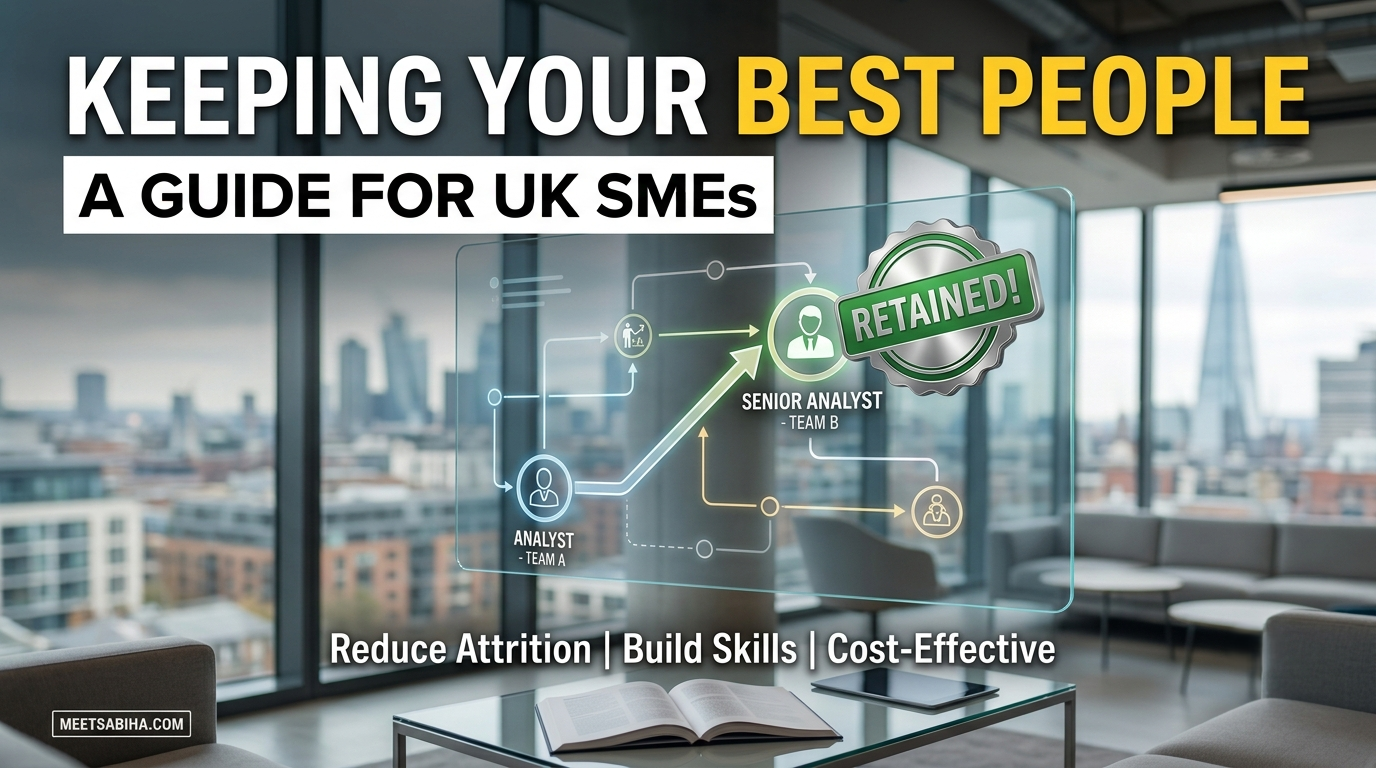
If retention has become your quiet crisis, internal mobility is one of the levers most founders and Heads of People are underusing. Not because it is complicated. Because nobody has framed it as a retention strategy in a way that fits a business of 51 to 200 people.
Internal mobility is the movement of your existing employees into new roles, projects, or responsibilities inside your own organisation, whether that is a promotion, a sideways move into a different function, or a stretch project that builds new skills. It sounds obvious. In practice, most UK SMEs default to external hiring almost every time a vacancy opens, and never consider whether someone already on the payroll could grow into it.
The context matters. The CIPD’s Resourcing and Talent Planning Report 2024, drawn from a sample of 1,016 UK organisations, found that 69% of employers reported intensified competition for talent, and 41% of those who hired new recruits saw at least one resign within their first 12 weeks. External hiring is getting harder, slower and more expensive at exactly the same moment new hires are becoming harder to keep. Meanwhile 56% of organisations in that same report said they were now focusing on in-house talent development as a response.
The direction of travel is clear. UK SMEs that build internal mobility as a deliberate practice, rather than an accident, are quietly building a hedge against the two most expensive problems in hiring: not finding the person, and not keeping the person once you do.
Because they never knew the role existed, or because their manager quietly discouraged the move. These are the two things I see over and over in SME environments, and both are fixable without a huge budget.
The visibility problem is enormous and under-discussed. LinkedIn’s Workplace Learning Report 2024 found that only 33% of organisations globally had formal internal mobility programmes, and only around one in five employees felt confident they could make an internal move if they wanted to. In a company of 80 or 120 people, the assumption is often that “everyone knows what’s going on.” They do not. Your operations manager does not know that marketing has just opened a hybrid role that would suit her partner-shift schedule. Your junior developer has no idea that finance is looking for someone with SQL skills. Openings live in the founder’s head, or on a Slack channel most people mute.
Then there is the harder problem. Talent hoarding. LinkedIn research widely cited across the field found that around 70% of talent acquisition professionals identify manager resistance as the primary barrier to internal recruiting. And it is rarely malice. A team lead who loses their best performer to another department carries the productivity dip, hits their targets late, and rarely gets rewarded for developing someone into their next role. So they block. They give a lukewarm reference. They tell the employee, quietly, that it is not the right time. A working paper from Ingrid Haegele published in 2025 found that when managers were temporarily prevented from hoarding, applications for internal promotions rose by 123%. The demand was always there. The system was suppressing it.
It reduces attrition because it gives your best people a visible reason to stay, and because internally moved employees tend to ramp faster, cost less to hire, and understand your culture from day one. Retention data supports this consistently.
LinkedIn’s Workplace Learning Report 2024 found that organisations with strong learning cultures saw meaningfully higher retention rates and higher internal mobility than those with weaker cultures, and identified internal mobility as one of the clearest predictors of whether an employee sees a future in their organisation. The CIPD Good Work Index 2025, based on 5,017 UK working adults surveyed in early 2025, found that employees who saw their line managers actively supporting their learning and development were significantly less likely to be considering leaving their organisation. Progression and internal opportunity are not just nice to have. They are one of the most reliable predictors of who stays.
For an SME, the maths compounds quickly. An external hire at senior manager level costs, on the CIPD’s 2024 median, around £2,000 in direct recruitment costs before you count agency fees, hiring manager time, onboarding, and the productivity drag of ramping someone new. An internal move avoids most of that. The person already knows your systems, your customers, and the people they need to work with. They are productive in the new role in weeks, not quarters.
I have watched a 90-person UK consultancy retain three of its highest-value people over 18 months simply by opening up two lateral moves and one stretch project. None of it was expensive. All of it was intentional. [Note to Sabiha: swap in your own preferred SME anecdote here from your client work if you have a stronger one.]
They treat it as an ad-hoc favour rather than a system, so it depends entirely on who has a good relationship with the founder. That means the confident employee gets the move. The quieter, often equally capable one does not. Over time you end up with a workforce that has learned progression is political, not merit-based.
A few patterns come up again and again in my conversations with UK founders and Heads of People. Openings are advertised externally before anyone checks whether an internal candidate could do the role. The skills your existing people have picked up over the last two years are undocumented, so nobody knows who could stretch into what. Managers have full veto power over internal applications, with no oversight from HR or leadership. And when someone does move internally, they get dropped into the new role with no onboarding, because “they already work here.” Six months later they are struggling, and the move is quietly labelled a failure.
Each of those failures is a system problem, not a people problem. And each one can be redesigned without hiring a Chief People Officer or buying a talent marketplace platform. Some UK SMEs I have worked with have made real progress with nothing more than a shared spreadsheet, a quarterly conversation, and a founder willing to say publicly that internal moves are welcomed, not resented.
Start by making internal openings visible before they go external, and by getting a rough map of the skills you already have inside the business. Neither requires a big budget.
Practically, that means every new vacancy pauses for a set period, say five working days, during which it is shared internally with a clear description of the skills required. Employees can express interest without their manager’s permission being the gatekeeper. HR or the founder, if there is no HR lead, reviews the internal expressions of interest before any external advert goes live. This one change alone shifts the culture. It tells your workforce that growth here is possible.
Alongside that, invest in a simple skills inventory. You do not need a platform. A structured conversation with every employee once a year, capturing what they can do now, what they want to learn, and what they would consider moving into, will get you 80% of the way. This is the same skills-mapping foundation I wrote about in our post on skills gap analysis for UK SMEs, and internal mobility is where that foundation earns its keep.
Then look at manager incentives honestly. If your team leads are evaluated purely on team performance, they will hoard. If you build talent development into how managers are assessed, celebrated, and promoted, the behaviour shifts. Public recognition for a manager whose team member has just been promoted to another function is worth more than any policy document.
AI can help you match existing employees to open roles based on skills rather than job titles, and surface people whose experience your organisation has forgotten about. For a smaller business without a formal talent marketplace, that is genuinely useful.
Modern AI-enabled tools can read across CVs, performance notes, and project histories to suggest internal candidates a hiring manager might not have considered. Used well, this widens the internal pool. Used carelessly, it can automate the same biases that plagued your last external hiring process. If you are exploring these tools, apply the same due diligence you would apply to any AI hiring vendor, which I covered in more detail in our guide to AI recruitment software due diligence. Ask what data trained the model, ask how it handles protected characteristics, ask what human oversight exists.
The technology is not the strategy. The strategy is deciding, as a leadership team, that your best people should have somewhere to go inside your business before they look outside it.
If you are seeing attrition in the roles you can least afford to lose, look inside before you look outside. Internal mobility for UK SMEs is not a large corporate practice you cannot afford. It is a small, intentional set of habits that make your existing workforce more visible to you and to each other. Founders who make this shift tend to notice something else too. The people who stay start recommending your business to people who would never otherwise have applied.
If you want the wider retention picture, that connects directly to our full guide on employee retention strategies for UK SMEs, which internal mobility sits inside as one of the most practical levers you can pull first.
Internal mobility is the deliberate practice of moving existing employees into new roles, functions or stretch projects inside your organisation instead of hiring externally by default. In a UK SME, it usually looks less formal than a large corporate talent marketplace, but the principle is the same: your existing people are considered first for opportunities that fit their skills and ambitions.
Promotion is one type of internal mobility, but not the only one. Internal mobility also includes lateral moves into a different function, secondments, stretch projects, and job redesigns. For UK SMEs where hierarchies are shallow, lateral moves are often more common and more valuable than upward promotions.
No. Most UK SMEs make meaningful progress with a simple set of habits: sharing every new vacancy internally before going external, maintaining a light-touch skills inventory, and making sure managers are not the sole gatekeepers of internal applications. You do not need a platform or a dedicated L&D function to begin.
Employees who see visible paths for growth inside their current organisation are consistently less likely to leave. CIPD and LinkedIn research both link internal opportunity, learning culture, and manager support for development to lower intention to quit. For an SME, keeping one senior hire who would otherwise have left often pays for the entire internal mobility effort several times over.
Talent hoarding is when a manager quietly prevents a strong team member from moving to another internal role, usually because losing them makes that manager’s own team performance harder to maintain. UK SMEs stop it by building talent development into how managers are evaluated and celebrated, and by removing single-manager veto rights over internal applications.
| About Sabiha is a Talent Acquisition Director, Speaker and Author with 16+ years of international hiring experience across the UK, Dubai, South Africa and Malaysia. She has advised more than 300 businesses on hiring strategy, retention, and workforce transformation, and was shortlisted for Best Career Coach UK by the Career Development Institute. Her forthcoming book on AI in talent and retention is published by Trotman in Autumn 2026. Visit meetsabiha.com to work with Sabiha on hiring, retention and AI in HR. |

Global Talent. Ethical AI. Strategic Hiring. Sustainable Retention.