

It’s Monday morning. An HR manager at a 110-person business opens their inbox to find three holiday requests, two questions about expenses, an overdue probation reminder and a message from IT asking about next week’s new starter.
None of these tasks is particularly difficult. But somebody has to deal with each one, and tomorrow there’ll be another batch.
This is where HR automation examples become useful. Most small businesses don’t need complicated technology. They need to stop spending valuable HR time chasing information, sending reminders and repeating administrative tasks.
After more than 16 years in talent acquisition and people operations across the UK, Dubai, South Africa and Malaysia, I’ve seen how easily routine administration takes over an HR team’s working day.
My advice is straightforward: automate repetitive administration, but keep people responsible for decisions, conversations and employee relationships.
A note on scope: This article provides practical guidance on HR processes, not legal advice. For decisions about your own systems and employee data, speak to a qualified specialist.
HR automation uses predefined rules to complete repetitive tasks, while AI can interpret information, draft content and summarise material.
For example, when a new employee signs their contract, an automated workflow can notify IT, request documents, alert payroll and remind the manager to prepare for their arrival.
AI has a different role. It might help HR draft an expenses policy explanation, summarise employee feedback or prepare questions for a probation review. Its output still needs human checking.
Both approaches can help SMEs. The key is understanding which tasks need predefined instructions and which require interpretation.
The CIPD’s 2026 AI readiness research found that around 45% of organisations were still using AI experimentally or on an ad hoc basis. The YouGov research surveyed 1,342 people professionals and business leaders between 14 January and 3 February 2026.
This is why I’d start with everyday operational problems before introducing more ambitious AI applications.
For a broader discussion, read my guide to AI in HR for UK small businesses.
The best starting points are processes with predictable triggers, repeatable administrative tasks and a clear human checkpoint.
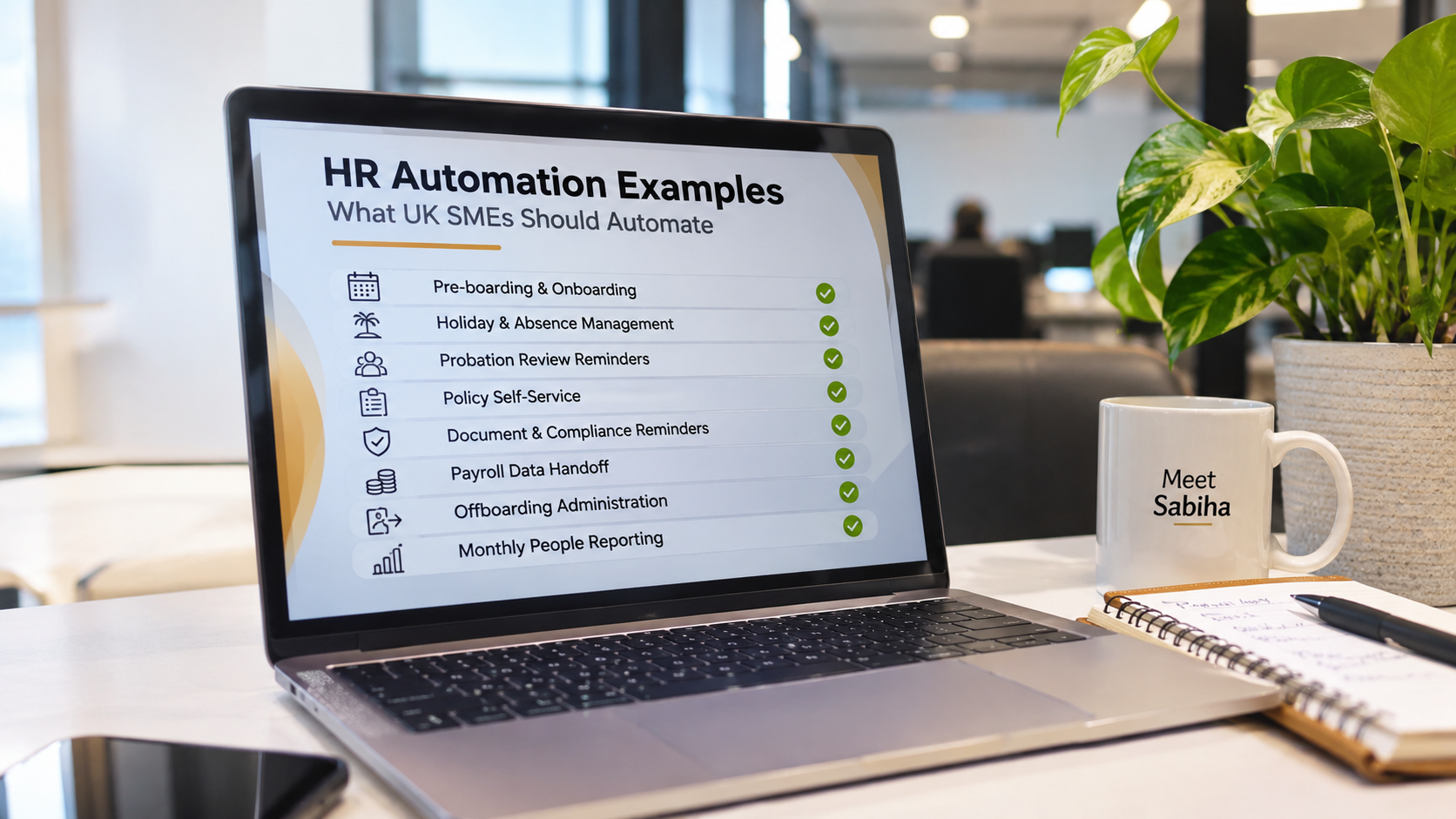
Here are eight practical examples for businesses with 51 to 200 employees.
Once an employee signs their offer, a workflow can request documents, notify IT about equipment and access, alert payroll and send the employee their first-day schedule.
The manager still needs to welcome the employee and explain their responsibilities.
For a fictional 85-person engineering consultancy, this could reduce the repeated emails between HR, IT and managers.
Explore the wider process in my guide to employee onboarding for UK SMEs.
When an employee submits a holiday request, automation can check their recorded balance, route the request to their manager and update the calendar after approval.
Absence notifications and return-to-work reminders can also be automated.
However, the manager must handle the actual conversation. Acas recommends return-to-work discussions to understand whether employees are ready to return and whether they need support. See its return-to-work guidance.
I would never automate a warning letter based purely on an absence threshold. A reminder to speak to someone is useful. A machine deciding what happens next is not.
Once an employee’s start date is recorded, the system can calculate review dates and remind managers when discussions are due.
It can also prompt HR to record review outcomes.
The manager must still discuss performance, progress, training and concerns with the employee. Acas explains the importance of regular reviews and ensuring that probation outcomes don’t come as a surprise.
Read more about probation period changes for UK SMEs.
An employee assistant can help staff find approved information about expenses, annual leave, remote working and other workplace policies.
For example, someone asking where to find the expenses policy could receive a direct link to the relevant document.
Sensitive questions, grievances and personal circumstances should go to HR. An assistant should never attempt to resolve these independently.
My practical AI prompts for HR guide explores how HR teams can use AI to prepare and retrieve information responsibly.
A workflow can monitor training certificates, contract renewal dates and professional qualification expiry dates, then notify the responsible person.
Where a right-to-work recheck is relevant, the system can remind HR about the date. The actual check and assessment of evidence remain human responsibilities.
The important thing is to assign someone to act on each notification. Otherwise, automation simply creates another inbox reminder.
When a starter, leaver or authorised employee change is recorded, approved information can flow into payroll preparation without repeated manual entry.
For a fictional 70-person professional services business, this could reduce the need to enter the same information into several spreadsheets.
However, payroll affects people’s income. A human should verify the information and approve it before the payroll run.
I would rather have one additional approval than risk incorrect salary or final-pay information.
Once an employee’s departure is recorded, automation can notify IT about access removal, remind managers about equipment returns, alert finance about final-pay inputs and trigger an exit survey.
The exit conversation must remain personal. A survey can collect feedback, but it cannot replace a discussion with an employee who wants to explain their experience.
See my guides to onboarding and offboarding and AI-powered exit interviews.
A workflow can bring together approved headcount, starters, leavers and absence information into a monthly report.
For example, a fictional 95-person care business might notice increasing absence in one department.
The report identifies the pattern. HR needs to investigate the reasons, speak to managers and decide what action is appropriate.
My guide to recruitment metrics for UK SMEs explores how people data can inform better business decisions.
Recruitment automation is a separate subject. Sourcing, CV screening, interview scheduling and candidate communications are covered in my guides to AI recruitment for UK SMEs and applicant tracking systems.
Map each process by its trigger, automated task, human responsibility and implementation effort before introducing a workflow.
| HR process | Trigger | What to automate | Human checkpoint | Effort |
|---|---|---|---|---|
| Pre-boarding | Signed offer | Documents, IT and payroll notifications | Welcome and induction | Medium |
| Holiday and absence | Employee request | Approvals and reminders | Manager conversation | Medium |
| Probation | Start date | Review reminders | Performance discussion | Low |
| Policy self-service | Employee question | Approved policy searches | Sensitive queries | High |
| Document compliance | Expiry date | Notifications | Evidence verification | Low |
| Payroll | Approved change | Data transfer | Payroll sign-off | Medium |
| Offboarding | Recorded departure | Access and equipment notifications | Exit conversation | Medium |
| People reporting | Monthly date | Data collection and dashboard updates | Interpretation | Medium |
These are indicative planning estimates, not measured implementation times. Existing systems and data quality will affect the actual effort.
Employment decisions involving people’s livelihoods, wellbeing and individual circumstances need meaningful human judgement.
Disciplinary decisions, dismissals and grievances require context and fair consideration. A system can organise records and send reminders, but it shouldn’t decide whether an employee should be dismissed or how a grievance should be resolved.
The same applies to performance ratings and redundancy selection. Employee data can inform a discussion, but it cannot explain every individual’s circumstances.
Sensitive health conversations should also remain human.
My view after 16 years in hiring and people work is simple: automate the administration, never the awkward conversation.
The Data (Use and Access) Act 2025 introduced UK GDPR Articles 22A–22D, covering automated processing, significant decisions and safeguards, including human intervention and the ability to contest certain decisions. See Section 80 of the legislation.
Choose one repetitive process, map it on paper and automate a single administrative step first.
Start by identifying where HR spends the most time chasing information. Holiday approvals, probation reminders and new-starter preparation are good examples.
Write down the trigger, who receives the information, what happens next and who approves the action. Include exceptions, such as what happens when a manager is unavailable.
Then automate one step. Test it with a small group and keep the existing human approval in place.
Measure the results over 30 days. Look at manual reminders, missed deadlines, duplicate entries and employee queries.
If the process works, move to the next one. If it creates confusion, fix it before expanding.
You can also use the government’s Employment Rights Act implementation timeline when reviewing processes affected by changing employment rules.
You don’t need to automate everything at once. Start with the problem that takes up the most unnecessary time.
The main risks are inaccurate employee information, inappropriate access, poor communication and decisions made without meaningful human involvement.
An incorrect start date can trigger the wrong probation reminder. Incorrect employee details can create payroll problems. Automation won’t automatically identify these mistakes.
Access also needs careful consideration. Health information, absence records and personal circumstances shouldn’t be available to everyone simply because a workflow makes sharing easier.
The Information Commissioner’s Office guidance on monitoring workers explains the importance of data protection, transparency and employee trust. The ICO’s guidance is also under review following changes introduced by the Data (Use and Access) Act 2025.
Employees should understand what information a system uses, who can access it and when they can speak to a person instead.
Managers also need training. Giving someone access to AI doesn’t automatically prepare them to use it responsibly.
I’d always recommend assigning an owner to every automated process, checking the information it produces and reviewing whether it is genuinely helping employees and the HR team.
Ultimately, good HR automation should give people more time to do the work that requires their experience and judgement.
Start with one process. Get it right. Then build from there.
Automating employee onboarding is a common example. When an offer is signed, a workflow can request documents, notify IT, alert payroll and remind the manager about induction. The manager remains responsible for welcoming the employee.
Start with probation reminders, holiday approvals, document expiry notifications and payroll data handoffs. Prioritise the process that creates the most repeated emails and manual chasing.
Automation follows predefined rules to complete tasks such as reminders and approvals. AI can draft communications, interpret language and summarise information. Both require appropriate human oversight.
Yes. SMEs can begin with existing employee records, shared calendars and simple approval workflows. Automate one task, measure the results and expand gradually.
Disciplinary decisions, dismissals, grievances, redundancy selection and sensitive health conversations should retain meaningful human involvement. Technology can organise information, but people must remain accountable for decisions.
Sabiha is a UK Talent Acquisition Director, speaker and author with more than 16 years of international experience across the UK, Dubai, South Africa and Malaysia. She has advised more than 300 businesses on hiring and retention and was shortlisted for Best Career Coach UK by the CDI. Her forthcoming book explores AI-powered hiring and retention for UK employers. Discover more at Meet Sabiha.
Global Talent. Ethical AI. Strategic Hiring. Sustainable Retention.