

A managing director rang me last month, part frustrated, part embarrassed. She had signed off on an AI screening tool six months earlier. It sat unused. Her hiring lead had opened it twice, decided it did not match how they actually worked, and quietly went back to spreadsheets. The invoice kept arriving anyway.
That story is not unusual. It is close to standard right now.
Implementing AI at SME scale is doable. What sinks it, almost always, is the order you try to do things in. This is a practical, step-by-step guide to that order, based on what I have seen work across 300+ businesses.
Because SMEs are starting with the tool, not the problem the tool is meant to solve.
The overall UK picture looks encouraging on paper. The CIPD Resourcing and Talent Planning Report 2024 found 31% of UK organisations now use AI in recruitment, roughly double the 16% figure from 2022. That headline hides a split. Analysis of ONS data by the Bennett School of Public Policy at Cambridge shows that small firms with fewer than 50 employees reached 26% AI adoption in 2025, while firms of 250 or more hit 44%. The gap is widening, not closing.
The barriers are not what most SME owners think. It is rarely the software. Skills, data readiness and governance keep coming up in almost every credible piece of UK research this year. If your existing hiring workflow is fragmented across a spreadsheet, an inbox and a job board, adding AI on top does not fix that. It automates the fragmentation. Faster errors, at scale.
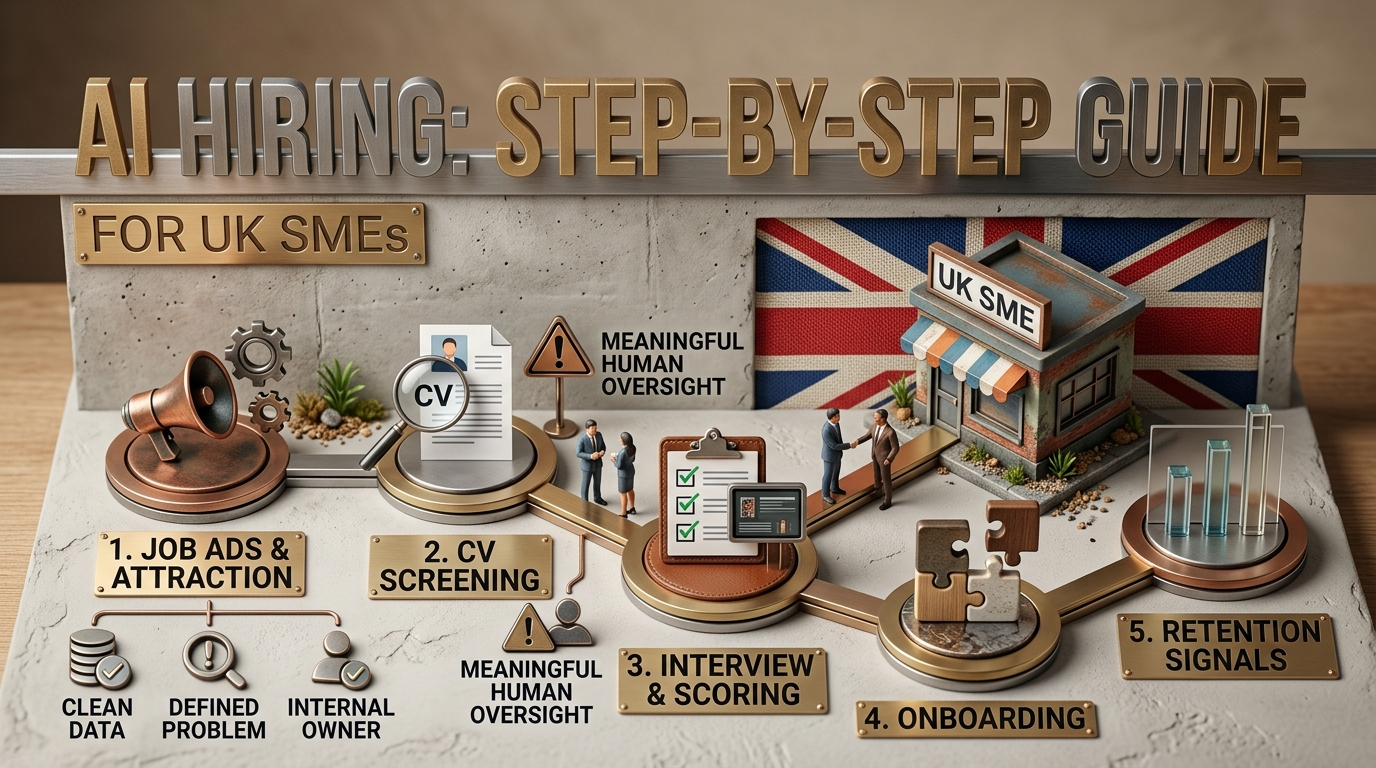
Three things need to be in place: a defined problem, clean-enough data, and a named internal owner.
Start with the problem. Not a vague one like “we need to hire faster”. A specific one. Something like: we are losing candidates between shortlist and interview because scheduling takes eight days on average. Or: we are hiring people who leave inside 90 days at a rate we cannot explain. If you cannot articulate the problem in a sentence, you are not ready to buy a tool. You are ready to do an audit.
Then look at your data. Where do your CVs live now. Where are interview notes stored. Do exit interviews get written down anywhere searchable. If your hiring data is spread across four inboxes and a shared drive nobody has tidied since 2023, AI will struggle to help you. Some cleaning happens first. This is unglamorous work, but it is where credible ROI actually starts.
And a named owner. Not a committee. One person who has this in their objectives and has time protected to run it. In an SME this is often the People or HR lead. Sometimes it is the founder. Rarely does it work when it is “everyone’s job”.
Start where the pain is loudest and the data is cleanest, then extend from there.
Across most UK SMEs I have advised, a sensible sequence looks like this.
First, job descriptions and attraction. This is the safest place to begin. AI can help you rewrite bloated JDs into skills-led ones, test them for gendered or exclusionary language, and adapt them for different channels. Low risk, quick wins, and it feeds every other stage downstream. The candidates you attract shape everything that follows. I wrote more about this in Why Your Job Description Is Costing You the Best Candidates.
Second, CV screening. This is where things get sensitive quickly. AI screening can genuinely reduce time-to-shortlist. It can also encode bias if you rely on it blindly. The ICO’s March 2026 Recruitment Rewired report, which reviewed AI hiring tools across more than 30 UK employers, flagged that many treated automated decisions as decision support without meaningful human involvement. The regulator wrote directly to 16 organisations it identified as likely to be operating outside UK data protection law, and all 16 have since committed to act. That is a signal worth reading. Screening is worth doing, but with a proper review layer. Full breakdown here: AI CV Screening in the UK: What Breaks and How to Fix It.
Third, interview structure and scoring. AI is useful for interview design, question banks, and consistent scoring rubrics. It should not be running interviews unattended. It is a support layer, not a replacement for the hiring manager’s judgement.
Fourth, onboarding. This is where I see the biggest missed opportunity in SMEs. AI can trigger 30, 60 and 90-day check-ins, personalise onboarding content, and flag early disengagement signals. Onboarding is the earliest lever you have to protect retention. More here: Employee Onboarding UK SME.
Fifth, retention signals. Pulse surveys, stay conversations, and pattern analysis of when and why people leave. This is the newest, most powerful use case for most SMEs and the one they touch last, if at all.
You do not have to do all five in year one. Most SMEs I work with do the first two properly in six months, then extend.
Any decision that affects a candidate or an employee needs a named human who can explain it and, where warranted, override it.
This matters commercially and it matters as regulatory context. The ICO has been signalling for over a year that “human in the loop” cannot mean a person rubber-stamping an AI output. The direction of travel here is clear, and it firmed up in early 2026. TThe Data (Use and Access) Act 2025 came into force on 5 February 2026, replacing Article 22 of the UK GDPR with Articles 22A to 22D. The change is more permissive in one respect: solely automated significant decisions on ordinary personal data are now allowed where safeguards are in place, rather than prohibited by default. But Article 22A also puts a definition of meaningful human involvement on the statute book, and the ICO’s Recruitment Rewired report a month later showed how many employers fall short of it. The permission got wider. The standard for what counts as human oversight got sharper.
The EU AI Act’s high-risk obligations for recruitment AI, originally due in August 2026, were deferred to 2 December 2027 under the Digital Omnibus. Its transparency obligations, which cover telling people when they are dealing with an AI system, applied from August 2026 and were not deferred. The UK is not adopting the Act directly, but UK employers with candidate flow from the EU should be tracking both dates. A qualified UK data protection or employment law specialist can help you translate this into your own setup.
In practical terms, meaningful human oversight looks like this: a hiring manager who can see why a candidate was ranked where they were, can flip that ranking with a reasoned note, and knows that log is auditable if anyone ever asks. Candidates need a route to challenge outcomes. This does not need to be complicated to be real.
Five numbers give you a truthful picture of whether AI is actually helping.
Time-to-hire. Are you moving candidates through the process faster than your baseline, without cutting quality corners.
Quality-of-hire proxy. Most SMEs use 90-day performance ratings or hiring manager confidence scores because true quality-of-hire measures take longer to land. Track something rather than nothing.
Candidate experience score. A short post-application survey, three questions. Are candidates telling you the process felt fair and clear.
Ninety-day retention. This is the number I care about most. If AI-assisted hiring is picking better matches, this improves. If it is not, it stalls or drops.
Set the baseline before you switch anything on. Whatever your current time-to-hire and 90-day retention rate look like today, write them down. That is the number AI has to beat. Without it, you will spend year two arguing with your board about whether any of this worked.
The aim here is not a dashboard for its own sake. It is honest knowledge of whether the thing is working.
Tool sprawl, no baseline, and no governance.
Tool sprawl looks like this. There is ChatGPT for job ads, a separate screener bolted onto the ATS, a Copilot licence someone is using to draft rejection emails, and an experimental scheduling assistant nobody has told finance about. None of them talk to each other. Nobody owns the whole. This is the single most common pattern I see in SMEs that told themselves they were “doing AI in hiring”.
No baseline means you cannot prove anything. If you did not know your time-to-hire, your 90-day retention rate, and your cost-per-hire before AI arrived, you cannot credibly claim to have improved them. Set the baseline before you switch anything on.
A hiring and retention operation where AI does the repeatable work, humans do the judgement work, and there are honest numbers to prove it.
By month twelve, the SMEs that get this right have a defined AI-assisted hiring workflow running from job description through to onboarding. One named owner. A baseline set of numbers that show whether they are ahead or behind their pre-AI performance. A light governance process that has been tested at least once by something going slightly wrong.
That is not a moonshot. It is a year of methodical work by one person with proper executive backing. Which is exactly what SME scale is built for.
Yes. In some ways it is easier at 30 people than at 300. Fewer legacy processes to unpick, fewer sign-offs, one owner can cover the whole rollout. What matters is executive backing and honest baseline numbers, not headcount.
The tool costs are usually not the main line item. Budget for the internal time to define the problem, clean data, and run the rollout properly. Many SMEs spend the bulk of their real AI implementation cost on data preparation, not software. A useful starter stack across job description support, screening assistance and scheduling can begin under £150 per month, but the surrounding process work matters more than the price of any single tool.
The direction of travel from the ICO is toward transparency. Practically, telling candidates clearly what AI is being used for, and giving them a route to raise concerns, is both good practice and increasingly expected. For anything binding on your specific setup, consult a qualified UK data protection specialist.
Attraction and screening improvements can show inside 90 days. Retention benefits from onboarding and stay conversations typically emerge over six to nine months, sometimes longer. Do not expect a step change in month one. Expect a gradient.
Sabiha is a Talent Acquisition Director, Speaker and forthcoming Author (Trotman, Autumn 2026) with 16+ years of international hiring experience across the UK, Dubai, South Africa and Malaysia. She has helped over 300 businesses improve their hiring and retention outcomes and was shortlisted as Best Career Coach UK by the Career Development Institute. Her book, How to Use AI to Win Talent and Retain People, is aligned to the CIPD Profession Map and lands with Trotman in Autumn 2026.

Global Talent. Ethical AI. Strategic Hiring. Sustainable Retention.