

A founder emailed me last month with the same sentence I have now heard three times this quarter. “We hired four people this year. Three have already gone.” She was not asking about the market. She was asking what she was doing wrong.
That is what the UK talent crisis actually looks like inside a small business. Not empty roles. Not silence on job ads. People arriving, and then quietly leaving before anyone has even learned how they take their coffee.
Most of the coverage frames this as a shortage story. Skills gap. Post-Brexit labour supply. Wage inflation. All real. None of them explain why an SME can fill a role and still be short-staffed in the same year.
Yes, but not the shortage you are being sold. The competition for skilled workers is real. The CIPD Resourcing and Talent Planning Report 2024 found that 69% of UK organisations reported intensified competition for skilled workers, and 64% said they struggled to attract the right candidates. That is a genuine market signal.
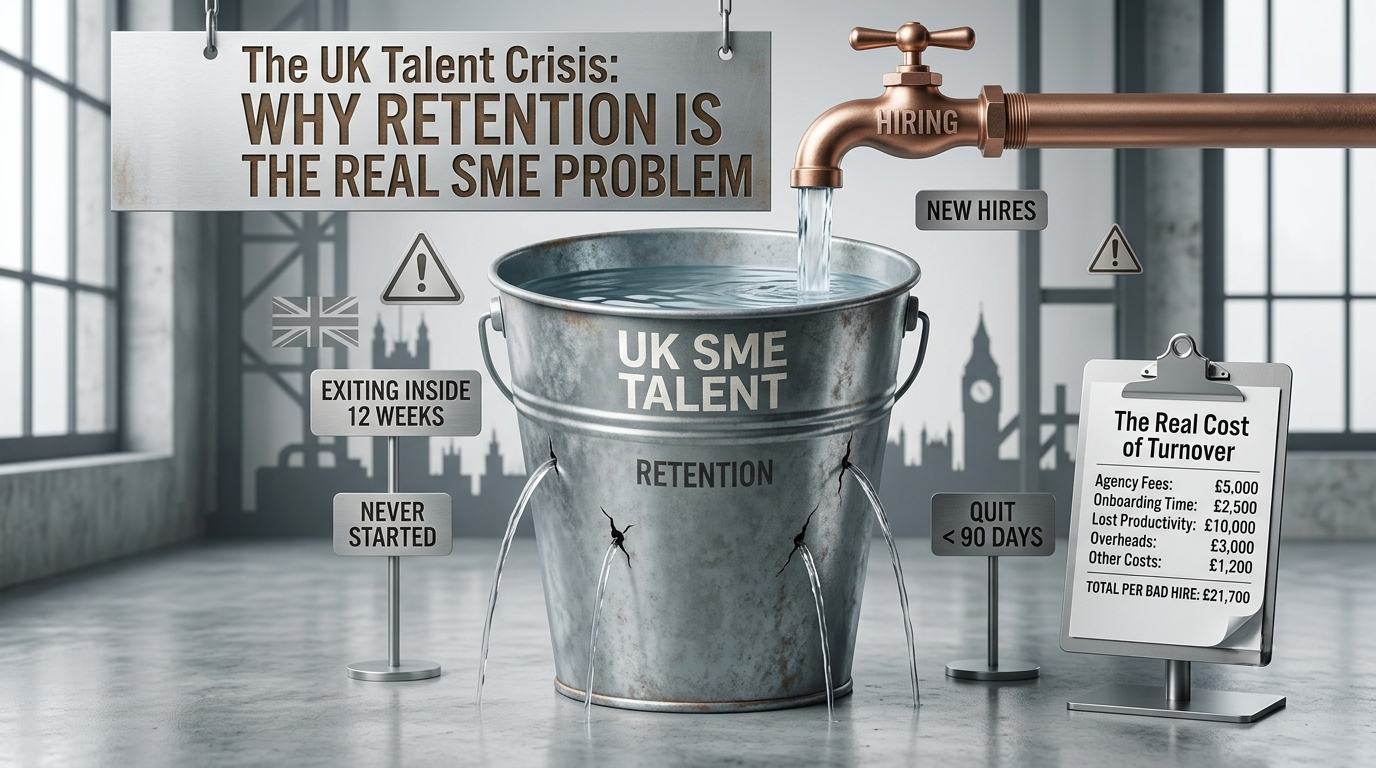
But sitting underneath that headline is a second number that changes the story. In the same report, 41% of organisations that hired new recruits in the last twelve months said those recruits resigned inside the first 12 weeks. Not the first year. Twelve weeks.
The same CIPD survey turned up an even more startling number. 27% of HR professionals said selected candidates always, mostly, or sometimes failed to turn up on the first day. Not resigned inside 90 days. Never started. If more than a quarter of employers are seeing this at all, something has broken in the space between offer and induction that almost nobody is measuring.
This is the shift I keep asking founders and HR leads to make. Stop counting vacancies. Start counting the ones that came back open within a year. And add a second column for the ones that never got filled at all because the person you offered it to went quiet.
Higher than most SMEs ever calculate. The industry estimate for a bad hire sits between 1.5 and 3 times annual salary once you fold in recruitment fees, onboarding time, lost productivity, and the ripple effect on the team that has to cover.
For a £45,000 role, that is somewhere between £67,000 and £135,000 walking out of the door. Once. Now imagine that has happened twice this year, in a business of forty people. The scale becomes uncomfortable very quickly.
And this is where the data gets bleaker. The CIPD found that only 31% of organisations that know their turnover figures actually calculate the cost of that turnover. The rest are absorbing it as a general business expense. It hides inside the P&L as “recruitment spend” or “training budget” and never gets named for what it really is.
If you cannot put a pound figure on losing your last hire, you cannot build a case for changing how you find and keep the next one.
Because the hiring process was optimised for filling the seat, not for the person who has to sit in it. In every 90-day exit I have unpicked, the story starts long before the person quit. It usually starts in the job description.
A vague role written from a template. A skills list copied from a competitor. An interview process that tested for polish, not fit. An offer that oversold the culture. A first week that was mostly a laptop, a Slack invite, and a calendar full of introductions the new hire could not follow.
Then the second week. A manager who is too stretched to actually manage. A first project that turns out to be nothing like what was described at second-stage interview. A quiet realisation, somewhere between weeks three and five, that the answer to “who owns this decision” is nobody in particular. That is when the internal disengagement begins. And once someone has decided, quietly, that this is not the place, everything after that is a countdown.
By day 60 the person knew this was not what they were told. By day 80 they were already interviewing elsewhere. The resignation on day 91 is the ending. The story was written weeks earlier.
I wrote about this pattern in more depth in Why New Hires Quit in the First 90 Days and unpacked how to fix the first thirty of those days in Employee Onboarding for UK SMEs. If you have lost people inside the first quarter this year, those are the two places to start.
Three things, in most SMEs I audit.
The first is a job description problem. Most UK SME job ads are still written the way they were written a decade ago. Long lists of “essential” requirements, half of which are proxies for experience rather than actual skill needs. Good candidates self-select out. The ones who do apply are often not who you needed.
The second is a screening problem. When CVs pile up, the shortlist gets built on speed rather than signal. Filters catch the wrong people. Strong candidates with non-linear paths get missed. Weaker candidates with polished CVs get through. The interview stage inherits that noise.
The third is an onboarding problem. The gap between what a candidate was sold in interview and what they experience in their first fortnight is where retention quietly dies. Nobody quits over one bad meeting. They quit over a slow accumulation of small signals that they are not really wanted here.
Fix any one of these in isolation and you get a small improvement. Fix all three as a system and you rebuild the pipe.
In the three places where SMEs are chronically time-poor: job design, CV screening, and onboarding structure. Not in decisions. In the work around the decisions.
The CIPD 2024 report found that 31% of UK organisations now use AI in recruitment, roughly double the 16% figure from 2022. Adoption is climbing, but it is still concentrated in larger employers. Most UK SMEs are still watching from the sidelines, which means the ones that move now have a real window.
The British Chambers of Commerce reported in March 2026 that 54% of UK SMEs are actively using AI in the business overall, up from 35% in 2025. So the appetite for AI is there. The question is whether it reaches the hiring function or stays stuck in marketing and finance.
Used well, AI can help an SME rewrite job descriptions to widen the pool, pre-sort applications on capability signals rather than keyword matches, structure interview questions, and draft consistent onboarding plans across every hire. None of that is glamorous. All of it is the difference between hiring once and hiring twice.
The important word here is used well. Poorly configured AI screening tools have been the subject of active review by the ICO, and the direction of travel on how these tools must be governed in the UK is tightening rather than loosening. I covered the practical implications for SMEs in AI CV Screening in the UK: What Breaks and How to Fix It.
They start at the wrong end of the funnel. Almost every SME I speak to opens the conversation with “we need more candidates”. Almost none open it with “we need fewer people leaving”.
More candidates without better screening just means more noise. Better screening without better onboarding just delays the resignation. Better onboarding without a job that actually matches what the person was hired to do just delays it a bit further.
The fix runs backwards through the funnel, not forwards. Start with the person who left last. Ask what they were told they would be doing. Ask what they actually did. Ask what would have kept them. Then walk that answer back to how you wrote the role in the first place, how you interviewed for it, and what you promised in the first fortnight.
That single exercise, done properly on the last two or three leavers, tends to surface more usable insight than any recruitment marketing overhaul. It is uncomfortable. Founders in particular often find they have been describing a version of the role that lives in their head rather than the one that lives in the business. That gap is where retention leaks out. Closing it costs almost nothing. Leaving it open costs the price of every next hire that repeats the same pattern.
Pick the leakiest point and fix that first. You do not need a full workforce strategy to move the numbers this quarter. You need to know where the pipe is cracked.
If your new hires are leaving inside 90 days, the leak is onboarding and role clarity. Start there.
If you keep getting shortlists that do not convert, the leak is job design and screening. Start there.
If you cannot attract applications at all, the leak is employer visibility and job description language. Start there.
The UK talent crisis, at SME scale, is rarely one big problem. It is three small ones sitting on top of each other, each making the others worse. Naming which one is loudest in your business this quarter is the actual first step.
And it is worth saying plainly. The businesses that will come through the next two or three years in decent shape are not the ones with the biggest recruitment budgets. They are the ones that stopped treating hiring as a task and started treating it as a system. That means writing the role once, properly. Screening for signal, not polish. Onboarding as if the person will stay for a decade. And measuring who left, why, and what it cost. None of it is complicated. Almost nobody does all four.
In practical terms, yes. Larger employers can absorb bad hires across a bigger workforce. For an SME, one wrong hire in a team of ten is a 10% culture problem, not a rounding error. The financial and operational impact per bad hire is proportionally higher.
A skills shortage means the people you need do not exist in the market. The UK situation is more mixed. In many roles, the people exist. The problem is how SMEs find them, choose between them, and keep them once hired. That is a systems problem, not a supply problem.
Both, depending on how it is used. AI that is bolted onto a broken hiring process just produces bad decisions faster. AI used to redesign job descriptions, structure screening, and consistent onboarding can meaningfully close the retention gap. The tool is not the strategy.
Cost of turnover per role, calculated honestly. Recruitment fees, onboarding time, lost productivity, and the cover cost on the remaining team. Once you have that number for the last person who left, the case for investing differently in the next hire writes itself.
Sabiha is a Talent Acquisition Director, speaker, and forthcoming author (Trotman, Autumn 2026) with over 16 years of international hiring experience across the UK, Dubai, South Africa, and Malaysia. She has helped more than 300 businesses improve how they hire and retain people, was shortlisted as Best Career Coach UK by the Career Development Institute, and writes and speaks on AI-enabled workforce strategy for UK SMEs.

Global Talent. Ethical AI. Strategic Hiring. Sustainable Retention.