


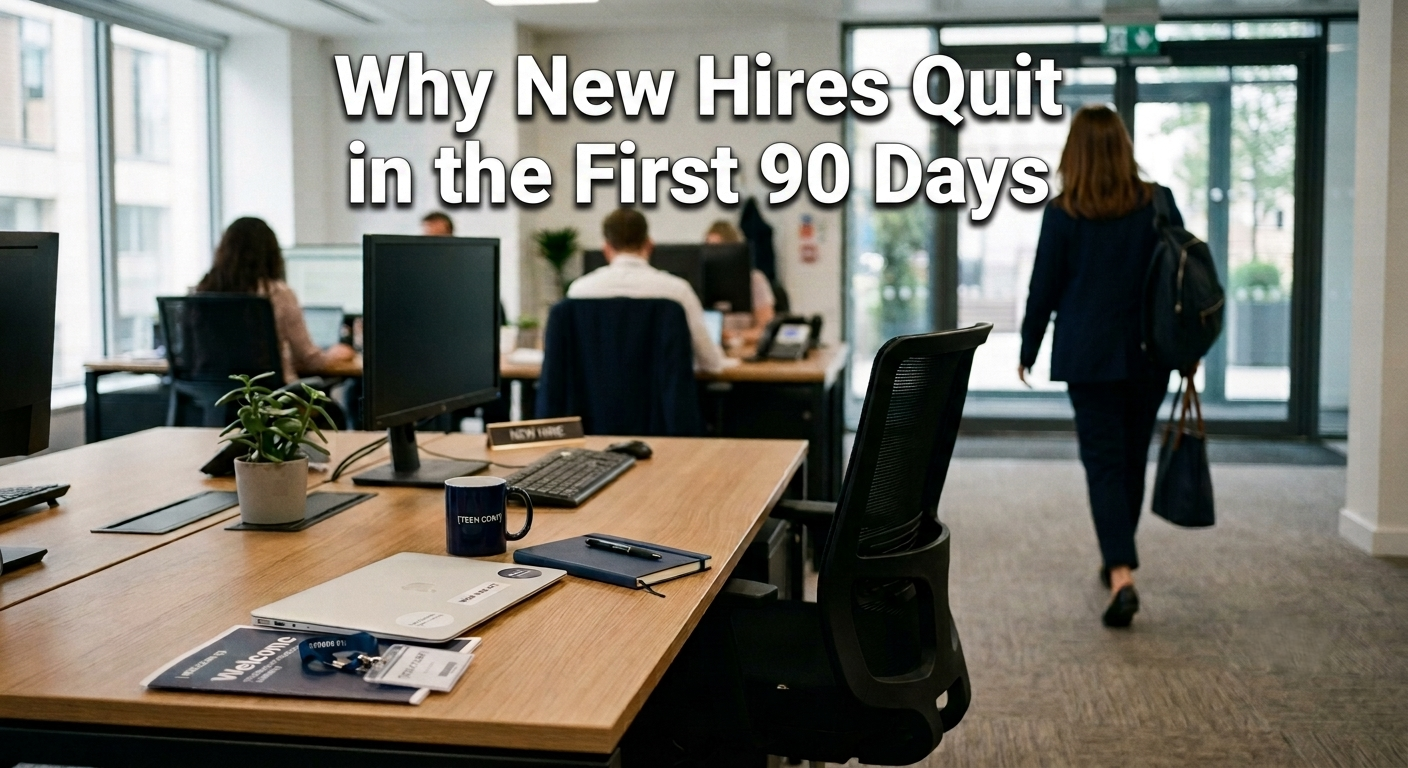
A People Director messaged me at 4pm on a Friday last year. She’d just had a resignation from someone she hired eight weeks earlier. Senior role, competitive package, three interview rounds, unanimous yes from the panel. Gone before the probation review was even scheduled.
Her message said one thing. “What did we miss?”
The honest answer is that she didn’t miss anything at the interview stage. She missed everything that happened after it.
The data is worse than most UK SMEs are willing to admit out loud. The CIPD Resourcing and Talent Planning Report 2024, based on a survey of 1,016 UK people professionals, found that 41% of employers who recruited in the past year had experienced new employees resigning within the first 12 weeks. That figure covers responses of “always, mostly, or sometimes,” which means for four in ten UK employers, losing a new hire inside 12 weeks is not a rare event. It is a recurring pattern.
The same survey found that 27% of employers who tried to fill vacancies had experienced new starters failing to turn up on day one. Ghosting is now a norm, not an outlier.
The wider retention picture is not better. Culture Amp’s December 2025 analysis, drawn from 1.4 billion responses across 8,200 global organisations including 816 in the UK, found that 24% of UK workers plan to leave their current role within the next 12 months, with a further 14% expecting to move within two years. CIPD 2024 confirmed that 56% of employers said retention had become harder over the last year, rising to 71% in the public sector.
You spent six months finding this person. They spent six weeks deciding whether to stay.
They almost never quit for one reason. In 16 years of hiring across the UK, Dubai, South Africa and Malaysia, I have not once had a new hire tell me they left because of one thing. It is always a stack.
The role they signed for is not the role they walked into. Scope shifted after the offer, the panel oversold it, or nobody wrote down what “good” looked like in the first 30 days, so week three feels like failing at a job nobody defined. Their manager is too busy. Not unwilling. Genuinely underwater. The new hire is having lunch alone by week two and rearranging their own diary because nobody has time.
Belonging is not happening. The team is friendly in a meeting-room way, but nobody has invited them for a coffee. They still feel like a guest in the building. And the one nobody talks about. They kept a second offer warm. The candidate market is competitive enough right now that most senior hires have a shortlist. If your first 90 days feel wobbly, that shortlist becomes very attractive very quickly.
Culture Amp’s global data on leadership impact makes the last point uncomfortably clear. With a great manager and great leader, employees’ commitment to stay is 94%. Good manager, poor leader drops it to 35%. Poor and poor falls to 19%. These are global figures, not UK-specific, but the pattern maps directly onto what I see in UK SMEs.
Retention in the first 90 days is not a personality question. It is a leadership question.
More than most finance directors are ever told. The direct cost of replacing a UK employee is commonly framed as an industry estimate range of 1.5 to 3 times the annual salary. Culture Amp’s own estimate puts it at 30% to 200% depending on role level. For a £45,000 hire, either framing lands you somewhere between £45,000 and £135,000 gone.
That is the number that gets reported. It is not the whole picture.
The invisible costs are usually bigger. The team that welcomed someone only to watch them walk out becomes noticeably more cynical about the next hire. Projects slip. The manager quietly loses confidence in their own hiring judgment, which affects the next three decisions they make. And there is a brand cost. Someone who leaves in 90 days rarely leaves silently. They post on LinkedIn. They tell the next candidate you interview why they left.
You are not just replacing a person. You are repairing a story.
Treating onboarding as an HR paperwork exercise instead of a design problem. Onboarding lives with HR. It is a folder of documents, a checklist of system logins, and a welcome email. The hiring manager appears for coffee on day one and reappears at the probation review.
That is administration. It is not onboarding.
The first 90 days need to be designed by the person responsible for that hire’s success. That is almost always the line manager. HR’s job is to make it easy for the manager to do this well. Not to own it. The other pattern is week-one front-loading. Everything happens in the first five days. Then week two goes silent. Week three is worse. By week six the new hire is quietly wondering if anyone remembers they started.
The fix is not more content in week one. It is a deliberate rhythm across 90 days.
Not by replacing the human relationship. By removing the friction that stops the relationship happening. AI is not the reason a new hire will stay. Their manager is. What AI can do, used well, is give managers back the time they say they don’t have.
Three applications are already working for UK SMEs.
Automated check-in prompts at 30, 60 and 90 days that go to the manager, not just the new hire. The manager gets a short, structured nudge with the questions to ask. Someone actually reads the responses. This is low-lift and it closes a loop most SMEs have open. Onboarding personalisation by role. Generic content wastes the first week. AI-generated role-specific plans, drawn from what has worked for similar hires, mean the new hire spends week one learning things that will matter in week three.
Early sentiment tracking, with proper consent and transparency. Handle this one carefully. It should surface disengagement patterns for the manager, not surveillance data for HR. Used correctly, it flags the quiet resignation two weeks before it happens. None of this replaces the manager having a real conversation. It makes sure the manager knows the conversation needs to happen.
Design them around what new hires need to stay, not what HR needs to file. There is no clean framework here. What people need changes by role, team, and manager. But there are patterns in almost every SME that gets this right.
Someone owns the outcome, not the process. A named person is accountable for whether that hire is still there and thriving at day 90. Usually the line manager, and it is written down. The manager has time carved out, not “makes time.” Half an hour, three times a week, blocked in the diary before the hire starts. If it is not in the diary, it will not happen.
Clarity about what “good” looks like at 30, 60 and 90 days is written down before the hire arrives. Not a job description. A specific picture of what success looks like at each checkpoint, agreed with the hire in week one.
Belonging gets built deliberately. Someone from outside the immediate team is assigned as a buddy. Coffees are booked, not hoped for. Feedback goes both ways early. Most SMEs ask, “how is it going” and expect an honest answer from someone still trying to make a good impression. Ask specific questions instead. What has been harder than you expected? What have I not explained yet?
This does not scale through documentation. It scales through management practice, supported by systems that make the practice easier to sustain.
If you are hiring in the UK right now, the market is not your biggest problem. Your first 90 days are.
Fixing AI CV screening, sharpening job descriptions for skills-based hiring, and building AI literacy across your hiring team, all of that matters. But none of it holds if the person you hired walks out at week eight.
Retention is designed into the first day, the first week, and the first three months. The UK SMEs that will win talent over the next two years are the ones that already understand this.
Everyone else will keep hiring the same person twice.
There is no single benchmark across every sector, but most UK HR practitioners treat a 90-day attrition rate above 10% as a signal that something needs attention. Sector matters. Hospitality and social care run substantially higher than professional services.
The commonly cited industry estimate range is 1.5 to 3 times the annual salary. Culture Amp’s analysis places the range at 30% to 200% depending on role seniority. Both framings agree the cost rises sharply for senior and specialist roles.
It refers to the first three months of a new hire’s employment, consistently identified as the highest-risk period for early attrition. CIPD 2024 data shows 41% of UK employers had experienced new recruits resigning within this window.
Used well, yes, but not by replacing the human relationship between manager and new hire. AI removes administrative friction, prompts structured check-ins, personalises onboarding by role, and surfaces early disengagement signals for managers to act on.
The line manager should own the outcome. HR should own the system that makes it easy for the manager to succeed. When onboarding sits entirely with HR, the new hire is being welcomed by someone who is not responsible for their success.
Sabiha is a Talent Acquisition Director, Speaker and Author with 16+ years of international experience across the UK, Dubai, South Africa and Malaysia. She has helped over 300 UK businesses redesign their hiring and retention strategies, and was shortlisted for Best Career Coach UK by the Career Development Institute. Her forthcoming book with Trotman, aligned to the CIPD Profession Map, explores how UK employers can use AI to win talent and retain people without losing the human-centred foundations of trust, culture and belonging.
Find more at meetsabiha.com.

Global Talent. Ethical AI. Strategic Hiring. Sustainable Retention.