

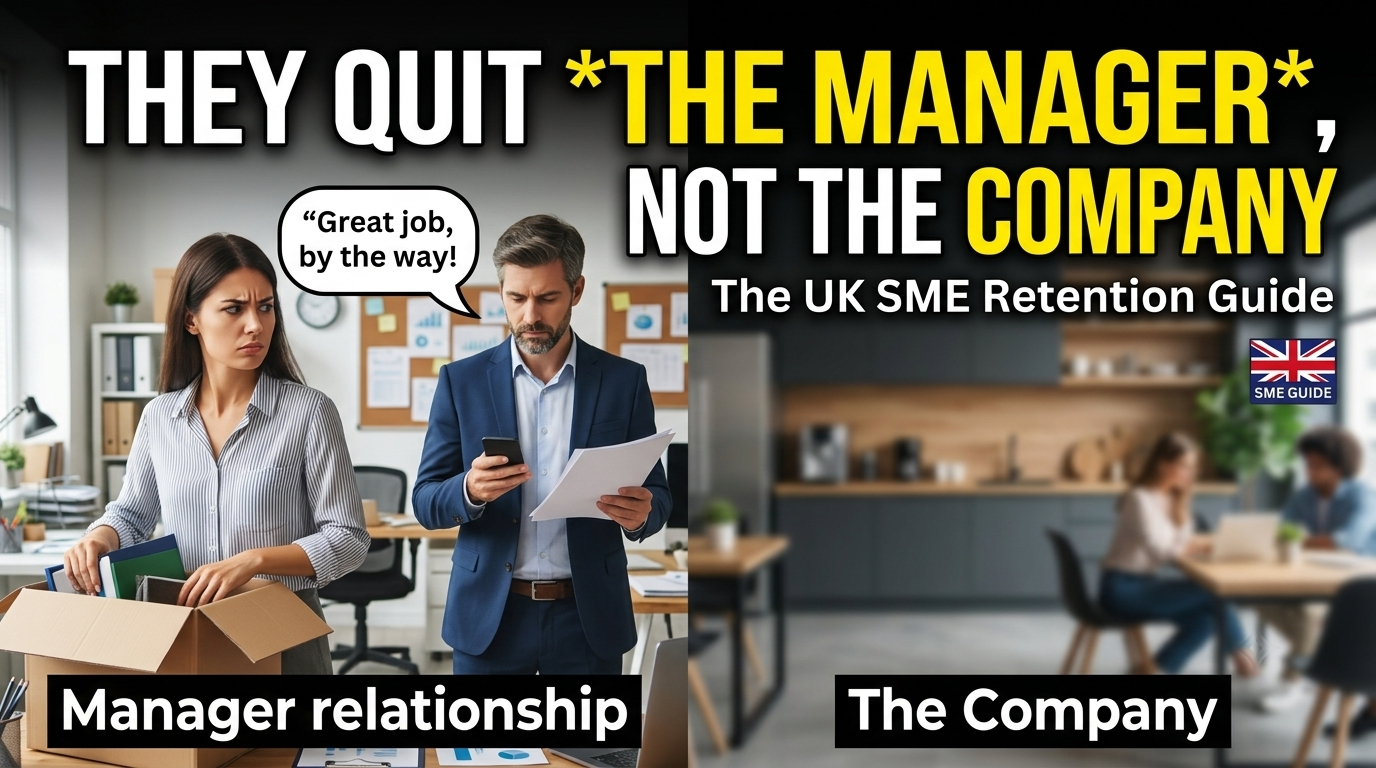
The exit interview said the pay was too low. It always says the pay was too low. When I sat down with the leaver a week later, over coffee she had paid for, the real story came out in about four minutes. Her manager had never asked what she wanted next. Never given her feedback beyond a quarterly review that felt like a form-filling exercise. Had missed her one-to-one three times in a row.
She was not underpaid. She was under-managed. And she was not unusual.
Employees quit their manager, not their company. Pay gets blamed on the way out because it is easier to say. The underlying driver in most voluntary exits is the day-to-day relationship with the person they report to.
Gallup research going back decades has found that around half of voluntary quits trace back to the direct manager. A February 2026 poll of 2,000 UK employees by Ciphr put pay first at 36 percent, and lack of recognition second. Recognition sits with the manager. So does the sense of being seen, developed, and trusted. Those are not HR policies. They are manager behaviours.
The scale of the problem in the UK is stark. Gallup’s most recent global engagement work puts UK employee engagement at around 10 percent, one of the lowest in Western Europe. CIPD’s 2025 flexible working research found 1.1 million UK workers left a job in a single year because they lacked flexibility. Flexibility, in most SMEs, is a manager decision, not a policy.
Most UK SME managers were never trained to manage. They were promoted because they were the best at the job below. That is a completely different skill. And no one told them.
This is the pattern I see week after week. A brilliant developer gets promoted to lead the team. A top salesperson becomes sales manager. A senior nurse becomes ward lead. The reward for being excellent at the work is being asked to stop doing the work and start managing people doing the work. Then given no training, no framework, and no honest feedback about how it is going.
In larger businesses, there is usually a leadership development budget, a coach, a structured programme. In an SME with thirty or forty people, there rarely is. The new manager copies the last manager they had, good or bad, and hopes for the best. That is how a company ends up with a group of accidental managers, each recreating slightly different versions of the same problems.
Every one of those managers has a small team under them. And every one of those teams is quietly deciding whether to stay.
Three habits separate the managers people stay for from the ones people quietly leave. A structured weekly one-to-one. A real career conversation at least twice a year. Recognition that names the specific thing, not the generic effort.
Not a status update. Not a project check-in. A protected thirty minutes owned by the report, not the manager, where the manager mostly listens. It gets moved only in an emergency, and it is rescheduled the same week, not skipped. If a manager cannot hold this consistently for five direct reports, they have too many reports or the wrong priorities.
Twice a year, at minimum, a conversation that is only about the person’s development. Where do you want to be in two years. What are you learning now. What is missing. This is separate from a performance review. A performance review looks backwards. A career conversation looks forwards. Most SMEs do neither well. The ones that do the second retain their strongest performers.
“Great job” is not recognition. It is noise. “The way you handled the Watkins account renewal last week, especially the pricing conversation, that is exactly the kind of judgement we need more of” is recognition. Specificity says the manager was paying attention. Generic praise says they were not. Employees know the difference within seconds.
Good managers absorb organisational pressure. They push back on unreasonable deadlines, unblock decisions, and protect their team’s focus. Poor managers pass every pressure downwards untouched. The team ends up doing the manager’s job of prioritising, on top of their own work, without the authority to make it stick.
AI is not a substitute for a good manager. It is a substitute for the administrative work that stops managers being good ones.
The single biggest complaint I hear from SME line managers is that they do not have time to manage. They are running their own workload plus their team’s, buried in status reports, chasing timesheets, drafting job specs, and writing feedback in the evenings. AI tools, used properly, can take a lot of that off their plate. Meeting summaries. Draft one-to-one agendas built from recent work, feedback pulled from actual project artefacts. Draft job descriptions when it is time to backfill. My implementation guide for AI in hiring walks through what the boundary should look like.
The boundary matters. AI should draft, not decide. It should surface patterns, not deliver verdicts. When a manager uses an AI-generated summary as a starting point for a conversation, that is fine. When they forward it to a team member and call it feedback, that is where trust breaks.
Audit your managers before you audit anything else. If your voluntary attrition is high, the answer is almost never a bigger pay budget. It is usually a training programme for people who were never taught how to manage.
Start with the numbers you already have. Which teams are losing people fastest. Which managers have never received formal training. If you do not know, you can find out in a week. Then invest in the three or four managers whose retention rate is dragging the average down. A small SME with better-trained managers will out-retain a much larger competitor with better pay. The early attrition piece gets into the first-ninety-days angle, and the onboarding guide covers how to set managers up for the arrival, not just the hire.
I have pulled every retention habit that works for a business of your size into one place: employee retention strategies for UK SMEs.
Gallup’s long-running research suggests around half of voluntary exits trace back to the direct manager, though the leaver rarely says so on the way out. Exit interviews tend to surface pay first because it is a socially safe answer. The manager relationship is usually the deeper driver.
Yes. Informal learning by copying the last manager works for the naturally talented and fails for everyone else. A short structured programme, even a few sessions on holding one-to-ones, giving feedback, and protecting the team, pays back through retention within a single year for most SMEs.
AI helps with the drafting and admin work around management. It should not replace the conversation itself. A manager who uses AI to prepare better and free up their week can be a better listener when it matters. A manager who outsources the actual judgement to a tool loses their team’s trust quickly.
Sabiha is a Talent Acquisition Director, Speaker and Author with more than sixteen years of international hiring experience across the UK, Dubai, South Africa and Malaysia. She has worked with over 300 businesses on their hiring and retention strategies and was shortlisted for Best Career Coach UK by the Career Development Institute. Her book, How to Use AI to Win Talent and Retain People, is published by Trotman in Autumn 2026.

Global Talent. Ethical AI. Strategic Hiring. Sustainable Retention.