

The finance director rings me on a Thursday afternoon. She wants to know why her hiring bill has jumped by nearly a fifth in the last twelve months, and whether the new sales manager will actually justify it. I look at her spreadsheet. The salary line is only half the story. Everything sitting under it, the National Insurance, the pension, the agency fee, three months of onboarding cover, the deal her predecessor left half-finished, has climbed too. And that is before the risk of the whole thing not working out.
Most UK SMEs know a bad hire is expensive. Very few know how expensive it has become in 2026, or where the number actually comes from.
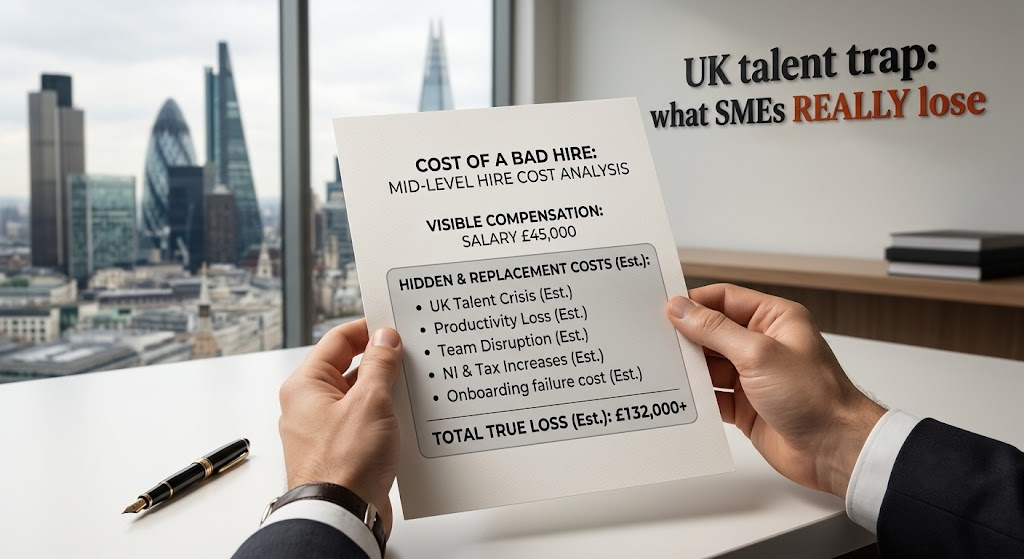
A bad hire at mid-manager level in the UK typically costs a business more than £132,000. That figure comes from the Recruitment and Employment Confederation and includes direct spend, lost productivity across the team, and the cost of running the process again.
REC’s Perfect Match research is the most widely cited UK benchmark. Its headline finding, that a mid-manager role paying £42,000 can carry a total loss of over £132,000, still holds when you plug 2026 numbers into it. If anything, the direction of travel is upward.
International benchmarks agree on the shape. SHRM puts replacement costs at 50 to 200 per cent of annual salary. UK industry consensus sits closer to 1.5 to 3 times salary above entry level, and higher for specialist or senior roles. None of these are official statistics, but every credible source lands in a similar range, and none of them place the number anywhere near what most SME budgets quietly pretend it is.
Three things have shifted since 2024. Employer National Insurance rose from 13.8 per cent to 15 per cent. The secondary threshold at which employers start paying NI dropped from £9,100 to £5,000. And the Employment Rights Act 2025 made statutory sick pay payable from day one.
HMRC’s own working shows the combined effect on an employee earning around £36,000 is roughly an extra £940 on employer NI alone, compared with the position before April 2025. Multiply that across a small team, then imagine losing two people inside twelve months. The bill for hiring the wrong person has quietly become one of the largest unbudgeted line items in a growing SME. You pay them, lose them, and pay them again.
Direct costs are the ones you can put on a spreadsheet before the person even starts. For a mid-level hire on £45,000, they typically run between £15,000 and £25,000 before you count a single hour of productive work.
A rough breakdown for a £45,000 role in 2026:
If the hire leaves before probation ends, most of this is gone. Agency rebate periods rarely stretch beyond three months. Onboarding investment does not refund. And unless you are eligible for the full £10,500 Employment Allowance, the NI already paid is not coming back either.
The hidden costs are the ones nobody puts on the spreadsheet and everybody eventually pays. Lost productivity, team disruption, missed revenue, client damage, and the drain on the manager who has to hold the situation together.
Research on new-hire ramp consistently shows people operate at 50 to 70 per cent productivity for the first three to six months. That is the working assumption for good hires. For a bad hire, that ramp never lands. What you get is six months of half-output, a manager pulled off strategic work, colleagues absorbing the workload, and often clients who felt the impact before anyone internally admitted the hire was not working.
Then there is the second-order effect nobody costs in. The sales territory not opened. The product feature not shipped. That role existed because the business needed something to move, and when it does not, the shortfall compounds every month the wrong person sits in the seat. Strong performers also notice when a weak hire is protected, and retention risk in the surrounding team rarely shows on any dashboard until someone with options resigns. This is where the £132,000 figure comes from. It is not padding.
More often than most owners realise. REC data shows 85 per cent of UK HR decision makers admit their organisation has made a bad hire. One in three of those decision makers still believe the mistake cost their business nothing.
CIPD’s Resourcing and Talent Planning survey reports that 41 per cent of UK employers say new hires leave within their first twelve weeks always, mostly, or sometimes. That is early-attrition territory, disproportionately concentrated in SMEs.
The gap between knowing bad hires happen and pretending they cost nothing is where the damage lives.
Most bad hires trace back to three points in the process, not one. The rush to fill, the shortcut in screening, and the unstructured interview.
The rush to fill is the most common. REC found a third of HR professionals attributed bad hires to the pressure to close the gap quickly. Every skipped step at the top of the funnel becomes a bill at the bottom of it.
The shortcut in screening is the second. Most UK SMEs still screen on CV keywords and referrals, with a covering letter as a tiebreaker. That is not screening. It is filtering. Our earlier piece on AI CV screening for UK SMEs walks through how a well-configured screening step changes the shape of the shortlist, and where the real risks sit.
The unstructured interview is the third. Two managers, a coffee, a conversation about “fit”, and a decision made in the corridor afterwards. That process cannot reliably distinguish a strong hire from a plausible one. Structured, evidence-based interviewing outperforms it in every serious published comparison. Most SMEs know this. Very few actually run it.
The organisations I see making the fewest bad hires do four things most SMEs skip. They design around skills, structure the interview, use AI screening where it genuinely earns its keep, and treat the first ninety days as part of the hire.
None of these are complicated. All of them are commonly skipped. That is precisely why the average bad-hire rate has not shifted in a decade.
For a fuller breakdown of what changes when SMEs treat the first ninety days as part of the hiring investment rather than the mopping-up phase, our piece on new-hire attrition in UK SMEs sets out the specific practices that move the numbers.
The cost of a bad hire in the UK is not really a mystery. It is a number most SMEs choose not to look at, because looking at it forces a decision about the process that produced it.
The finance director who rang me on Thursday knew the number by the end of the call. Two months later she had rebuilt her hiring process around skills, structure, and the first ninety days. Her next hire is still with the company. The one after that is too. That is what the number is for.
The most widely cited UK benchmark is REC’s Perfect Match research, which places the cost of a mid-manager bad hire on a £42,000 salary at more than £132,000. That combines direct spend, lost productivity, management time, and the cost of running the process again.
It remains the benchmark most UK sources use, and the direction of travel is upward. Employer NI rose to 15 per cent from April 2025, the secondary threshold dropped to £5,000, and the Employment Rights Act 2025 added day-one statutory sick pay. Every one of those changes raises the true cost of every hire.
Start with direct cost: recruitment fee, employer NI, pension, onboarding, manager and team time. Then add lost productivity for the months the hire operated below expected output, and the value of work that did not happen. The total is usually two to three times what finance originally budgeted.
Structured interviewing with a scoring anchor. A properly configured AI screening step with human oversight. And treating the first ninety days as part of the hiring investment. None require a bigger recruitment budget. They require a different one.
Sabiha is a Talent Acquisition Director, Speaker, and Author with over sixteen years of international hiring experience across the UK, Dubai, South Africa, and Malaysia. She has worked with 300+ businesses to design hiring and retention systems that use AI responsibly and keep human judgement at the centre. Sabiha was shortlisted for Best Career Coach UK by the Career Development Institute.

Global Talent. Ethical AI. Strategic Hiring. Sustainable Retention.