

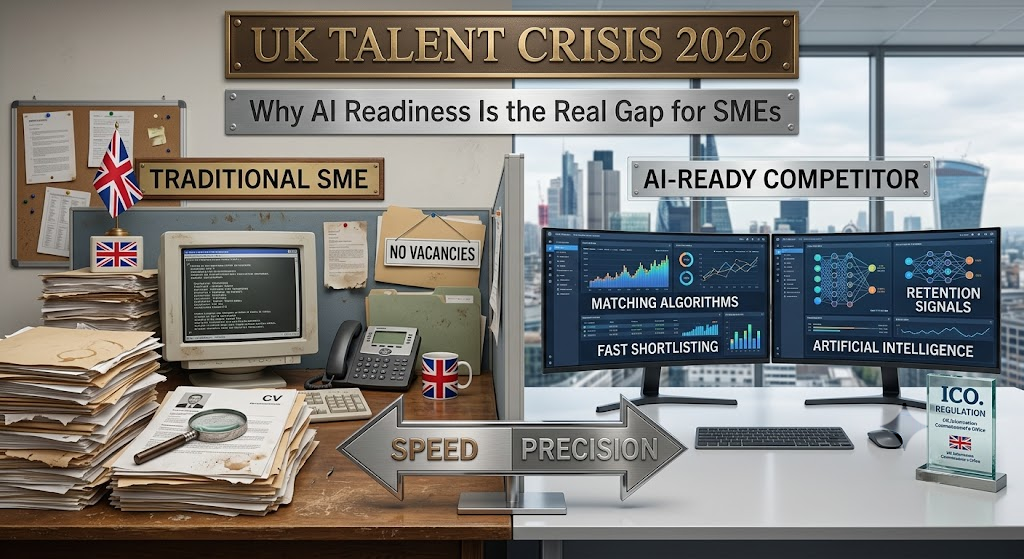
A managing director I spoke to last month told me she had lost three good hires in a row. Two never made it past week eight. One never showed up on day one. She thought the problem was her employer brand. When we looked closer, it was something else. She was hiring the same way she did in 2019, while her larger competitors had quietly rebuilt their entire pipeline around AI. Faster shortlists. Better matching. Retention flagged before it became a resignation. She was not losing to money. She was losing to speed and precision.
This is the UK talent crisis in 2026. It is not just a shortage story. It is a readiness story. And the gap between the SMEs who have started closing it and the ones who have not is widening every quarter.
The UK does not have one talent crisis. It has two overlapping ones. A shortage of skilled candidates, and a shortage of employers ready to hire them well.
The CIPD Resourcing and Talent Planning report found that 69 percent of UK organisations reported increased competition for talent, and 64 percent struggled to fill vacancies. The same report showed 31 percent of UK organisations now use AI in some part of recruitment, nearly double the 16 percent recorded in 2022. Two-thirds of those using it say hiring efficiency improved.
The catch sits in the other 69 percent. CIPD analysis on the same dataset noted that around 80 percent of UK SMEs, public sector bodies and non-profits were not using AI in recruitment at all. A more recent Access Group and YouGov survey from December 2025 found that 73 percent of UK HR decision-makers now use AI somewhere in their role. The direction of travel is clear. Adoption is no longer the question. Readiness is.
So when a small business tells me hiring is broken, I look at two things first. What does their pipeline look like end to end, and how much of it is still done manually while a competitor down the road is doing the same work in a fraction of the time.
Because AI does not just make hiring faster. It makes hiring cumulative. Every hire teaches the next one. SMEs still hiring manually start each search from scratch.
There is a compounding effect the CIPD numbers do not fully capture. An SME using AI to screen, match and track candidates is not just saving hours per role. It is building a picture of who succeeds, who leaves early, which sources deliver, which job ads work. That picture gets sharper with every hire. The SME still working from spreadsheets, gut feel and a scattered ATS gets none of that back.
Meanwhile the shortlist arrives later. The best candidates have already accepted somewhere faster. The bad hires cost between one and a half and three times annual salary in industry estimates, and the good ones leave when they realise the onboarding was thrown together the day they started. This is not a technology problem. It is a systems problem. AI is what is exposing it.
It is not buying a tool. It is knowing where AI belongs in your pipeline, where it does not, and who is accountable when it goes wrong.
When I work with UK SMEs on this, I look at four things.
The job design. Is the role written for skills a candidate can demonstrate, or a CV template from 2016? AI attraction tools amplify whatever you feed them. Feed them a vague job ad and you get vague applicants faster.
The screening layer. Where in your funnel is a machine narrowing the pool, and does a human with actual authority review that shortlist before it goes further? The ICO looked at this closely in 2026 and found the honest answer for most UK employers was no.
The retention signal. Are you tracking who leaves in the first ninety days and why, or waiting until the exit interview? The data you need to fix retention lives in the first quarter, not the last one.
The human layer. Who owns the AI decisions in your business? If the answer is nobody, that is your first fix. Not the tool.
If any of that sounds familiar, my earlier piece on how to implement AI in hiring for UK SMEs walks through a phased rollout that does not require a technology team.
The rules are moving. They are not fully settled. But the direction of travel is unmistakable.
The ICO published Recruitment Rewired in March 2026, based on evidence from more than thirty UK employers between March 2025 and January 2026. The central finding was that most employers using AI in recruitment thought they were using it as decision support, when the tools were in fact making the decisions. The regulator wrote to sixteen organisations directly. All sixteen have now committed to change how they operate.
At EU level, the AI Act classifies recruitment tools as high risk. The Digital Omnibus agreement reached in May 2026, and approved by the European Parliament in June, is expected to move the compliance deadline from August 2026 to 2 December 2027, subject to formal Council adoption. UK employers hiring across Europe should re-verify this before relying on the extension. What has not changed is the underlying principle. Meaningful human involvement in automated decisions is now a baseline expectation, not a nice-to-have.
Start with one part of the pipeline, not the whole thing. The SMEs that fail with AI try to do everything at once. The ones that succeed pick a single bottleneck and fix it well.
In practice that usually means one of three places. Attraction, if your job ads are not landing the right candidates. Screening, if your team is drowning in unsuitable applications. Or onboarding and first-ninety-days retention, if your good hires are leaving before you have paid back the cost of finding them.
Pick the one that hurts most. Fix it with a tool that has a clear owner in your business and a documented human review point. Then move to the next. If early attrition is where your pain sits, my post on new hire attrition in UK SMEs goes deeper into what actually breaks in the first ninety days.
The SMEs I see closing the gap are not the ones with the biggest budgets. They are the ones who stopped treating hiring as an administrative task and started treating it as a system that pays back every year it improves.
Both, but not equally. Pay matters, and the CIPD data on candidate motivations shows salary and flexibility still lead. What AI changes is the speed and precision of the whole pipeline, so the SME using it well can find, hire and retain a good candidate before a slower competitor has finished shortlisting.
The CIPD data suggests yes. Around 80 percent of SMEs were not using AI in recruitment at the point of the 2024 survey, while overall adoption has climbed to 31 percent. That gap between larger organisations and SMEs is what the readiness conversation is really about.
Losing human accountability. The ICO looked at exactly this in 2026 and found many UK employers had automated more of the decision than they realised. The risk is not the technology. It is not knowing where the tool ends and your judgement begins.
Sabiha is a Talent Acquisition Director, Speaker and Author with 16+ years of international hiring experience across the UK, Dubai, South Africa and Malaysia. She has worked with 300+ businesses to build stronger hiring and retention systems, and was shortlisted for Best Career Coach UK by the Career Development Institute. She writes on AI-enabled talent acquisition and workforce strategy for UK SMEs, and speaks regularly on the future of hiring.

Global Talent. Ethical AI. Strategic Hiring. Sustainable Retention.