

Scope note: This article references UK and EU regulatory context, including Skills England guidance, the UK AI Opportunities Action Plan, and the EU AI Act. This is regulatory signal and workforce direction, not legal advice. For decisions that touch employment law, data protection, or AI compliance, consult a qualified UK specialist.
I was on a call last week with the founder of a 60-person logistics firm in the Midlands. She had spent three years hearing about AI and had finally hired a consultant to help her team use it. Three months in, the consultant left. Nobody on her staff could describe what the tools were actually doing.
She asked me a good question. If AI is meant to be so simple, why does it feel like the skills gap keeps widening?
That is the story of UK SMEs and AI in 2026. Adoption is climbing. Understanding is not keeping up. And the leaders who close that gap over the next three years will define who wins talent, who retains it, and who quietly falls behind.
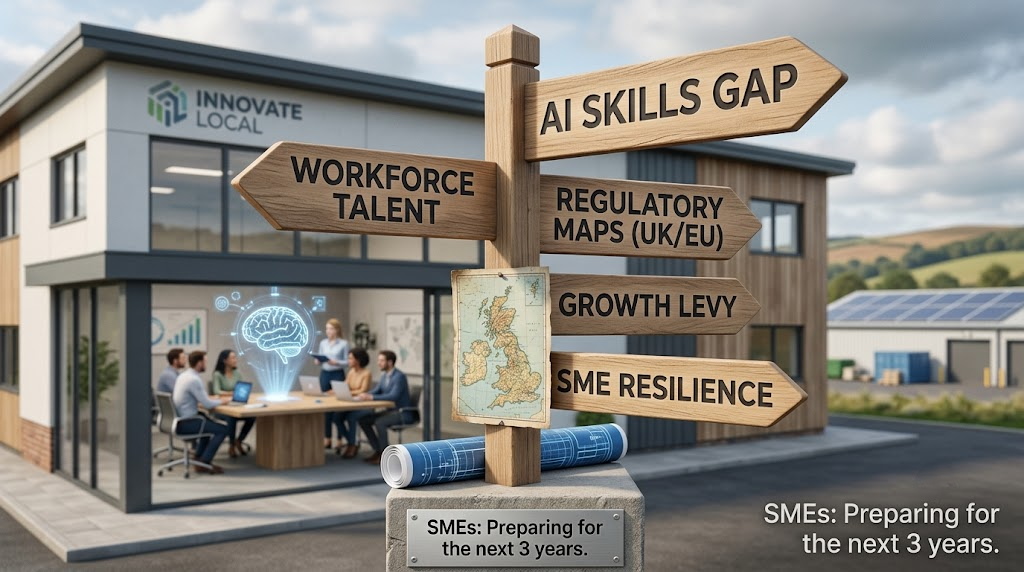
This post covers what the AI skills gap actually looks like for UK SMEs right now, which skills matter most, how to build them without a huge L&D budget, and what to prepare for next.
The gap is bigger than most SME leaders realise, and it is widening in the sectors that need AI most.
Adoption looks encouraging on the surface. BCC research from March 2026 found 54% of UK firms are now using AI, up sharply from 35% in 2025 and 23% in 2023. Around 94% of the sample was SMEs.
But adoption is not capability. The DSIT AI Labour Market Survey 2025, published in January 2026, found that 97% of surveyed organisations reported at least one AI skills gap. 57% flagged technical shortages in areas like programming and data science. Only 40% said they had the non-technical skills they needed. The proportion of employers saying their teams do not really understand AI concepts and algorithms rose from 55% to 60% over five years.
Size matters too. DSIT research found 14% of micro businesses use AI compared with 36% of large firms. Smaller SMEs, consumer-facing businesses and manufacturers are lagging behind B2B professional services on adoption. And 28% of surveyed organisations said their AI skills shortages have already stopped them hitting business goals.
That is not a hype problem. That is a live commercial risk.
AI skills for an SME are less about coding and more about judgement. Knowing where AI helps, where it should not be trusted, and how to work with it well.
Skills England published its Assessment of priority skills to 2030 in August 2025 and followed with an AI Skills Framework and Adoption Pathway in October. Its categories are useful for SMEs because they separate technical AI skills from the ones everyone in the business needs.
At entry and mid level, the essentials are practical. Writing a good prompt. Spotting when an AI-generated answer is wrong. Checking outputs against the source. Knowing what data should never go into a public model. These are workplace habits, not deep technical skills, and they are learnable in weeks.
At leadership level, the shift is different. Managers need to know where AI belongs in a workflow and where it does not. They need to evaluate a vendor honestly, ask about training data, and decide what a human still has to sign off on. That is a talent conversation as much as a technology one, which I covered in Post 2 on the AI literacy skills gap.
The WEF Future of Jobs Report 2025 backs this up. Its top growing skills to 2030 are AI and big data, but sitting alongside them are analytical thinking, resilience, creative thinking, and technological literacy. AI does not remove the need for human judgement. It raises the bar on it.
The SMEs that treat AI as a single specialist hire tend to struggle. The ones that treat it as a workforce-wide capability tend to pull ahead.
The most effective path is small, task-based, and internally led. Not a big-bang training programme, and not another consultant.
A few things are working for SMEs right now.
First, use what is free. Skills England has published an AI Skills Framework, an Adoption Pathway, and an Employer Checklist. All open access. All designed to help SMEs work out where they are and what to build next. The BCC AI Academy, launched in October 2025, is doing similar work through the Chamber network.
Second, fund it properly. From 2026 the Growth and Skills Levy can be used for shorter, more flexible training including AI literacy. Smaller businesses that historically found the Apprenticeship Levy hard to use are in a much better position now.
Third, appoint internal AI champions. This is the single practice that separates SMEs where AI sticks from ones where it does not. One or two people per team who know the tools well, model good use, and answer the everyday questions. Cheaper than external training. Faster to embed. And it keeps capability inside the business when the consultant leaves.
Fourth, keep it task-based. A month spent teaching every team member to use one AI tool well on one real job task beats a quarter of generic training. DSIT reports 75% of AI-using UK businesses seeing productivity gains, but those gains are concentrated where staff use the tools daily, on real work. If you want the full rollout roadmap once your team is ready, Post 8 walks through implementation step by step.
Three shifts are coming that will separate the SMEs who lead from the ones spending 2027 catching up.
The first is agentic AI. The DSIT AI Labour Market Survey found 57% of organisations planning to adopt agentic AI within three years. That is a step change from tools that answer questions to systems that take actions. The skills required to supervise them are different, and the governance conversation is only just starting.
The second is skills disruption. The WEF Future of Jobs Report expects 39% of workers’ core skills to change by 2030. 85% of employers plan to prioritise upskilling. 70% expect to hire people with new skills that were not on their org chart three years ago. Workforce planning for a UK SME in 2026 is a different exercise from workforce planning in 2020.
The third is the regulatory ground moving. Skills England is now the national anchor for workforce skills strategy. The AI Opportunities Action Plan sets a target of 7.5 million UK workers gaining essential AI skills by 2030 through a partnership with NVIDIA, Google, IBM and Microsoft. The EU AI Act’s high-risk provisions for standalone recruitment tools now apply from 2 December 2027, deferred from August 2026 by the Digital Omnibus. That deferral is not permission to stand still. It is 16 more months to get your house in order.
The SMEs who use that window well, mapping current skills, building AI literacy across the workforce, appointing champions, and preparing for supervised agentic tools, are the ones who will hire and retain the best talent in 2027 and beyond.
The founder I spoke with last week is not behind. She is where most UK SMEs are. What separates the next three years is whether leaders treat AI as one more thing to buy, or as a workforce capability to build.
The talent crisis is not going away. The AI skills gap is not closing on its own. But the SMEs who plan for both together are the ones who will stop searching and start hiring differently.
The largest gap is understanding, not tools. DSIT research found 60% of surveyed organisations report that staff do not fully understand AI concepts and algorithms, up from 55% five years ago. The tools have moved faster than the workforce’s ability to reason about them.
For most SMEs, upskilling existing staff is more effective. Task-based AI literacy across the workforce, backed by one or two internal champions, tends to outperform a single specialist hire. Skills England’s AI Skills Framework and the BCC AI Academy are free starting points.
AI literacy is the practical ability to use, question, and check AI tools in day-to-day work. AI expertise is deep technical knowledge of how models are built and trained. Most SME workforces need broad AI literacy across every role and deep expertise in a small number of them.
The EU AI Act’s high-risk obligations for standalone recruitment AI systems now apply from 2 December 2027, following the Digital Omnibus deferral in May 2026. UK-based employers hiring EU candidates or using EU-provided AI tools should treat that date as a planning baseline and consult a qualified specialist on their specific exposure.
Sabiha is a Talent Acquisition Director, speaker, and author with 16+ years of international hiring experience across the UK, Dubai, South Africa and Malaysia. She has helped over 300 businesses improve how they hire and retain talent, was shortlisted as Best Career Coach UK by the CDI, and is the author of How to Use AI to Win Talent and Retain People (Trotman, Autumn 2026). “I was my own first client” is the line that anchors her work: she builds workforce systems she would want to use herself. She writes and speaks on AI-enabled hiring, retention by design, and building future-ready workforces for UK SMEs.

Global Talent. Ethical AI. Strategic Hiring. Sustainable Retention.