

This post references UK GDPR, the Data (Use and Access) Act 2025, ICO guidance, the Equality Act 2010, and the EU AI Act as regulatory context and direction of travel. It is not legal advice. UK SMEs using AI in interviews or assessments should consult a qualified UK data protection or employment law specialist for their specific setup.
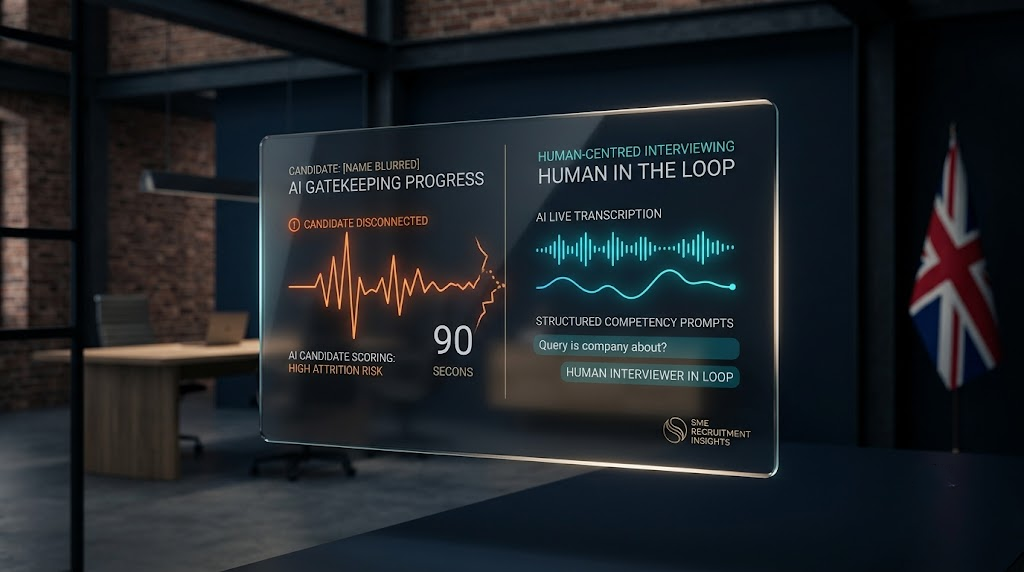
A candidate opens the interview link on a Tuesday evening. She is expecting a person on the other end. Instead the screen shows a small preview of her own face, a countdown timer, and a first question she has ninety seconds to answer. She closes the tab. The employer never sees her again, and probably never knows she was there.
That is one of many reasons “human-centred AI” has stopped being a slogan for UK employers and started being a compliance question.
AI is running more of the interview than most UK hiring managers realise. CIPD data shows 31% of UK organisations now use AI in recruitment, nearly double the 16% recorded in 2022, and it has moved beyond CV screening into live interview and assessment processes at real scale.
The figures come from the CIPD Resourcing and Talent Planning Report 2024, based on a survey of over 1,000 UK HR and people professionals.
The category “AI interview” covers a wide range of tools. On the light end you have scheduling assistants, live transcription, and post-interview note synthesis. In the middle you have structured question generators and skills-assessment platforms that mark technical tasks. At the heavy end you have async video platforms where the candidate records answers into a webcam, an algorithm scores the response, and only shortlisted candidates ever reach a human. Most UK SMEs think they are buying the light end. Many are further along that spectrum than they realise.
we covered the CV-screening end of this spectrum in an earlier post, AI CV Screening in the UK: What Breaks and How to Fix It.
UK candidates are dropping out of AI-led interviews at rates that would end any other hiring channel. Recent survey research reported by People Management found 47% of UK jobseekers have already been interviewed by AI. Of those, 82% were not told beforehand, and 24% only realised AI was involved once the interview had started.
The wider picture is sharper. People Management’s coverage of the Greenhouse 2026 candidate report found more than a third of candidates leave the process the moment an AI interview appears unannounced. Only 10% of UK candidates said their employer had a clear policy on AI, and 59% thought disclosure should be a legal requirement.
Younger candidates are more sceptical, not less. Prospects at Jisc’s Early Careers Survey 2026 found 89% of students and graduates thought it was unfair for employers to use AI for live online interviews, and 83% felt the same about recorded ones. That is the exact talent pool most UK SMEs are trying to reach.
Human-centred AI in interviewing means the AI helps the interview happen. It does not decide who moves forward. A human interviewer reads, hears, and evaluates. Any AI output sits underneath that human judgement, never above it.
That is a simple line to write and a difficult one to hold. The pressure on small hiring teams is real. A recruiter reviewing eighty video responses over a weekend will lean on whatever tool speeds things up. Human-centred does not mean slow. It means the person making the hiring call has genuinely engaged with the candidate in a conversation. This is what the ICO means when it says human review must be meaningful, and not a token gesture or a rubber stamp.
AI earns its place in preparation, consistency, and post-interview synthesis. It reduces load on hiring managers and improves the quality of the human conversation. It stops earning its place the moment it replaces that conversation.
Practical uses that hold up: scheduling and reminders, live transcription so the interviewer can listen instead of scribbling, structured question generation so the same skills get tested consistently across candidates, and post-interview summaries for hiring debriefs. Job-relevant skills assessments work too, where the task is the actual work of the job: a coding exercise for a developer, a writing sample for a copywriter. Real work, evaluated by a human, with AI helping on timing or scoring.
AI breaks interviews the moment it starts scoring the person rather than the task. Voice tone analysis, facial-expression scoring, and personality inference tools raise the same fairness and regulatory concerns as biased CV screening, and often more.
Voice tone models trained on native English speakers do not read second-language accents accurately. Facial-expression scoring penalises neurodivergent candidates and disabled candidates whose facial movement the vendor never accounted for. Personality inference from short video responses correlates with class, region, and age in ways the tool was never designed to measure.
Async one-way video interviews with no human viewer are the sharpest edge. If nobody at the company ever watches the recording, the AI is not supporting a decision. It is making the decision. That is exactly the situation the ICO flagged in its March 2026 report. The Equality Act 2010 sits in the background of all of this.
The ICO’s March 2026 “Recruitment Rewired” report set a clear direction of travel. Many UK employers using AI in hiring believe they have human oversight but in practice do not. That gap is where enforcement risk currently sits.
The ICO’s Recruitment Rewired report reviewed AI use across more than 30 UK employers between March 2025 and January 2026. Its central finding was that many employers relying on automated recruitment tools are likely making solely automated decisions without meaningful human involvement, placing those decisions under UK GDPR safeguards that our evidence suggests are often not yet in place. The ICO’s related draft guidance on automated decision-making reflects the Data (Use and Access) Act 2025, which reformed UK GDPR provisions on automated decisions.
On the EU side, the timeline has just moved. The EU AI Act’s high-risk obligations for recruitment were due from 2 August 2026. Under the “AI Omnibus” package, the European Commission has confirmed this has been extended to 2 December 2027. UK SMEs hiring EU-based candidates or using EU-built tools should track the new date and confirm current status with a specialist. None of this is legal advice.
The question is not whether to use AI at all. It is how to use it in a way that keeps candidates in the process, keeps hiring managers making the decisions, and keeps the business on the right side of where the ICO is heading.
Ask what the tool is actually doing before you buy it. Not the marketing description, the processing description. If the vendor cannot explain in plain English which decisions the tool makes and which decisions a human makes, that is your answer.
Tell candidates before the interview. Say what AI is being used for, what a human will do, what data the tool collects and how long it is kept. It is a signal from the ICO, and the single fastest way to reduce candidate drop-out.
Keep a human in the seat, not just on the audit trail. If nobody at your company has time to review the AI’s output meaningfully, you do not have time to be using the tool.
Use skills tests that would exist without the AI. If the assessment only makes sense because the AI is scoring it, it is probably not testing what you think.
Log human decisions, not just AI scores. When a candidate is rejected, the record should show the human reasoning behind it.
The businesses winning talent in 2026 are the ones treating AI as a colleague, not a gatekeeper. We set out the wider hiring roadmap in How to Implement AI in Hiring and Retention: UK SME Guide. Interviews are still where the hire actually happens. Everything AI does should point back to a stronger human conversation, not a shorter one.
Transparency is a strong signal from both the ICO and candidates themselves. The ICO’s draft ADM guidance stresses meaningful information about how automated tools work, and 59% of UK candidates believe disclosure should be a legal requirement. Regardless of the current legal position, telling candidates is now practical hygiene.
It is used, but its legal footing is under active regulatory scrutiny. The ICO’s 2026 report flagged solely automated decisions without meaningful human review as a central concern. Employers running async video assessments should consult a qualified UK data protection specialist about their setup.
It applies to AI systems placed on the EU market, used by EU-based providers, or affecting people in the EU. The high-risk recruitment provisions were due from 2 August 2026 but have been extended to 2 December 2027 under the EU’s AI Omnibus simplification package. UK SMEs hiring EU-based candidates or using EU-built tools should confirm the current position with a specialist.
AI-assisted interviews, where technology supports a human decision-maker, can add real value in a small business. Fully AI-run interviews, where the algorithm decides who moves forward, sit in the highest-risk category and are the least likely to hold up under regulatory or candidate scrutiny.
Losing the candidates you most want to hire. Enforcement matters, but the immediate cost is commercial. When strong candidates walk out of the process, the business does not always know it has happened, and the vacancy stays open.
Sabiha is a Talent Acquisition Director with 16+ years of international hiring experience across the UK, Dubai, South Africa and Malaysia. She has helped 300+ businesses improve hiring and retention, is shortlisted as Best Career Coach UK by the Career Development Institute, and is the author of the forthcoming How to Use AI to Win Talent and Retain People (Trotman, autumn 2026).

Global Talent. Ethical AI. Strategic Hiring. Sustainable Retention.