


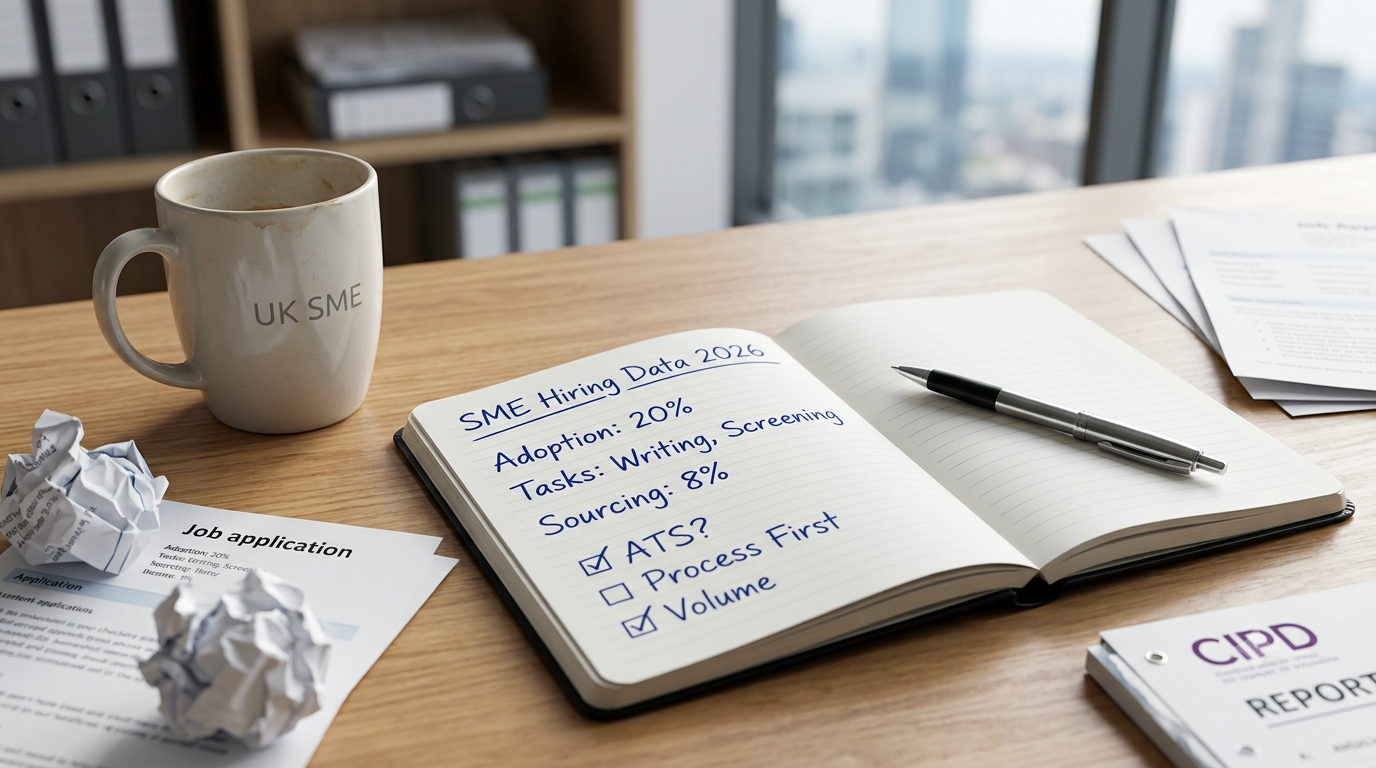
A client asked me in September how far behind everyone else they were. Ninety people, engineering, based in the Midlands. They had started using ChatGPT to draft job adverts and assumed the rest of the market was years ahead of them. We went through the data together. They were not behind. On that one task they were ahead of roughly five in six businesses their size, and nobody had ever told them.
The noise around AI in hiring has run a long way ahead of the evidence, and UK employers are making investment decisions against a picture of the market that is not accurate.
Here is the short version. 56% of UK organisations use no AI anywhere in their recruitment process, and among small and medium-sized employers that figure rises to 80%. Adoption is real, but it is shallow, concentrated in two tasks, and far smaller than the conversation suggests.
Every figure below comes from the CIPD Resourcing and Talent Planning Report 2026, published on 22 September 2026, unless stated otherwise. Fieldwork ran from 2 April to 2 May 2026 with 1,014 UK HR and people professionals with responsibility for resourcing, weighted to be representative of UK employers by size and sector.
Fewer than half. And for smaller employers, it is roughly one in five.
In the 2026 survey, 56% of organisations said they use no AI or machine learning in any part of their recruitment process. A further 6% did not know. That leaves well under half using it anywhere at all.
The trend is moving, but slowly. The same question returned 62% in 2024 and 84% in 2022. Two years of intense public attention on generative AI shifted the non-adopter figure by six percentage points.
The size split is where it gets useful:
It is worth holding that against general business adoption. ONS data published on 2 July 2026 found 29% of UK businesses using at least one AI technology in June 2026, up eight percentage points in a year, rising to 49% among those with 250 or more employees. A separate ONS analysis published on 20 July 2026 put adoption at around 35% for businesses with 10 or more employees, up from around 12% in late 2023.
So AI is arriving in UK businesses faster than it is arriving in UK hiring. Recruitment is not the front door. It is one of the later rooms.
Two tasks, and both of them sit at 16%.
The CIPD asked about nine distinct uses. These are the 2026 figures, with 2024 and 2022 in brackets so you can see the direction:
Two things stand out. Writing and screening have both roughly quadrupled since 2022. Sourcing has not moved at all across three surveys, sitting at 8% in 2022, 2024 and 2026, despite being the use case most heavily marketed to employers.
The pattern is consistent. AI has taken on the reading and writing jobs in recruitment. It has not taken on the finding job.
Because most smaller employers do not have the recruitment systems that AI plugs into.
This is the finding I would put in front of any SME leader worrying they have missed something. More than half of SMEs, 53%, use none of the recruitment technologies the CIPD asked about. Not an applicant tracking system, not online assessments, not an onboarding platform, nothing. Among organisations with 250 or more employees, that figure is 10%.
Underlying technology use is creeping up. Applicant tracking systems reached 32% in 2026, up from 26% in 2024 and 19% in 2022. Online tests and assessments reached 27%, onboarding platforms 25%. Video and telephone interviews have both fallen, which suggests employers are going back to meeting people face to face.
The constraints are easing, though not gone. Among organisations using technology in recruitment, 38% said a lack of internal technical skills had limited their use, down from 44% in 2024. 37% cited a lack of resources, down from 47%.
If you do not have an ATS, an AI screening tool has nothing to screen. That is a capability question long before it is a software question.
For the minority using it, the gains are real but modest, and the market-wide cost of hiring has gone up, not down.
Among the 314 organisations in the survey that use AI in recruitment:
Set against that, the median cost per hire has risen. For senior managers and directors it reached £3,500 in 2026, up from £2,000 in 2024. For other employees it reached £2,000, up from £1,500. Those figures come from a subsample of respondents able to state costs accurate to within 20%, 263 and 223 respondents respectively, so treat them as directional rather than precise.
One more caution from the technology findings. Of organisations using recruitment technology, 57% said it helped them screen out unsuitable applicants to some or a great extent, but only 13% said it helped to a great extent. The tools are assisting. They are not solving.
More than a quarter of recruiting employers say candidates are using AI excessively, and a third are now monitoring for it.
27% of organisations that tried to recruit reported that candidates mostly or always made excessive use of AI in their CVs and applications. 35% of employers now attempt to monitor jobseekers use of generative AI, rising to 42% among large organisations. Of those monitoring, 75% say they reject candidates over AI use at least some of the time. One in five organisations, 21%, have changed their assessment methods to limit the advantage AI gives.
This is showing up in application quality. 58% of employers reported an increase in unsuitable applicants over the year, against just 33% reporting an increase in suitable ones. For SMEs the unsuitable figure was 52%, for large organisations 61%.
So the clearest effect of AI on UK recruitment in 2026 is not employers screening faster. It is candidates applying faster, and employers absorbing the volume.
19% measure the return on their recruitment spend. 46% describe their own approach as ad hoc.
This is the context that makes the AI figures make sense. You cannot automate a process you have never measured.
Median labour turnover for 2025 came out at 4.1%, down from 5.4% for 2023, based on 310 respondents able to give complete figures. The market has cooled, which buys employers a window to fix the underlying process rather than firefight.
No, and you should be sceptical of the ones you see.
Market-sizing figures for AI in UK recruitment circulate widely, usually in billions with a growth rate attached. Almost all come from commercial research firms that do not publish their methodology, their sample, or how they define the category. I do not cite them and would not build a business case on them.
What is measurable, and what this page uses, is three things: how many employers use AI, which tasks they use it for, and what hiring costs them. Those come from national statistics and a weighted survey with a stated sample and fieldwork window. A narrower picture, and a true one.
One further signal worth knowing about. In November 2024 the ICO published the outcomes of its audits of AI recruitment tool providers, making almost 300 recommendations, all of which were accepted or partially accepted. The direction of travel is clear enough: responsibility for how a tool treats candidates sits with the employer using it, not only the vendor selling it. A qualified data protection specialist can advise you on what that means for your own setup.
That you are almost certainly not behind, and that the sequence matters more than the software.
Three things I would act on this quarter.
1. Stop benchmarking yourself against the noise
Four in five employers your size use no AI in hiring at all. If you are drafting adverts with it, you are already in the leading minority. Buying more tools to catch up with a race that is not happening is how recruitment budgets get wasted.
2. Fix the measurement before you buy the tool
If you are in the 46% taking an ad hoc approach, or the 36% collecting no workforce planning data, AI will not help you. It will give you faster answers to questions you have not defined. Start with time to hire and first-year retention. Two numbers, tracked honestly, will tell you more than any pilot.
3. Deal with application volume first
58% of employers are drowning in unsuitable applications, and that is the problem AI is currently creating rather than solving. Sharper role definition, realistic job previews and clearer screening criteria do more for shortlist quality than a screening tool bolted onto a vague job description.
The organisations that will get value from AI in hiring over the next two years are not the ones that bought earliest. They are the ones that knew what their process was doing before they automated any part of it.
56% of UK organisations use no AI or machine learning anywhere in their recruitment process, according to the CIPD Resourcing and Talent Planning Report 2026, published 22 September 2026. That is down from 62% in 2024 and 84% in 2022, which puts current adoption at well under half of employers.
Mostly not. 80% of UK SMEs use no AI or machine learning in any recruitment process, compared with 38% of organisations with 250 or more employees. 53% of SMEs use none of the common recruitment technologies at all, including applicant tracking systems.
Writing job descriptions and screening candidates, each used by 16% of UK organisations in 2026. Chatbot communications follow at 14% and scheduling at 13%. Sourcing candidates remains the least adopted at 8%, unchanged since 2022.
Not across the market. Among organisations using AI in recruitment, 30% report reduced hiring costs and 32% reduced time to hire. But the median cost per hire rose in 2026 to £3,500 for senior managers and £2,000 for other employees, up from £2,000 and £1,500 in 2024.
| About Sabiha Sabiha is a Talent Acquisition Director, speaker and author with more than 16 years of international hiring experience across the UK, Dubai, South Africa and Malaysia. She advises UK SMEs on AI-enabled hiring and retention, independently of any software vendor, and has supported more than 300 businesses in improving how they hire. She was shortlisted for Best Career Coach UK by the Career Development Institute. Her book on using AI to win talent and retain people is published by Trotman in Autumn 2026. |

Global Talent. Ethical AI. Strategic Hiring. Sustainable Retention.