


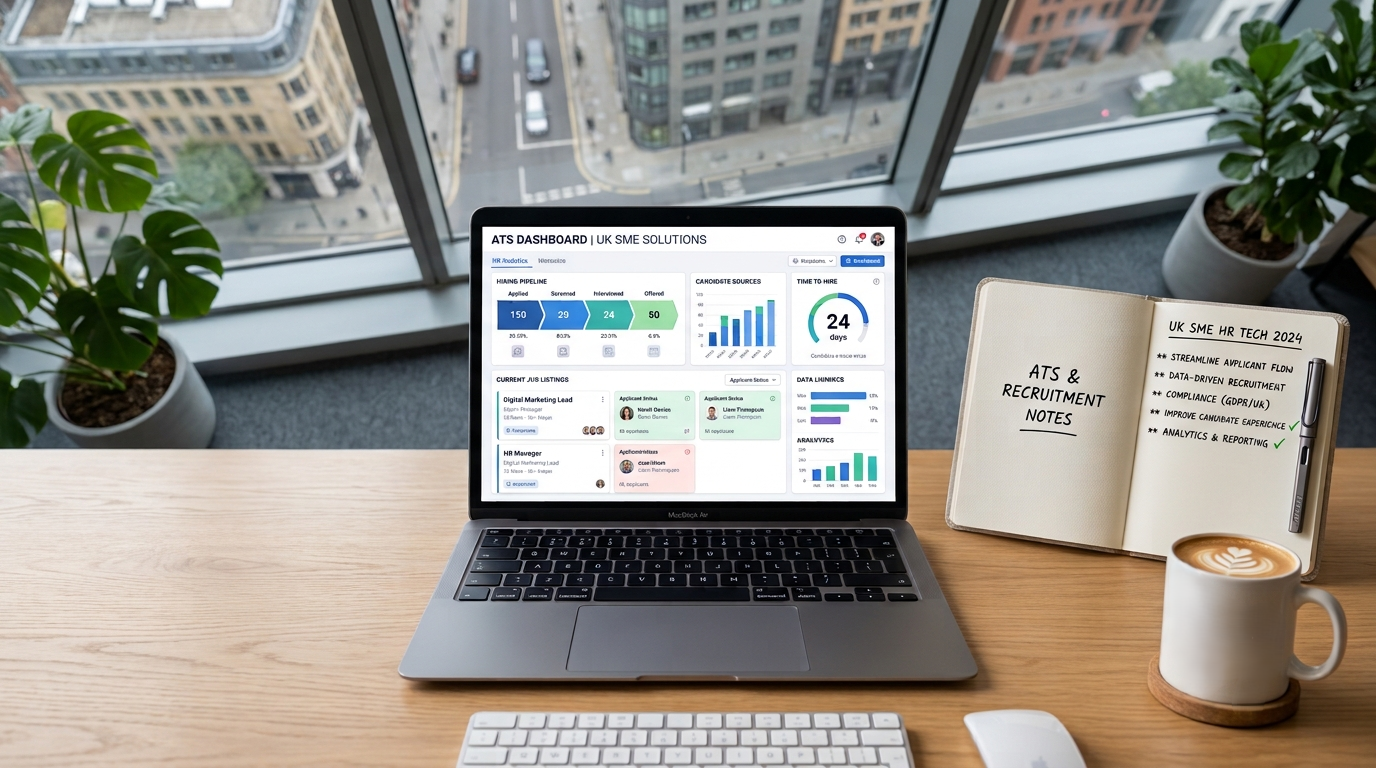
Most UK SMEs buy an applicant tracking system six months too early, pick the wrong one, and build their entire hiring process around a tool they do not yet understand. The demos are good. The sales decks are better. By the end of a 45-minute walkthrough, a Head of People at a 90-person company is being told that posting jobs on three boards and shortlisting in a shared inbox is a crisis.
It usually is not. And buying an applicant tracking system UK at the wrong moment, from the wrong vendor, for the wrong reason, is one of the most expensive HR technology mistakes a growing company makes.
This is the pre-purchase decision an SME founder, Head of People, or HR Director needs to make before booking a single demo. It is not a vendor review. It is the framework the vendors do not want you to apply.
At its simplest, an applicant tracking system is a database that collects job applications, tracks candidates through hiring stages, and stores the audit trail of what happened and why.
That definition has not changed in twenty years. What has changed is what sits on top of the database. In 2026, an applicant tracking system UK buyers are evaluating is almost always layered with AI features: CV parsing, candidate matching, interview scheduling, scorecards, workflow automation, and, increasingly, generative AI drafting assistants for job descriptions and candidate communications.
That layer is where most of the money is going, and most of the risk sits.
The UK applicant tracking system market was valued at approximately £355 million in 2023, according to analyst estimates. Dozens of UK and international vendors now compete for SME budget, each positioning themselves as the obvious answer. They are not all the same. More importantly, they are not all appropriate for your stage, your sector, or your hiring volume.
The right time to buy is when the pain of not having one is costing you more than the system will. These are the signals that tip the scale.
1. Hiring volume is breaking your current process. If you are running more than four or five live roles at any given time, or hiring more than 25 to 30 people a year, a shared inbox and a spreadsheet will start to leak candidates. Response times slip, applications get lost, and hiring managers lose track of where candidates are. If you are also seeing too many job applicants per role, the volume signal is already breaking you. Measure it before you assume it: how many days does your current best candidate wait between applying and hearing back?
2. Your team is distributed and multiple people need the same view. Two recruiters in two locations, hiring managers in a third, and a founder who wants to see pipeline weekly. If everyone is working from different versions of the same document, you have outgrown email.
3. Compliance exposure is now a boardroom question. The Information Commissioner’s Office is signalling tighter expectations around automated decision-making in hiring. The Data (Use and Access) Act 2025 reshaped automated-decision rules in February 2026. The 2024 gov.uk Responsible AI in Recruitment guidance, developed with the ICO, EHRC, CIPD and REC, raised the bar on documentation, audit trails, and candidate transparency. If a tribunal, an ICO enquiry, or a procurement due diligence process asked you to produce the full decision history of a rejected candidate from six months ago, could you?
If two of these three signals apply, start evaluating and if only one applies, keep reading before you book demos.
Vendors will not tell you this part.
1. You are hiring fewer than 15 people a year and your pipeline fits in one shared folder. At this volume, a well-structured Google Sheet with locked columns and a shared label system in Gmail or Outlook will outperform most entry-level ATS platforms, because the overhead of configuring and maintaining the ATS exceeds the admin it removes.
2. Your hiring process is not yet documented. Buying an ATS to fix a broken process never works. The tool will encode whatever process you give it. If you do not know your interview stages, your decision criteria, or who signs off on an offer, writing those down on paper is the first spend, not £3,000 a year on software. This is also where AI recruitment for UK SMEs goes wrong most often: automating a process you have not yet designed.
3. You have not run a proper vendor comparison on your actual use case. Most SMEs buy the first ATS they demo. The gov.uk SME Digital Adoption Taskforce flagged in its 2025 final report that the hardest stages for SMEs are understanding what they need and choosing the right product. If you cannot answer “what are my three must-have features and why” in two sentences, you are not ready to buy.
The applicant tracking system you buy in 2026 is a different purchase from the one you would have made in 2022. Three things changed.
AI-native versus AI-added. Some platforms were built around AI from the start. Others bolted AI on top of a 15-year-old core. The difference shows up two years in, when the bolted-on version starts breaking at scale and the vendor stops updating it. Ask the vendor directly: when was the matching engine built, and is it their own or a third-party API?
ISO/IEC 42001 and AI governance. This is the international standard for AI management systems, finalised in late 2023 and increasingly cited in UK procurement. Greenhouse achieved certification in February 2026. Pinpoint has positioned itself as one of the first ATSs globally certified to the standard. For an SME, ISO 42001 is not yet a legal requirement, but if your clients include enterprise or public sector buyers, their procurement teams will start asking whether your HR tech stack can demonstrate AI governance. The direction of travel is clear.
Transparency and the right to explanation. Under UK data protection law post-DUAA 2025, candidates have reinforced rights around significant automated decisions. If your ATS silently ranks candidates and you cannot explain to a rejected applicant why they scored where they did, you have a problem that is yours, not the vendor’s. A qualified specialist can advise on your specific obligations, but the question to ask every vendor is simple: can you produce a plain-English explanation of why this candidate was ranked below that one? This connects directly to the fair AI interview process question most SMEs have not yet answered.
Scope note: This post discusses UK data protection and AI governance as regulatory context, not legal instruction. Sabiha is not a lawyer. For organisation-specific obligations under the Data (Use and Access) Act 2025, UK GDPR Articles 22A–22D, or the EU AI Act’s high-risk recruitment provisions, consult a qualified specialist.
Vendors have refined their demos for years. They know which features light up a buyer’s eyes. Here are the questions that cut through the choreography.
Any vendor that cannot answer those questions clearly in a demo is not the vendor for a growing SME. Any vendor that answers them well is worth a second meeting.
The right applicant tracking system UK for your company today may not be the right one in 24 months. UK SME AI adoption climbed from 25% in 2024 to 35% in 2025 to 54% in 2026, according to successive British Chambers of Commerce surveys. The regulatory baseline is tightening. Candidate expectations are shifting. Review the decision annually against three questions: is the volume still right, is the compliance story still defensible, and is the AI governance keeping pace with your clients’ procurement expectations?
Hiring technology is not a one-time purchase. It is a system that needs to grow with the business, or get replaced before it holds the business back.
UK ATS pricing for SMEs typically runs from around £2,000 to £15,000 a year, depending on headcount, feature tier, and whether AI modules are included. Entry-level platforms start at £50 to £200 per user per month. Mid-market platforms with AI matching, structured scorecards, and compliance tooling usually sit between £6,000 and £12,000 annually. The fully loaded first-year cost is almost always higher than the sticker price once implementation, integrations, and training are included. Ask every vendor for the fully loaded first-year figure in writing.
Not all of them. If you are hiring fewer than 15 people a year and your pipeline fits in one shared folder, a structured spreadsheet and a shared inbox will often outperform an entry-level ATS. The signals that genuinely warrant one are hiring volume breaking your current process, distributed teams needing a shared view, and compliance exposure now surfacing at board level. Two of those three signals is the threshold.
Honest implementation timelines run from two weeks for a basic deployment to three or four months for a mid-market platform with integrations, custom workflows, and hiring manager training. Vendor claims of “live in days” usually refer to the technical setup, not to the point at which the team is actually using the system well. Build the longer timeline into your decision, and ask the vendor how many hours of your team’s time the implementation will consume, not just how many calendar weeks it will take.
There is no single best ATS in the UK, which is why vendor rankings keep contradicting each other. The right platform depends on your hiring volume, your sector, your compliance exposure, and whether your clients will ask about AI governance in procurement. UK-founded platforms such as Pinpoint, Eploy, Jobtrain and Talos360 are built around UK compliance from day one. International platforms such as Greenhouse and Workable bring deeper AI feature sets. Match the platform to your use case, not to the review-site ranking.
No. GDPR and UK GDPR compliance is a shared responsibility between the vendor and the employer. The vendor is responsible for the technical infrastructure, data hosting, and security controls. The employer is responsible for lawful basis, retention periods, candidate transparency, and the decisions the system supports. Buying a “GDPR-compliant ATS” does not transfer your obligations as data controller. A qualified specialist can advise on your specific position.
ISO/IEC 42001 is the international standard for AI management systems, finalised in late 2023. It is not yet a legal requirement in the UK, but it is increasingly cited in enterprise and public sector procurement. Greenhouse achieved certification in February 2026. Pinpoint has positioned itself as one of the first ATSs globally certified. For an SME, the question is less “is my ATS certified” and more “can my ATS vendor demonstrate credible AI governance if a client asks”. The direction of travel is clear.
Honest implementation timelines run from two weeks for a basic deployment to three or four months for a mid-market platform with integrations, custom workflows, and hiring manager training. Vendor claims of “live in days” usually refer to the technical setup, not to the point at which the team is actually using the system well. Build the longer timeline into your decision and ask the vendor how many hours of your team’s time the implementation will consume, not just how many calendar weeks it will take.
About Sabiha
Sabiha is a Talent Acquisition Director, speaker, and author with 16+ years of global hiring experience across the UK, Dubai, South Africa, and Malaysia. She advises UK SMEs on AI-enabled hiring and retention as a vendor-free practitioner, has supported 300+ businesses, and was shortlisted for Best Career Coach UK by the Career Development Institute. Her book How to Use AI to Win Talent and Retain People is published by Trotman in Autumn 2026 and is CIPD-aligned.
Weighing an ATS purchase or an AI hiring tool decision? Book a strategy call at meetsabiha.com.

Global Talent. Ethical AI. Strategic Hiring. Sustainable Retention.