


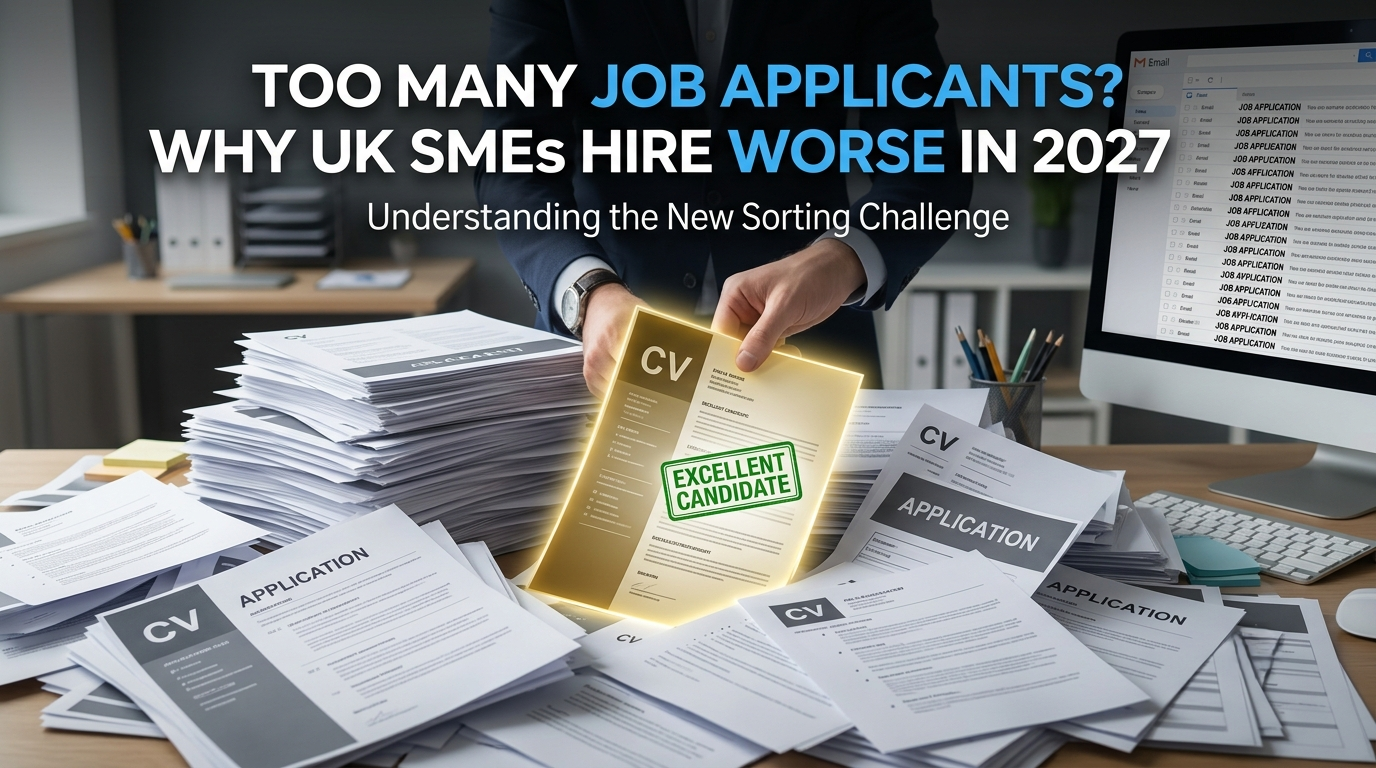
Post one operations role this month and you will be reading applications by Thursday evening. Not forty of them. Closer to two hundred.
Most will be competent. A lot will be near-identical. Two or three will be genuinely excellent, and there is a fair chance you will never reach them, because by application ninety your attention has gone and you are skim-reading for reasons to say no.
UK hiring has quietly flipped from a scarcity problem to a sorting problem. Almost nothing about how small teams hire has changed to match. The advice most SMEs are given is to narrow the funnel until the volume becomes manageable, and that advice is making shortlists worse while appearing to help.
Expect somewhere between 25 and 55 applications for a typical SME role, not the 140 figure you have seen in the headlines.
The number doing the rounds this month comes from the Institute of Student Employers, whose Student Recruitment Survey 2026 launched on 14 October. It analyses data from 155 large employers, covering more than 1.7 million applications and 31,577 hires across the 2025 to 2026 recruitment cycle, and it puts competition at 141 applications per graduate vacancy, rising to 172 in London.
That figure is real. It is also not yours. It describes structured graduate schemes run by large, well-known employers with campus brands, open application windows and a marketing budget behind them. A 90-person engineering firm in Leicester advertising a quality manager is operating in a different market entirely.
Provider data from UK job-board campaigns gives a more useful anchor. One recruitment provider reporting on its own client postings recorded a median of 51 applications per advert in Q3 2026, up 13% on the same quarter a year earlier. Wider market estimates across recent quarters have ranged from the high teens to the mid-forties, with retail and hospitality roles regularly going past 100.
So the honest planning assumption for most SME roles sits in the 25 to 55 range, with a long tail for anything customer-facing, entry-level or fully remote. Knowing which number applies to you matters more than it sounds, because the fixes for 40 applications and the fixes for 400 are not the same, and almost all of the published advice is written for the second.
The more useful measure is not the count at all. It is the ratio of applications to interviews, and whether that ratio is the result of a decision you made or the point at which the person reading ran out of patience.
Fewer vacancies, one-click applying and AI drafting have together removed almost all of the effort cost of applying.
Office for National Statistics figures published on 15 September put UK vacancies at 702,000 for June to August 2026, the lowest level outside the pandemic since 2014 and down 36,000 on the year. There were 2.5 unemployed people for every vacancy in May to July 2026, up from 2.3 twelve months earlier.
Fewer doors, more people. That alone pushes applications per advert upwards.
The second change is mechanical. Applying to a job used to cost a candidate an evening. It now costs a few seconds, and an AI assistant will produce a plausible, tailored-looking cover letter for every role in a saved search without the candidate reading any of them.
Someone facing those odds is behaving rationally when they apply to eighty roles instead of eight. The individual decision makes sense. The aggregate effect is that the signal you used to read from a well-written application, namely that this person cared enough to do the work, has largely disappeared.
The ISE data shows where that lands for employers. 92% of surveyed employers had suspected or identified candidate AI misconduct somewhere in selection, up from 85% a year earlier, and 66% specifically identified undisclosed AI use during interviews. Only 16% of the same group currently use AI in recruitment themselves.
Candidates industrialised applying two years ago. Employers have not industrialised reading. That gap is the entire problem, stated in one sentence.
It reduces volume, but it removes the wrong people first.
The standard advice is to write a narrower specification, add knockout questions and make the application form longer. All three work, in the sense that fewer people finish. The question nobody asks is who stops.
Long application forms filter for available time and persistence, not for capability. The person who completes every field of a 25-minute form is disproportionately the person applying to everything, because they are out of work and they have the hours. The person already employed and performing well in a similar role will abandon it halfway through, because they are browsing on a Sunday evening and they have a job to go to on Monday.
Strict years-of-experience gates do something worse. They screen out career changers, returners and people whose relevant experience sits under a different job title, which is exactly the group that skills-based hiring is designed to reach. If you have spent a year opening up how you hire, bolting a knockout question onto the front of the form can undo that work in a single afternoon.
Narrow the advert where it genuinely removes mismatches rather than people. Publish the salary. Describe what the job actually involves on a normal Tuesday. Name the two or three things that are truly non-negotiable and leave everything else out. Then stop, because every additional gate beyond that point is buying you a shorter list at the price of a worse one.
Write your shortlist criteria before the advert goes live, then score against them instead of reading in arrival order.
Most SME hiring runs the other way round. The advert goes out, the applications land, and the criteria get formed while reading, which in practice means they get formed by whoever applied first. The third CV becomes the benchmark. Everything after it is judged against a person who was simply early.
Four changes make the difference, and none of them need software.
There is a fifth step that costs almost nothing and pays back for years. Write your rejection message once, properly, and send it to everyone. Silence is the single most expensive thing a small employer does at volume, and it is entirely avoidable.
None of this is new thinking. It is simply rarely done in a business with no recruiter, where hiring is something the operations director fits around everything else. That is precisely why it is worth building once and reusing for every role afterwards.
AI is strong at structuring and summarising a pile against criteria you set, and weak at judging who is good.
The useful applications are narrow and unglamorous:
What it should not do is reject anybody. Automated rejection at volume is where small teams create problems they cannot see, and it is where the quality loss hides, because the model optimises towards similarity with the people you already hired. There is more on where the line sits in my piece on AI CV screening and on which parts of recruitment are worth automating.
Treat AI as a reading assistant that prepares the pile and keep the decision with a person. That distinction is the difference between a hiring process that scales and one that quietly narrows every single year without anyone noticing.
Slower hiring, a shortlist narrower than you think you have, and a steady drift back towards hiring people you already know.
The time cost is the visible part. Two hundred applications at ninety seconds each is five hours out of somebody’s week, and it is almost never in anyone’s objectives or anyone’s budget.
The invisible costs are larger. Candidates who hear nothing talk, and in a 90-person business in a regional market the people they talk to are your next applicants and sometimes your customers.
Then there is the default. When a process overwhelms the person running it, they fall back on the familiar: the internal referral, the person a colleague worked with before, the CV that most resembles the last hire who worked out. That is how a business with 200 applicants ends up with a narrower and less capable shortlist than a business with 30.
There is a timing argument too. The KPMG and REC UK Report on Jobs published on 8 October recorded permanent placements rising for a second consecutive month, the strongest increase in four years, while the growth in candidate availability slowed to its weakest pace in three years. The flood of available people is not a permanent feature of this market. The habits you build while it lasts are the habits you will be hiring with when it tightens again.
Stop reading harder. Decide what good looks like, write it down before the advert goes live, and build a process that can hold 200 applications without collapsing into the first familiar name. The volume is not going back down. Sorting well is the job now.
There is no number that makes a process good or bad. A role attracting 40 applications with no written criteria is in worse shape than one attracting 300 with a scorecard. Watch the ratio of applications to interviews, and whether that ratio came from a decision or from the point at which the reader gave up.
Closing early is reasonable once you have enough scored applications meeting your must-haves. It is unreasonable when you simply have enough to read. Strong candidates who are currently employed often apply late, in the evening or at a weekend, so closing on day three systematically removes them.
It can summarise and rank applications against criteria you define, which saves real time. Letting it reject automatically is a different decision and a riskier one, because you lose sight of who was removed and why.
Usually because the advert is broad, the application is frictionless, and nothing in the process asks for evidence early. Volume rises while evidence stays flat, so the proportion of strong applications falls even when the absolute number of strong applicants holds steady.
AUTHOR
Sabiha is a Talent Acquisition Director, speaker and author with 16 years of international hiring experience across the UK, Dubai, South Africa and Malaysia. She has advised more than 300 businesses on hiring and retention, was shortlisted for Best Career Coach UK by the Career Development Institute, and is the author of a forthcoming book on using AI to win talent and retain people, published by Trotman. She works with UK SMEs building AI-enabled hiring and retention systems.

Global Talent. Ethical AI. Strategic Hiring. Sustainable Retention.