

A founder sent me a job ad last month and asked why nobody good was applying. She had used ChatGPT to write it. The opening line was, and I am not exaggerating, “We are a dynamic, fast-paced company looking for a rockstar to join our journey.”
She was not doing anything unusual. This is what happens when a small business types “write me a job description for a marketing manager” into an AI tool and pastes the output onto the careers page. The result reads like every other ad on the internet, because it was trained on every other ad on the internet. The problem is not the tool. It is what we accept when it hands back something plausible.
Because generic prompts produce generic outputs, and most SMEs are giving AI tools almost nothing to work with.
Ask ChatGPT or Copilot to write a job description for a sales manager and it will draw on the millions of near-identical ads it was trained on. You get a passive summary, a bullet list that could apply to any company, and a requirements section full of “strong communication skills” and “proven track record.” It is technically a job description. It is also invisible.
Research from job platform Applied found that strong masculine-coded language drops female applications by up to 10 percent (People Management coverage). A Michael Page analysis put the share of UK job ads carrying gender-biased wording at 52 percent. Most of it is unconscious. Words like “driven,” “individual,” “aggressive” and “lead” all tilt masculine. Paste an AI draft without editing and you are shipping some version of that same problem.
The generic voice does not just cost you diversity. It costs you specialists. People with options do not apply for roles that sound like they were written for anyone.
Three things: no context, no editing, and no test of whether the ad actually reflects the role.
The first is prompt starvation. A one-line prompt tells the AI nothing about your company, your team, the reason the role exists, or what a good hire will do in the first ninety days. You are asking a stranger to describe your business.
The second is treating the first draft as the final one. AI is useful for scaffolding, not for ghostwriting. Skip the edit and you publish something anyone could have generated in fifteen seconds. Candidates can tell.
The third is the biggest. Many hiring managers write job descriptions without ever asking the person currently doing the job what the job actually is. AI does not fix that. It amplifies it. You end up hiring for a fantasy version of the role, which connects to the wider issue I wrote about in designing jobs for skills, not CVs. If you cannot describe the skills the role needs, no writing tool will save you.
Specificity, honesty about what the role is, salary transparency, and language that sounds like a human wrote it.
The February 2026 Omni survey of 739 UK candidates found that 56 percent said honest job descriptions, including clear salary and role expectations, would increase their trust in an employer (Staffing Industry Analysts coverage). Candidates are actively filtering out ads that hide the salary or promise a “family culture” without saying what that means.
The CIPD Resourcing and Talent Planning survey has shown for years that 52 percent of UK employers see unsuitable applicants as a top hiring frustration. Vague ads produce vague applicants.
The ads that work in 2026 open with why the role exists, list the outcomes the person will own, state a real salary band rather than “competitive,” and describe the team in plain language. Not complicated. Takes more thought than a one-line prompt.
As a first-draft partner, not a replacement for the thinking. Give it context, ask it to challenge your brief, and edit hard.
The workflow I use with clients has five steps.
Start with a proper brief. Before touching AI, write down why the role exists, what the person will own in year one, non-negotiable versus nice-to-have skills, and your real salary range. If you cannot answer these, no writing tool will save the ad.
Feed the AI real context. Give it the brief, your last three job ads, and a paragraph on your company in plain language. Ask for a first draft in that voice.
Ask it to challenge you. A prompt I use often: “What is missing from this brief that a strong candidate would want to know? What sounds vague? What could carry bias?”
Edit for voice. Read out loud. Rewrite anything that sounds like a press release. Cut “rockstar,” “ninja,” “guru” and “passionate.” Applied’s gender decoder is a useful free flag.
Test on a real person. Send it to someone currently doing that role or someone you would like to hire. Ask what would put them off. Worth more than any AI critique.
Only if you treat it as an assistant with known blind spots. AI systems have been shown to reproduce and sometimes amplify existing hiring biases.
The Information Commissioner’s Office audited AI recruitment vendors in November 2024 and found tools filtering on protected characteristics and inferring them from names. It issued around three hundred recommendations (ICO AI in recruitment). Its March 2026 Recruitment Rewired review signalled that too many UK employers were treating AI outputs as decisions rather than inputs.
For job descriptions the risks are subtler than for CV screening. The tool will not filter anyone at the draft stage. What it can do is quietly nudge you toward language that skews who applies. That is your responsibility.
The Equality Act 2010 has always applied to job advertising. Current ICO signalling is that employers understand what their tools do and keep humans meaningfully in the loop. This is talent acquisition perspective, not legal advice. A qualified UK employment law specialist can help set the guardrails.
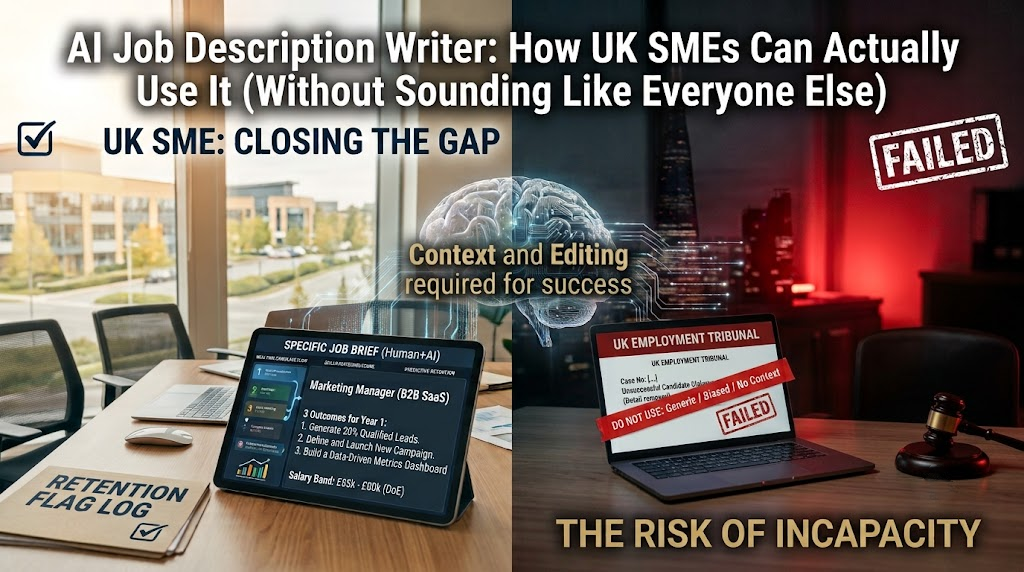
A structured prompt with role context, company context, skills brief, tone guidance, and an editing challenge.
The shape that produces something worth editing has four blocks.
Role context: why the role exists, three outcomes they will own in year one, who they report to, location and pattern.
Company context: size, sector, what you do for customers in plain English, one genuine trade-off about working there.
Skills brief: non-negotiable skills, nice-to-haves, real salary range, whether a degree is required.
Editing challenge: “Draft in a warm, specific, human voice. Avoid generic corporate language. Flag any wording that could carry gender or age bias. Tell me what is missing that a strong candidate would want to know.”
That last line changes the output more than anything else. Same discipline as AI-powered employer branding. Tools are only as good as the thinking behind them.
Yes, but the gain is compound, not viral.
A specific, honest ad rarely triples applications overnight. It shifts the quality mix. Fewer speculative AI-generated applications, more from people who read the ad and thought, yes, that is me. It matters for screening too: if your ad is specific, your AI CV screening has something concrete to match against. Vague ads produce noisy shortlists. It starts with the words on the page.
Use it as a drafting partner, not as the writer. Without your brief, your voice and your editing, the output will be generic and probably slightly biased. Treat it like a junior copywriter who has never worked at your company.
There is no rule against using AI to draft an ad. What matters is what the ad says once published. The Equality Act 2010 applies whether a human or AI wrote the first draft, and you are responsible for the content. This is not legal advice.
Not editing. Hiring managers paste the first draft onto the careers page because it looks fine. It is fine. It is also invisible. Every competitor is doing the same thing.
Yes. The Omni February 2026 survey found clear salary is one of the strongest trust signals for UK jobseekers. If you cannot state a real range, you are usually not clear enough on the role to advertise it well.
Sabiha is a Talent Acquisition Director, Speaker and Author with over sixteen years of international hiring experience across the UK, Dubai, South Africa and Malaysia. She has worked with more than 300 businesses and was shortlisted for Best Career Coach UK by the Career Development Institute. Her book on using AI to win talent and retain people, published by Trotman and aligned with the CIPD Profession Map, is out autumn 2026.

Global Talent. Ethical AI. Strategic Hiring. Sustainable Retention.