

A note on scope. This post gives regulatory context, not legal advice. Sabiha is not a lawyer. Any organisation deploying AI-scored assessments should have a qualified UK data protection or employment law specialist sign off the specific setup.
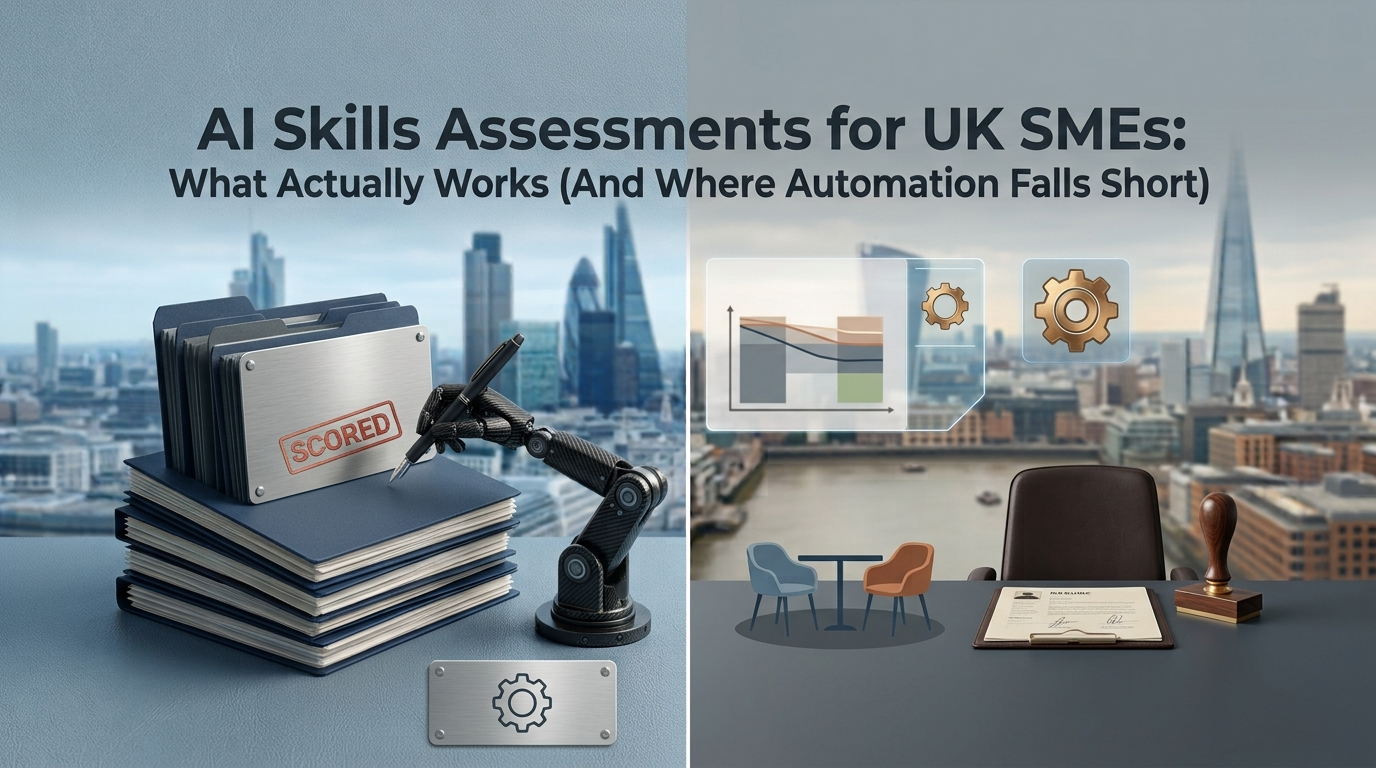
A candidate can pass a screening interview, accept the offer, start on Monday and quit by Friday. That happens because most hiring processes measure what someone says they can do, not what they can actually do. Skills assessments try to close that gap. Now AI has arrived to make them faster, cheaper and, according to every vendor deck currently sitting in an HR inbox, fairer.
Some of that is real. A lot of it is not. And the UK regulatory picture has shifted enough in the last twelve months that “we bought a tool” is no longer a defensible answer.
Because a CV has become an unreliable signal. AI-written applications, inflated titles and identical-sounding personal statements have flattened the top of the funnel. If two-thirds of applicants sound the same on paper, the only way to distinguish them is to see them do the work.
Skills-based hiring also opens access to people your job description would otherwise reject. UK SMEs competing for scarce talent cannot afford to filter out capable candidates because they took a non-linear route.
This is one reason we covered the AI CV screening problem and how to write job descriptions with AI properly in earlier posts. Assessments are the third leg of that stool.
Most of them do not, at least not on their own. The most-cited evidence base in industrial psychology, Schmidt and Hunter’s meta-analysis and its 2016 update by Schmidt, Oh and Shaffer, ranks the strongest predictors of job performance in a fairly consistent order.
General mental ability tests sit at around 0.51. Structured interviews sit at around 0.51. Work sample tests were originally estimated at 0.54 but were revised down to around 0.33 in later studies. A further revision by Sackett and colleagues in 2022 pulled several figures lower still.
Two lessons come out of that. First, no single assessment is a magic filter. Second, combinations do better than any component. Pairing a work sample with a structured interview outperforms either method alone.
For a UK SME, that means the goal is not to pick the best AI assessment tool on a G2 leaderboard. The goal is to build a small, defensible stack of two or three complementary methods, each measuring something the job actually requires.
Three places, honestly.
Marking at scale. AI can score structured technical exercises, coding tasks and written work more consistently than a rotating panel of humans doing it in evenings.
Adaptive difficulty. Some platforms adjust question difficulty based on responses, shortening the assessment without losing signal.
Pattern flagging. AI can highlight unusual response patterns for human review. Someone completing a two-hour exercise in eight minutes, or answering every question to the second in the same time.
Where it is not adding value: personality inference from video, culture-fit scoring, and anything that claims to predict performance from tone of voice or facial micro-expressions. The ICO’s vendor audit was direct that inferring demographic characteristics from proxies such as names is not accurate enough to use, and may be unlawful without a valid basis.
Candidates now have AI too. Live interview copilots, real-time answer generators and desktop tools that sit outside the browser have made unsupervised online assessments significantly less reliable than they were two years ago.
Proctoring vendors have responded with behavioural detection: flatline response times, gaze tracking, environment analysis. Some of that works. Some of it introduces its own bias, particularly against neurodivergent candidates and those in noisy home environments.
The practical response, at least until the tooling settles, is to use short live exercises with a real person in the room, whether virtually or otherwise, rather than long unsupervised tests. It is slower. It is also honest signal.
Enough that this is worth reading properly before you buy anything.
The ICO’s Recruitment Rewired report, published March 2026, found that many UK employers using AI in hiring believed they were operating decision-support tools when the regulator’s evidence suggested those tools were making solely automated decisions. The Data (Use and Access) Act 2025 replaced Article 22 with new Articles 22A to 22D on 5 February 2026, changing the framework but not softening the expectation that meaningful human involvement must be real, not nominal.
Practically, if you are using AI to score assessments, you need a Data Protection Impact Assessment done early, evidence of meaningful human review at any stage that affects a candidate’s progression, documentation from your vendor showing what the tool measures and how it was tested, and a route for candidates to contest a decision.
That last one, contestability, is often the missing piece.
Keep it small. Three components, each doing one job well.
Then run the whole thing through the DSIT Responsible AI in Recruitment principles: safety and robustness, transparency and explainability, fairness, accountability and governance, and contestability and redress. If your process cannot answer one of those five, that is where to start.
Most SMEs do not need a specialist AI assessment platform. A structured interview and a scored work sample outperform most tools on the market. AI becomes worth the money at higher application volumes, or where marking a specific technical exercise is genuinely a bottleneck.
Yes, if you meet the requirements. That includes a Data Protection Impact Assessment, meaningful human involvement in decisions with significant effects on candidates, and a route for candidates to contest a decision. The framework sits under Articles 22A to 22D of UK GDPR since 5 February 2026. This is regulatory context, not legal advice. A qualified UK data protection specialist should sign off your specific setup.
Using them without a scoring rubric. An assessment without a framework becomes another gut-feel decision, dressed up as objectivity.
For now, prefer short live exercises to long unsupervised ones. Assume any take-home assignment will be AI-assisted to some degree, and design tasks that test judgment rather than just output.
About the author Sabiha is a Talent Acquisition Director, speaker and author with 16+ years of experience across the UK, Dubai, South Africa and Malaysia. She has advised 300+ businesses on hiring, retention and AI-enabled workforce strategy, and was shortlisted for Best Career Coach UK by the Career Development Institute. Her book on using AI to win talent and retain people is published by Trotman in Autumn 2026

Global Talent. Ethical AI. Strategic Hiring. Sustainable Retention.