

This article discusses workforce skills assessment from a talent acquisition perspective. It references the UK regulatory environment as context, but is not legal advice. For specific compliance decisions, consult a qualified UK data protection or employment law specialist.
A managing director in the Midlands told me last year that his business had a recruitment problem. Four roles open for most of the year, agency invoices climbing, nothing landing. We spent an afternoon pulling those four roles apart. Two of them were already being done, unofficially and badly, by people on his payroll who had never been asked whether they could do them properly. One role did not need to exist at all.
He did not have a recruitment problem. He had never looked properly at what his own people could already do.
That is the gap a skills gap analysis closes. And most SMEs in the 51 to 200 band have never run one.
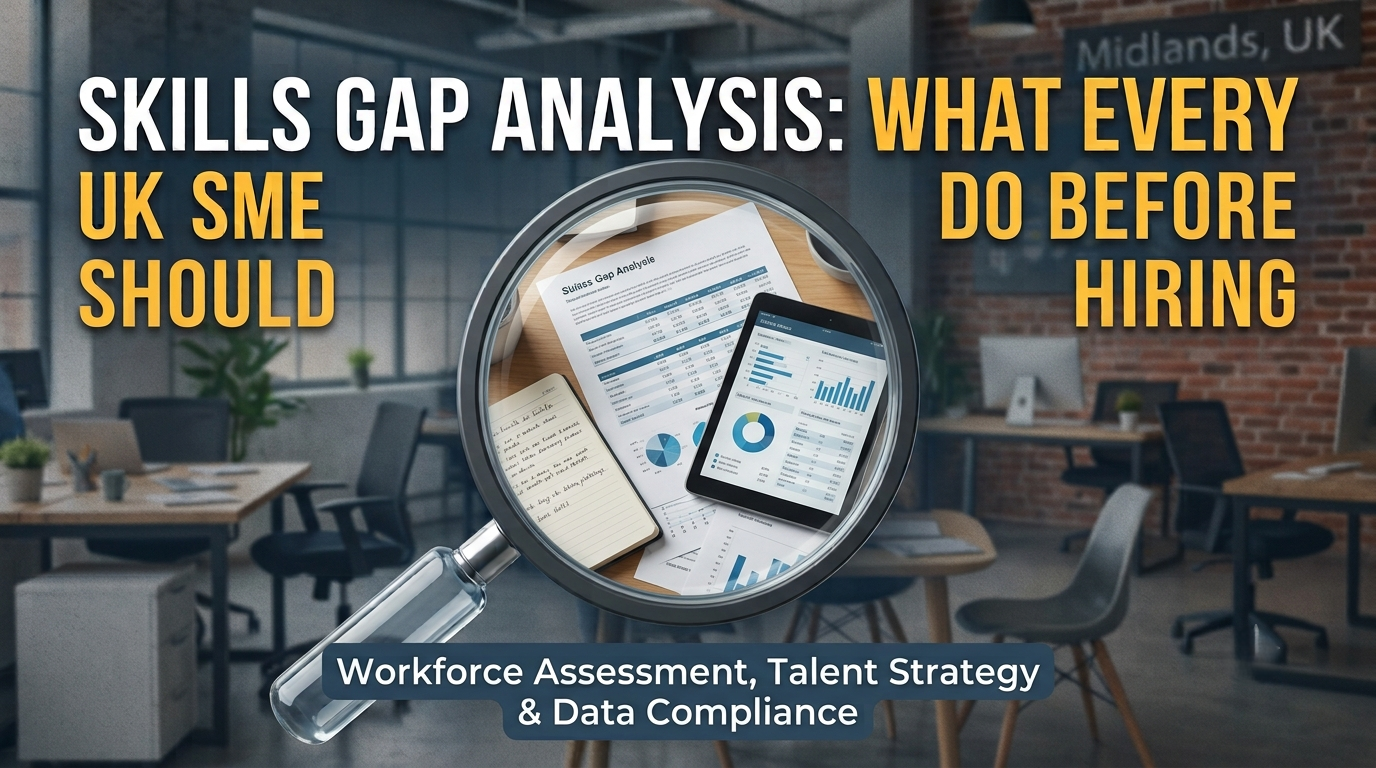
A skills gap analysis is a structured comparison between the capabilities your business needs over the next twelve to eighteen months and the capabilities it currently holds. Not job titles. Not headcount. Capabilities.
SMEs skip it for an honest reason. It feels like a large-company exercise, the sort of thing that arrives as a spreadsheet from a consultancy and dies in a shared drive. There is also a quieter reason. Asking what your team cannot do means finding out, on the record, and then owning what you do about it. Hiring is easier. Hiring feels like progress.
The cost of skipping it shows up later, usually as an expensive external hire for a capability that was sitting two desks away.
The official picture is more encouraging than the headlines suggest, and more misleading than it looks. The Employer Skills Survey 2024, run by the Department for Education with Skills England across 22,712 employers, found 12% of employers reporting at least one member of staff who was not fully proficient. That covers 1.26 million employees, or 4.0% of the UK workforce. Both figures are the lowest recorded in the survey series.
Then look at the breakdown by size. Skills gap incidence rises from 4% among sites with two to four employees to 38% among those with a hundred or more. Density follows the same curve, from 1.8% to 4.6%.
Read that carefully. Larger employers are not less capable. They are better at seeing. They have the appraisal systems, the competency frameworks and the managers with time to notice. A fifty-person business with the same underlying gaps often reports none, because nobody has ever measured.
Meanwhile the demand side keeps moving. Skills England’s Annual Skills Report 2026 projects that demand for priority occupations will grow by roughly a quarter over the next decade, around 1.8 million additional workers by 2035. It also notes that employer investment in training continues its long decline, and that SMEs in particular struggle to engage with the skills system at all. Training spend per employee fell to £1,700 in 2024, down from £1,960 in 2022.
Fewer employers training. Rising demand for skills. That combination does not resolve itself through recruitment.
Start with the commercial plan, not the org chart. What is the business committing to over the next eighteen months, and what does delivering that actually require someone to be able to do?
Write those requirements as capabilities. “Can build and interpret a rolling cash forecast” is a capability. “Finance Manager” is a job title, and job titles hide as much as they reveal. This is the same discipline behind skills-based hiring, applied inward rather than outward.
Then rate what you have. Two ratings per capability, one from the line manager and one from the person doing the work. The gap between those two ratings is often the most useful thing you will find all week. Managers routinely underestimate what junior staff have quietly taught themselves.
Look at where work queues. If one person is the bottleneck for a whole process, that is a single point of failure and a skills gap wearing a disguise.
Finally, sort every gap into build, buy or borrow. Build means training or a stretch assignment. Buy means recruit. Borrow means contract or partner. Most SMEs default to buy for everything, which is why hiring budgets feel permanently stretched.
AI is good at the structuring work, which is the part that usually kills the exercise before it starts. It can turn a folder of inconsistent job descriptions into a common capability list, cluster free text responses from a staff survey into recognisable themes, and flag where two departments are describing the same capability in different language. Work that would take an HR lead three weeks can take an afternoon.
What AI cannot do is judge proficiency, or decide which capabilities carry commercial weight in your business. That judgement stays with people who know the work.
There is a wrinkle worth naming. Skills England’s own research, published in June 2026, found that AI adoption is running ahead of workforce capability, with much of the learning happening informally through trial and error and online videos. So AI literacy is frequently a genuine gap in its own right, and it rarely appears on anyone’s competency framework. If you run an analysis and nobody raises it, ask directly. I have written separately about why AI literacy is proving the hardest skill to hire for.
Proficiency ratings about named individuals are personal data, and once you attach automated scoring to them the regulatory picture changes.
Since 5 February 2026, the rules on automated decision-making in the UK sit in Articles 22A to 22D of the UK GDPR, introduced by section 80 of the Data (Use and Access) Act 2025. The direction of travel is more permissive than the previous framework, but it is safeguard-led rather than unconditional. Where a significant decision about someone is made without meaningful human involvement, the expectation is transparency, a route to human review, and the ability to contest.
The signal from the regulator is worth reading closely. In its Recruitment Rewired report, published in March 2026 after engagement with more than 30 employers, the ICO found that many organisations believed a human was making the decision when the evidence suggested the tool effectively was. A scored output that a manager glances at and approves is the pattern the ICO flagged.
Applied here, that means being straightforward with staff about what is being assessed and why, keeping the judgement with managers rather than the model, and thinking carefully before an AI-generated proficiency score feeds anything that affects pay, promotion or redundancy. A qualified UK data protection or employment law specialist can advise on your specific setup.
Act on three things, not thirty. A skills gap analysis that produces a forty-row action plan produces nothing.
Take the gaps that block the commercial plan, and address those first. Fill from inside where you credibly can, because internal moves are faster, cheaper and visibly good for retention. Recruit for what genuinely does not exist in the building.
Then rerun it in twelve months. The value is not in the snapshot. It is in the trend.
I have pulled every retention habit that works for a business of your size into one place: employee retention strategies for UK SMEs.
Two to four weeks of elapsed time if it is scoped properly, with perhaps five to eight days of actual effort spread across an HR lead and line managers. The most common failure is scope creep. Cover the roles that deliver your commercial plan first, and leave the rest for the next cycle.
No. A framework is useful, but waiting for one is how this gets postponed indefinitely. Start with a plain capability list for your priority roles and let the framework emerge from what you learn.
Yes, and plan for it before you start. An assessment that people experience as a secret scoring exercise damages trust quickly, and it produces worse data because nobody answers honestly. Share individual results with individuals and treat gaps as development conversations.
About the author
Sabiha is a Talent Acquisition Director, speaker and author with more than 16 years of international hiring experience across the UK, Dubai, South Africa and Malaysia. She has advised over 300 businesses on hiring and retention strategy and was shortlisted for Best Career Coach UK by the Career Development Institute. She works with UK SMEs on AI-enabled talent acquisition, and was her own first client.

Global Talent. Ethical AI. Strategic Hiring. Sustainable Retention.