

In July, close to 200 HR professionals joined a Personnel Today webinar on the coming unfair dismissal reforms. Asked whether their line managers had any training in running probation, 52.9 per cent said no. Another 11 per cent did not know.
That second group worries me most. In 16 years of hiring across the UK, Dubai, South Africa and Malaysia, I have found that the gaps which hurt a business are rarely the ones it can see.
The probation period changes UK employers are now preparing for do not rewrite probation law at all. They change the ground probation stands on from 1 January 2027, and for many SMEs the first people affected are already on the payroll.
| A note on scope Sabiha is a talent acquisition practitioner, not an employment lawyer. This article sets out regulatory context drawn from GOV.UK, Acas and the ICO, the direction of travel, and what practitioners are broadly recommending. For decisions about your contracts, policies or a specific employee, a qualified UK employment law specialist can advise you. |
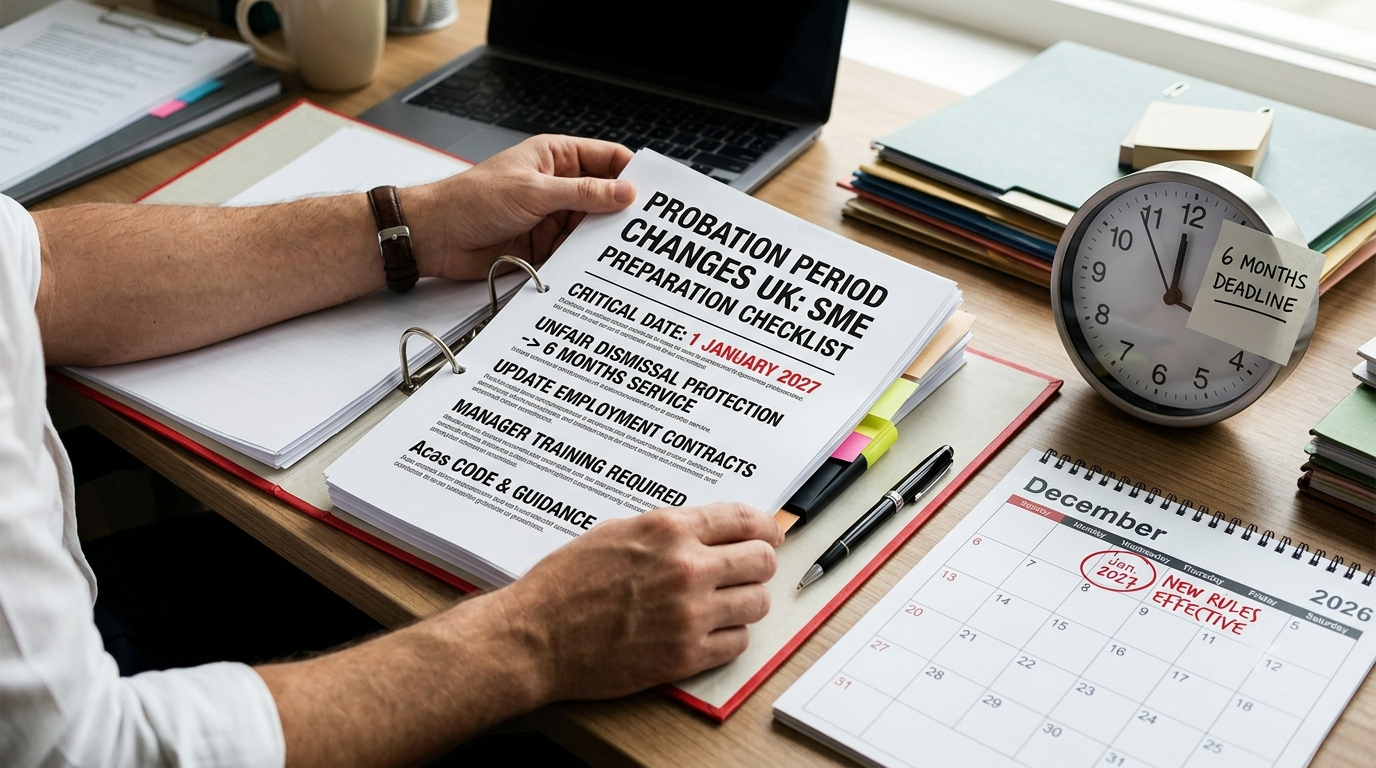
Probation law itself is unchanged. From 1 January 2027, employees gain protection from ordinary unfair dismissal after six months’ service instead of two years.
Acas is clear on the first point. The Employment Rights Act 2025 does not affect probation periods, there is still no legal requirement to have one, and they can be any length.
What changes sits around probation. The GOV.UK guidance for employers confirms that from 1 January 2027 the qualifying period for ordinary unfair dismissal drops from two years to six months, the right to ask for written reasons for dismissal moves to six months as well, and the cap on the compensatory award is removed. Day-one protections against discrimination and automatically unfair dismissal stay as they are. The changes cover England, Scotland and Wales. Northern Ireland is not included.
The cap currently sits at the lower of £123,543 or 52 weeks’ gross pay. GOV.UK points out that most awards land well below it, so this deserves some perspective. The bigger shift is practical. The first six months stop being a low-risk trial and become the window in which every decision needs a fair, documented basis.
Anyone who already has six months’ service on 1 January 2027 is protected from that day. In practice, that means everyone who started on or before 1 July 2026.
A lot of published coverage of the UK probation period changes blurs this date, so here is the simple test. Count six months from the start date. If that date falls before 1 January 2027, protection begins on 1 January. If it falls after, protection begins on the six-month date itself.
| Situation | When unfair dismissal protection starts |
| Started on or before 1 July 2026 | 1 January 2027 |
| Started 1 September 2026 | 1 March 2027 |
| Started 1 December 2026 | 1 June 2027 |
| Starts 1 February 2027 | 1 August 2027 |
| Dismissal takes effect before 1 January 2027 | Current two-year rule still applies |
One detail catches employers out. GOV.UK notes that statutory notice counts as service when working out whether a dismissal falls inside the qualifying period, whether or not that notice is actually given. Once someone has worked for you for a month, statutory notice is one week. A decision taken in the final week before the six-month mark can therefore carry that employee over the line.
Until 31 December 2026, the two-year rule still governs any dismissal that takes effect before the new year. That creates a short, uncomfortable window. Concerns about someone who joined in the spring, left unaddressed through the autumn, become a protected employee’s concerns on 1 January.
This is why practitioners are broadly recommending that probation decisions land by the end of month five rather than at a six-month review.
Since the probation period changes were confirmed, most UK practitioners point to three or four months with a short extension option. Acas cautions that one length will not suit every role.
Six months is still the default for many employers. Brightmine’s 2025 probation research found 62.2 per cent of organisations used a six-month probation, against 28.4 per cent using three months. At that July webinar, 43.9 per cent of attendees still ran probation of six months or more.
Under the new rules, a six-month probation ends at the exact point protection begins, leaving no room for a final conversation or an extension. Employment law firms are therefore broadly recommending three months, extendable by around a month, so any final decision sits comfortably inside month five.
Acas adds a counterweight worth taking seriously. Its guidance notes that ending probation before protection arrives does not remove legal risk, that employers can still dismiss fairly after six months, and that technical or specialist roles may need longer than six months for training and assessment.
My read, from the hiring side, is to set probation length by how quickly the role can honestly be judged. A sales development hire produces useful evidence within weeks. A senior engineer or a regulated finance role may not. For those roles, a short probation focused on conduct and early capability, followed by a clear performance framework that runs past month six, is more honest than stretching probation and hoping for the best.
Probation can only confirm what your hiring process already tested. With six months instead of two years, weak selection turns into risk much faster.
In my experience, most failed probations are visible before day one. A job description that never defined good performance. An interview that rewarded confidence over capability. An offer made in a hurry because the role had been open too long.
The fix is simple and rarely done: turn the scorecard you hired against into the probation objectives. Same criteria, same language. If the scorecard said the new hire would run month-end close without supervision by week ten, that becomes the question at the week-ten review. The employee has known the standard since the interview, and the manager judges against evidence rather than impressions.
I cover the selection side in depth in our guide to Employment Rights Act hiring. The other half is onboarding. Nobody can pass a probation they were never properly onboarded into, which is why structured employee onboarding belongs inside your probation plan from week one.
Written objectives from day one, reviews in the diary, concerns raised when they happen, and a recorded decision before month five.
Before day one. Share a short objectives document built from the hiring scorecard. On the start date, put two dates into your HR system: the six-month service date and a decision date four to five weeks earlier.
During probation. For a three-month probation, reviews around weeks 4, 8 and 12 give the employee a fair chance to hear feedback and improve. Keep a brief written note after every review, including the ones that go well. Raise concerns when they appear, with a clear description of what good looks like, what support you will give and by when.
The review note. Five lines is enough: the date, the objectives discussed, the evidence against each one, what was agreed, and the date of the next review. Write it the same day and share a copy with the employee. A note written three months later, when a decision is already in view, carries far less weight and reads that way.
Extensions. Extend only where the contract allows it, confirm it in writing before the original period ends, and check the extended period still finishes before your decision date.
The decision. Acas sets out what a fair probation process looks like, and its Code of Practice on disciplinary and grievance procedures is the baseline tribunals look to once someone has protection. Both are worth reading before your next review.
Managers. The July poll is the loudest signal here. If more than half of managers have no probation training, the cheapest risk control an SME has is a short session for every manager who hires, covering objectives, review notes and how to raise a concern well.
Use AI for the administration managers tend to skip, and keep every pass, extend or end decision with a person who can change the outcome.
Most probation failures I see are administrative before they are anything else. Reviews slip, notes go unwritten and the six-month date passes unnoticed. That is exactly the kind of work AI handles well.
Practical uses for an SME include drafting probation objectives from the job description and scorecard for a manager to edit, generating a short agenda for each review, turning rough one-to-one notes into a consistent written record, sending reminders when a review is overdue or a decision date is close, and helping managers phrase difficult feedback clearly and fairly.
The line to hold is the decision itself. Since 5 February 2026, section 80 of the Data (Use and Access) Act 2025 has replaced Article 22 of the UK GDPR with Articles 22A to 22D. The ICO describes automated decision-making as a significant decision based solely on automated processing, with no meaningful human involvement. The direction of travel is clear. Where AI shapes a decision about someone’s job, the ICO is signalling that a person should be genuinely involved and able to change the outcome.
Keep sensitive details, especially anything about health, out of general-purpose AI tools, and tell new starters how AI supports your probation process. If you are unsure whether your setup counts as automated decision-making, a qualified specialist can advise you.
Check who the UK probation period changes already cover, redesign probation for new starters, and train every manager who hires.
Start with a list of everyone who joined on or before 1 July 2026 and has an unresolved performance or conduct concern. From 1 January those employees have protection, so those conversations belong in this quarter, with specialist advice where needed.
Then update the documents that still assume two years: contract templates, offer letters, probation policies and manager guides. Connect your hiring scorecard to probation objectives, add decision dates to your HR system and book the manager training.
Six months is enough time to know whether a hire is working, provided the whole six months is used deliberately, starting with the job description.
Stop searching. Start hiring.
No. Acas confirms the Act does not affect probation periods. There is still no legal requirement to have one and they can be any length. What changes is the unfair dismissal qualifying period, which falls from two years to six months on 1 January 2027.
Nothing in the Act prevents it, but the employee gains protection at six months regardless of probation status. Practitioners are broadly recommending shorter probation with decisions made by month five, while Acas notes that some technical or specialist roles may genuinely need longer assessment.
No. Protection depends on length of service, not on whether someone is still on probation. An extension that runs past six months gives no extra protection from an ordinary unfair dismissal claim.
No. GOV.UK confirms the unfair dismissal changes apply in England, Scotland and Wales. Unfair dismissal law in Northern Ireland is devolved.
Yes. GOV.UK notes that non-renewal of a fixed-term contract counts as a dismissal for unfair dismissal purposes, so for staff with six months’ service the non-renewal will need to be fair.
AI can support the process, but the ICO is signalling that significant decisions need meaningful human involvement under UK GDPR Articles 22A to 22D. The safest practical position is that AI prepares the evidence and a person makes the decision.
| About Sabiha Sabiha is a Talent Acquisition Director, speaker and author with more than 16 years of hiring experience across the UK, Dubai, South Africa and Malaysia. She has advised 300+ businesses on hiring and retention and was shortlisted for Best Career Coach UK by the CDI. Her book, How to Use AI to Win Talent and Retain People, is published by Trotman in Autumn 2026. |

Global Talent. Ethical AI. Strategic Hiring. Sustainable Retention.