


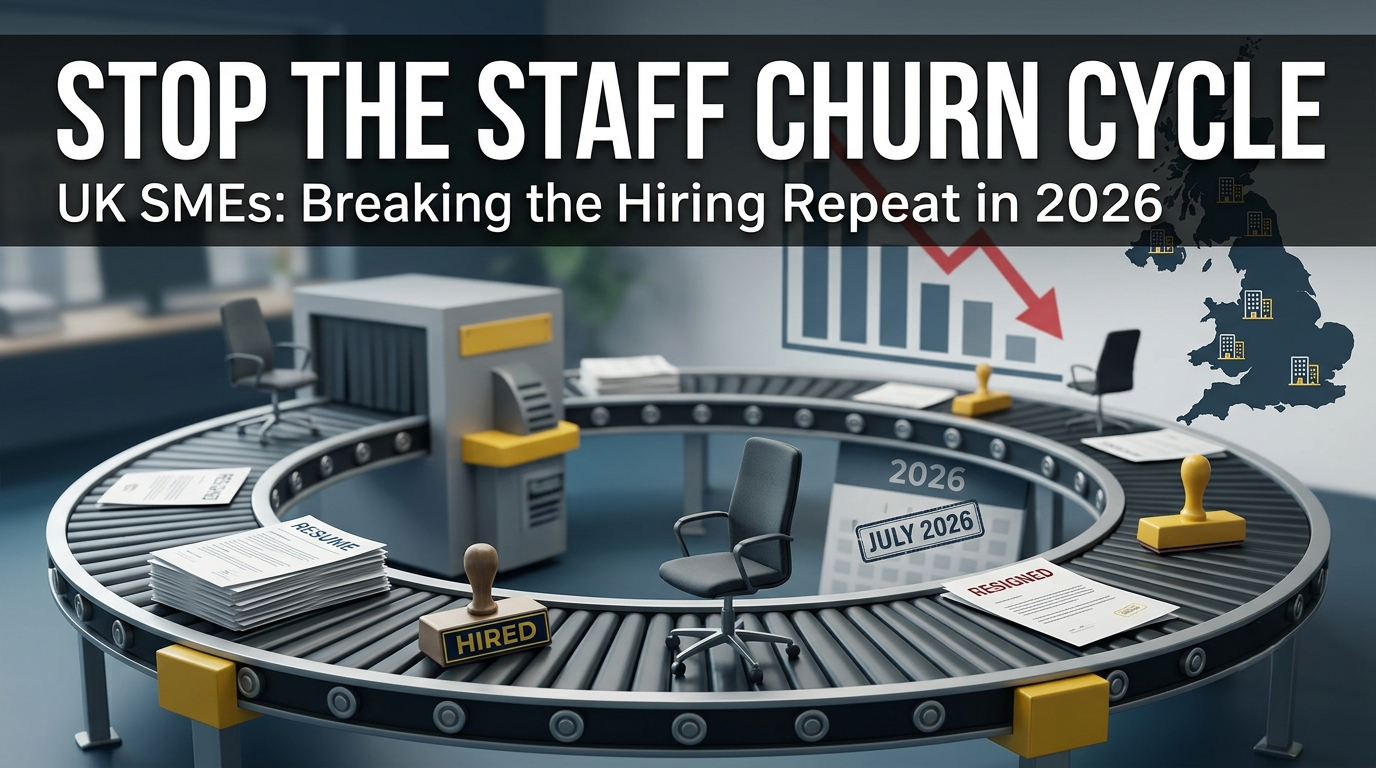
An HR director I spoke with this summer opened her Monday with what she thought was a routine task: reopen the head of operations role. Sitting down with the fresh job description, she realised it would be the third time in twenty months. Same title. Same salary band. Different person each time. She had assumed the first two were unlucky hires. Looking at the JD, she started to wonder whether the problem might actually be the role.
That is not an isolated story. It is the shape of a churn cycle, and by mid-2026 it is running quietly through a significant number of UK SMEs.
| Scope note. This post covers commercial and organisational context for UK SME HR leaders. It is not legal advice. The Employment Rights Act 2025 introduces significant new obligations from April 2026 onwards, and the wider UK regulatory picture continues to shift. A qualified employment specialist can advise you on how these apply to your organisation. |
Behind every SME churn cycle sits a retention system that was never designed.
CIPD’s Labour Market Outlook Summer 2026, published in August 2026 and drawing on responses from more than 2,000 employers, finds that 62% of UK employers plan to recruit in the next three months. The number sounds healthy until you read what sits underneath it. Employer confidence remains close to record lows outside the pandemic, and the majority of that hiring is aimed at maintaining current headcount, not growing.
Translated into the day-to-day of a UK SME, most of the recruitment happening across the country in late 2026 is replacement hiring. Roles are opening because someone left, not because the business is scaling. And when that pattern repeats around the same seat, you are not looking at a run of bad luck. You are looking at a system that produces departures on a schedule.
The wider macro picture reinforces the point. The Office for National Statistics reported 2.5 unemployed people per vacancy for March to May 2026, a ratio that has stayed at that level since summer 2025 and sits above the 1.9 recorded a year earlier. Candidates are more available than they have been in recent memory. Yet the same roles keep opening. That is not a supply problem.
You can read the wider talent context in our UK talent crisis pillar for SMEs. But the churn cycle is a different animal. It lives inside the four walls of your business, and it is fixable without waiting for the labour market to change.
Replacing one salaried employee typically costs a UK SME between one and a half and three times that employee’s annual salary once productivity gaps and knowledge loss are counted.
The Recruitment and Employment Confederation and Oxford Economics have both explored the true cost of replacing an employee, and the ranges they produce consistently sit in the 1.5x to 3x annual salary band. That range is wide because it depends on seniority, sector, and how quickly the replacement gets to full productivity. For an operations manager on £55,000, you are looking at a genuine cost somewhere between £82,000 and £165,000 by the time you count agency fees, notice-period drag, the vacancy period, onboarding time, the ramp of the new hire, and the disruption to the team.
That is the cost of one departure. Multiply it by a cycle. The head of operations who leaves in month eleven, is replaced in month fourteen, and whose successor leaves in month twenty-six, has quietly cost that SME the equivalent of a second salary line for two years. Most SMEs never build that calculation because the departures are staggered enough that no single one feels like a crisis.
We covered the mechanics of one single bad hire in our post on the cost of a bad hire in UK SMEs. What we are naming here is different. It is the cost of the pattern.
Because most UK SMEs design a hiring process and then stop. The onboarding system never gets built.
CIPD’s Resourcing and Talent Planning Report 2024, produced with Omni RMS and based on responses from over 1,000 HR and people professionals, found that 41% said new recruits always, mostly, or sometimes quit within the first twelve weeks. The same survey found that 27% said selected candidates always, mostly, or sometimes failed to turn up on the first day.
Both numbers point at the same underlying issue. The hiring process ends at the offer letter, and then what was supposed to be an onboarding system turns out to be a laptop, an HR induction slide deck, and a manager who is too busy to have the conversations that would tell a new starter the job is real. By week four the new hire has quietly decided this is not what was described at interview. By week ten they are already interviewing elsewhere and by week twelve they are gone.
The pattern is now common enough at UK SMEs that it registers in national data. It is also entirely designable out.
The break point sits earlier than most HR teams look. It sits at job design, several steps upstream of any engagement survey.
By the time a new hire is answering an engagement survey, the retention decision has already been made in their head. The interventions that break a churn cycle sit much further upstream.
The Four Break Points in the SME Churn Cycle
1. Job design. Is this role designed for one person, or for three overlapping people?
2. Screening. Are we hiring for skills that predict staying, or skills that predict starting?
3. Onboarding. Does day one build belonging, or does it deliver a laptop?
4. Retention signals. Are we measuring the leading indicators, or waiting for the exit interview?
The framework is not sequential. You can start work on any of the four. But the earlier you intervene, the cheaper the fix. Redesigning a job description costs a HR director an afternoon. Rebuilding a broken onboarding programme after the fact costs months and requires the buy-in of managers who are already sceptical because they have watched three new starters leave.
Skills-based job design is where most SME churn cycles quietly begin. If the role was written to attract someone with the CV of the last person who left, you will keep hiring the same profile who will experience the same friction and leave for the same reasons. The job description itself becomes the retention risk.
AI collapses the operational gap between what enterprise people-teams could always do and what a 100-person SME can now do without a bigger team.
Personalised retention was, until very recently, an enterprise-only capability. Not because the ideas were secret. The frameworks for one-to-one career pathing, quarterly stay conversations, personalised development plans, and early disengagement signal tracking have been in the CIPD literature for over a decade. They were enterprise-only because they were labour-intensive. A 5,000-person business could afford a people-analytics team to run them. A 120-person SME could not.
That gap is closing. Not through vendors, and not through any specific product. Through the general capability now sitting inside standard business software: pattern recognition across text, structured summaries of unstructured feedback, and the automation of the low-value administrative work that used to sit between a HR director and the strategic conversations they never had time for.
The SME opportunity in 2026 is not to buy an AI retention platform. It is to redirect the two or three hours a week that AI now frees up in a HR director’s diary into the specific one-to-one conversations that keep people. The tooling matters less than the reallocation of time.
We cover the design-level view of what those retention conversations should surface in our employee retention strategies guide for UK SMEs.
Practical moves available this quarter that need no new headcount and no software spend.
Action one: audit the roles you have hired more than once in the last two years. For each, ask what changed about the role between the departing person’s arrival and their exit. Nine times out of ten the answer is that the role changed shape and nobody rewrote it. The next hire walked into a job that no longer existed on paper.
Action two: block ninety minutes per new starter, per manager, in the first twelve weeks. Not induction meetings. Not training. Structured one-to-ones designed to surface friction before it becomes resignation. This costs nothing except calendar discipline.
Action three: track the leading indicators, not the lagging ones. Exit interviews are the lagging indicator. Stay conversations, promotion movement, internal referral rates, and manager one-to-one consistency are the leading ones. Pick three, measure them monthly, and act on what they tell you.
A note on the wider regulatory picture. Some elements of the Employment Rights Act 2025 came into force in April 2026, and CIPD’s Labour Market Outlook Spring 2026, published in May 2026, found that only 20% of SMEs identify regulatory compliance as an organisational priority, compared to roughly 32% of larger firms. That gap matters for retention because employees affected by the new provisions will notice quickly if their employer has not caught up.
Turnover is the total percentage of employees leaving in a given period, regardless of role. Churn is the pattern of specific roles or specific teams losing people repeatedly. A business can have a healthy overall turnover rate and still have a serious churn problem inside one function.
Independent research from the Recruitment and Employment Confederation and Oxford Economics places the true replacement cost of a salaried UK employee at between one and a half and three times annual salary, once vacancy period, onboarding time, productivity ramp, and team disruption are included. The range is wide because it depends heavily on seniority and sector.
The Act introduces significant new employee rights from April 2026 onwards, and the CIPD Spring 2026 Labour Market Outlook found SMEs are less likely than larger firms to have identified regulatory compliance as a priority. Whether it makes retention harder depends on how quickly individual SMEs adjust. Employees affected by the new provisions will feel the gap if their employer has not.
Sabiha is Talent Acquisition Director with 16+ years of international hiring experience across the UK, Dubai, South Africa and Malaysia. Shortlisted for Best Career Coach UK by the Career Development Institute, she has advised 300+ businesses on hiring and retention. Her forthcoming book, How to Use AI to Win Talent and Retain People (Trotman, Autumn 2026), is aligned to the CIPD Profession Map.

Global Talent. Ethical AI. Strategic Hiring. Sustainable Retention.