

Three times in the past fortnight I have heard the same sentence from UK SME founders. “We’re going to wait and see what the Budget does, then decide about hiring.” It is an understandable sentence. It is also the sentence that will cost them their 2027 hire.
The Autumn Budget lands on 28 October 2026. Chancellor John Healey’s first. By 29 October, every HR consultancy, payroll provider, and recruitment agency will be out with their take. The temptation for an SME is to let the week play out, read the summaries, then pick up planning in November.
That approach was defensible in 2024. It is a mistake in 2026. The reason sits in the September jobs numbers, the latest CIPD data, and what UK small businesses are actually doing with the AI tools they have bought in the past year. For UK SME hiring 2027, the six-month window from now to April is tighter than it looks, and the three datasets below explain why.
Because the private sector just posted its first vacancy growth in over two years, and that signal moves fast.
The October 2026 KPMG and REC UK Report on Jobs, compiled by S&P Global from a panel of around 400 UK recruitment consultancies, is the clearest signal the market has given in two years. Permanent placements rose for the second consecutive month in September. The rate of growth was the strongest in four years. Temporary billings expanded. Vacancies fell at the weakest rate in over two years, and the private sector saw permanent demand turn positive for the first time since mid-2024.
Jon Holt, Group Chief Executive of KPMG UK and Switzerland, called it “the jobs market starting to flicker back to life.” Maxine Bligh, Interim Chief Executive of the Recruitment and Employment Confederation, called it “the permanent jobs market revving its engine,” and noted that the last sustained run of growth in permanent placements was between March 2021 and September 2022.
Both of them used the word “fragile.” That matters. A fragile recovery is still a recovery. By December, if the pattern holds, the UK will have had four consecutive months of permanent placements growth. By March 2027, employers who waited for Budget clarity, then Christmas, then Easter will be competing for candidates against SMEs who started building their pipeline in November.
Candidate supply tells the same story from the other side. Staff availability is still rising, but at the slowest pace in three years. The window where an SME can post a role and expect fifty qualified CVs is closing month by month.
That attraction and retention got harder in 2026, not easier, and the Employment Rights Act is accelerating both problems.
The CIPD Resourcing and talent planning report 2026, published on 22 September 2026 and based on YouGov fieldwork with 1,014 UK HR decision-makers between 2 April and 2 May 2026, is the one dataset every UK SME HR director should have read by now. Few have.
Three numbers from that report matter for anyone planning hiring in the next six months. 44% of employers report that talent has become more difficult to retain. 53% of organisations that attempted to recruit in the last year said they experienced difficulties attracting candidates, particularly for senior and skilled positions. 58% reported an increase in the number of unsuitable candidates applying for jobs.
Those three numbers describe the exact shape of the problem an SME feels most sharply. Fewer suitable candidates. Harder to attract the ones who are suitable. Harder to keep the ones you do hire. The CIPD response, with Omni RMS, is that 48% of UK employers have increased efforts to develop talent in-house over the past year, and 91% are already upskilling or considering it. That is the enterprise response. It assumes the budget, the L&D infrastructure, and the time to grow senior talent internally over two to three years. Most SMEs do not have any of those three.
A fourth number from the same report is where the SME argument sharpens. 26% of employers expect to recruit fewer workers because of the anticipated costs of the Employment Rights Act 2025, and 20% say they are less likely to hire workers who need additional support. That is a tightening of the pipeline that bites hardest at the bottom and middle of SME hiring, where margins are thinnest and the first-hire-is-the-growth-hire logic is strongest.
On 20 October 2026, Neil Carberry, Chief Executive of the CIPD, put it directly in a pre-Budget statement responding to the latest ONS figures: “It’s clear that small businesses are struggling to hire and grow, squeezed by rising labour costs and changes to employment legislation.” He also noted that UK vacancies have dropped below 700,000, their lowest level since 2014 outside the pandemic. The thaw in September is real. The underlying squeeze is also real.
Everywhere except the hiring and retention problem the CIPD data describes.
Simply Business published its 2026 SME Insights Report on 20 October 2026, based on a survey of 1,842 UK small business owners between 30 July and 7 August 2026. The headline shift is one of the largest single-year adoption jumps in any UK business technology survey this decade: 47% of UK small business owners now use AI tools, up from 22% in 2025.
That number is a signal. The follow-up numbers are the story.
The most common SME uses of AI are creating content (63%), problem solving (53%), generating ideas (50%), and saving time on administrative tasks (46%). Hiring, retention, candidate screening, interview preparation and workforce planning do not make the top uses. Only 19% of small business owners describe themselves as “very confident” using AI day to day. Security and privacy concerns are the top barrier, cited by 44%.
What that means for UK SME hiring 2027: the budget has already been spent, the tool licences are already live, and the capability sitting inside the business is being pointed at the easy wins. Content. Admin. Ideation. The two functions where AI could materially change an SME’s cost-of-hire and cost-of-attrition in 2027 are the two functions it is barely touching.
This is not a tool problem. The tools SMEs already have in their stack can draft better job descriptions, screen CVs against a defined skills profile, run first-pass structured interview analysis, flag retention risk in exit survey data, and build the workforce planning dashboards the CIPD report suggests most UK organisations do not have at all. The problem is one of application and confidence, not purchase. I have written separately on where UK SMEs should actually point their AI first, and the sequence matters as much as the tool choice.
Treat the six months as four distinct milestones and build a plan each one feeds into.
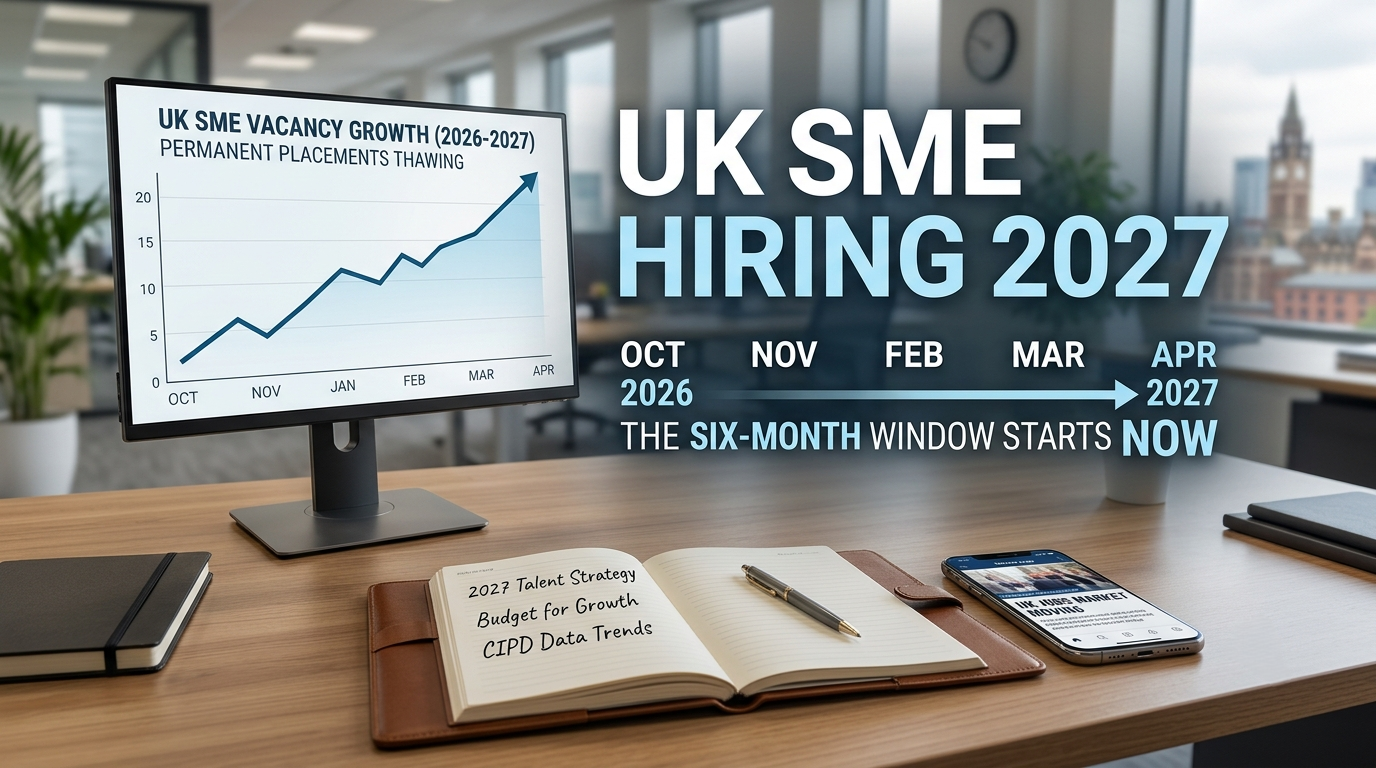
The six-month window from today runs through four fixed points. Each one shapes what you should have in place by the next.
The first is the Autumn Budget on 28 October 2026. Whatever the Chancellor announces, the useful question for an SME is not what the Budget contains but what it means for your labour-cost model next April. Read the specifics on 29 October. Rebuild your 2027 hiring budget with the actual numbers by the end of that week. The point is not to react, it is to stop waiting.
The second is April 2027 as a confirmed baseline. The National Minimum Wage changes, Statutory Sick Pay reforms, and Employment Rights Act 2025 provisions coming into force shape every entry-level hire you make in 2027. Those numbers are already law.
The third is January 2027, when the probation-period framework for unfair dismissal changes. I have written about this separately, and it changes how an SME should structure new-hire reviews, feedback loops and the first ninety days. If you have not already redesigned your probation process, do it before the new year, not after.
The fourth is Q2 2027, when the KPMG and REC data suggest permanent demand will be meaningfully competitive again if the September pattern holds. Any role you want filled in April needs to be in your pipeline by January. Any pipeline you want in place by January needs the attraction, screening and interview infrastructure built in November.
Four practical actions sit across those milestones.
Build the workforce planning data layer. For an SME, this is five numbers tracked monthly: time-to-hire, cost-per-hire, first-year attrition, exit reason, and open-role revenue impact. That is enough to start.
Point your existing AI tools at the hiring problem. The 47% of SMEs who now have AI in the business already have the capability. Pick one function this quarter. Job descriptions is the quickest win. Structured first-pass CV screening against a skills profile is the highest-leverage one.
Fix the attraction problem before you fix the volume problem. The CIPD 58% unsuitable-candidates number is a job description and employer brand problem, not a volume problem. More applications are not the goal.
Prepare for a thawing market where candidates have options again. The playbook of the last two years, where SMEs had the pricing power in the hiring conversation, is ending. By March 2027, if the recovery holds, candidates will too, and the retention strategies that worked in a soft market will need to tighten.
Because the thaw compounds, pay-growth softening is the SME window to compete on offer, and 2027 budgets lock in Q1.
The private-sector vacancy turn in the KPMG and REC data is the signal that matters most. A single month of growth is noise. Two consecutive months is a pattern. Three months, which will be published in early December, is a trend. SMEs who treat the next Report on Jobs release as a milestone to watch, rather than an input to planning, will find themselves setting Q1 hiring strategy in late January against a market that has already moved.
Pay growth is the second signal. The same KPMG and REC data shows permanent salary growth slowing for the first time in four months. For an SME, the gap between what you can afford and what a competing offer looks like is narrowing. That gap closes further every month the market firms up. The window to compete on culture, flexibility, growth path and manager quality, rather than headline salary, is open now and tighter by March. This is the moment to face into the structural squeeze rather than wait it out.
The third reason the window closes faster than it looks is simple scheduling. Most SMEs set their 2027 workforce plan between late November and early February. If that plan is written against the shape of 2024 hiring, it will miss. Written against the shape of September 2026 and whatever the Budget sets up, it can lead.
For UK SME hiring 2027, the question is not whether the market will be more competitive. It is whether your business will be ready for it when it is.
According to the October 2026 KPMG and REC UK Report on Jobs, permanent placements rose for the second consecutive month in September 2026 at the strongest rate in four years, and private-sector vacancies grew for the first time in over two years. KPMG and REC describe this as a “fragile recovery,” not a return to boom conditions.
Rebuild your 2027 labour-cost model using what is already law for April 2027, keep your 2027 hiring plan in draft rather than freezing it, and read the Budget specifics on 29 October to adjust the model, not restart the plan.
The CIPD Resourcing and talent planning report 2026 found that 53% of UK organisations that attempted to recruit in the last year experienced difficulties attracting candidates, particularly for senior and skilled positions, and 58% reported an increase in unsuitable candidates. For SMEs the problem usually sits in job description quality, employer brand clarity, and screening infrastructure.
Treat the six months from November 2026 to April 2027 as four distinct milestones: the 28 October 2026 Budget, April 2027 wage and employment-rights changes, the January 2027 probation framework change, and Q2 2027 pipeline competitiveness. Build backwards from Q2 2027 pipeline needs into the hiring and workforce planning work you do in November and December.
Sabiha is a Talent Acquisition Director and Speaker with 16+ years of global hiring exsperience across the UK, Dubai, South Africa and Malaysia. She advises UK SMEs on AI-enabled hiring and retention systems. Her forthcoming book, How to Use AI to Win Talent and Retain People, is published by Trotman in autumn 2026 and is aligned to the CIPD Profession Map.

Global Talent. Ethical AI. Strategic Hiring. Sustainable Retention.