

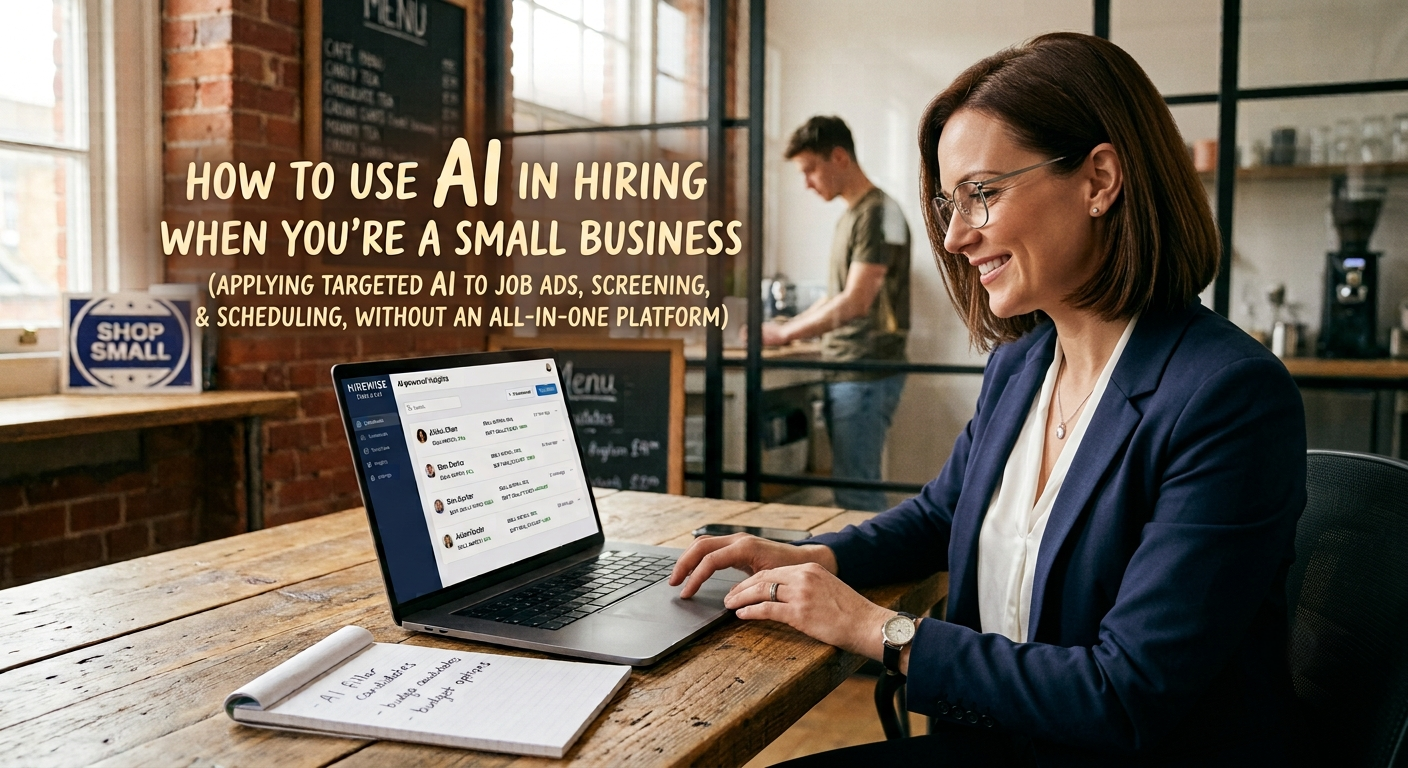
Most UK SMEs say they use AI in hiring. Few actually run on it. The real gap isn’t money, and it’s one you can close faster than a larger competitor can turn its ship around.
If you run a small business, you can use AI in hiring without spending much at all. Point it at the parts of hiring that eat your time, like writing job adverts, sorting through early applications, and booking interviews. Leave the actual decisions with a person. The thing that holds most small companies back is not the price of the tools. It is not knowing where to put them to work.
That answer sounds easy enough. Most of the small business owners I work with still get stuck on it, so let me walk through why.
THE GAP NOBODY TALKS ABOUT
Small businesses have fallen behind because they do not have someone in-house who knows how to put AI to work, not because they cannot afford it.
The numbers tell the story plainly. Roughly six in ten large organisations have already built AI into how they hire. Among small businesses, it is closer to one in three. Mid-sized firms sit only a little way ahead of the small ones.
That is a real distance, and it is opening up fast. While the bigger players screen and schedule in hours, a lot of smaller employers are still doing it by hand over days, chasing the same candidates with a slower process. The candidate takes the first good offer, and it usually is not the one that took a week to reply.
Everyone assumes the reason is money. Big companies have the budgets and the teams, small ones do not, so of course they are behind. Except that is not what small businesses say when you actually ask them. The barrier they name most often is that nobody on the team knows how to set AI up properly. Resistance to changing the way things have always been done comes next. Cost is rarely the first thing they mention, partly because a good deal of what they need is either cheap or already sitting inside software they pay for and never fully use.
WHAT IT REALLY CHANGES
AI takes the repetitive work off your plate, the advert writing, the first sift through applications, the back-and-forth of booking interviews, so a small team can run a quicker and fairer process without hiring anyone extra to do it.
Here is what has quietly happened. The tools got cheap and easy long before most people learned how to use them. A ten-person company can now reach for the same core AI as a company of a thousand. What the ten-person company does not have is the person who knows which tool fixes which problem, and how to use it without causing a new one.
That matters more this year than last, because the hardest skill to hire for in the UK right now is comfort with AI itself. Not the ability to build it, just the confidence to use it well in an ordinary job. So a small business gets squeezed from both sides. It struggles to bring AI into its own hiring, and it struggles to hire the people who already know their way around it. One problem makes the other worse.
WHERE TO BEGIN
Start with the part of hiring that wastes the most of your time and quality, which for most firms is writing adverts, doing the first sift, and arranging interviews. Put AI there first. Do not try to automate everything at once.
The businesses getting this right did not begin by buying the most impressive platform they could find. They looked hard at where their own hiring kept breaking down, and they fixed those spots. In practice that tends to mean four things.
Look at what those four have in common. Not one of them is really about money. Each one is about knowing where AI belongs in your process, and just as importantly, where it does not.
THE PART PEOPLE WORRY ABOUT
No. Only about one in ten UK employers use AI to cut jobs. It takes over the admin, not the judgement, and it gives a genuine edge to the people who understand how to use it.
For a small business, that is good news worth sitting with. What stands between you and smarter hiring is not some wall of spending you can never scale to. It is a gap in know-how, and know-how can be learned. You can close it with the right help far quicker than a bigger, slower competitor can change how it operates. If you cannot easily hire that know-how in, and most small businesses cannot, the answer is to grow it inside the team you already have. I wrote about why in AI literacy is the hardest skill to hire for in the UK.
So the question was never really whether you can afford AI in your hiring. It is whether you can afford to keep saying you use it while everything underneath still runs the old way.
Stop searching. Start hiring differently.
Is AI in recruitment worth it for a small business?
Yes, as long as you aim it well. Put AI on your job adverts, your first sift, and your interview scheduling, and a small team feels the time it saves almost straight away, without paying to automate the whole process. The value comes from clearing friction at a few specific stages, not from buying one big system that promises to do everything.
Does using AI in hiring create bias?
It can, if you train it on biased history and then leave it alone. Used with care, judging candidates on what the role needs and keeping a person over every decision, it can make your early screening steadier than a rushed human sift. The safeguard is simple. A human stays answerable for anything that affects a candidate.
What is the biggest barrier stopping small businesses using AI in hiring?
Know-how, not budget. The barrier UK small businesses name most is that nobody on the team knows how to set AI up well, followed by a general wariness about changing how things are done. A lot of genuinely useful tools cost little, and some are already built into software the business already pays for.
Do I need a big HR team to adopt AI in hiring?
No, and smaller teams often gain the most, because AI soaks up the repetitive admin a lean team never has time for. You do not need scale. You need to know which stage to start with, and to keep a person answerable for the final call.
ABOUT THE AUTHOR
Sabiha is a Talent Acquisition Director, speaker and author with more than 16 years of hiring experience across the UK, Dubai, South Africa and Malaysia. She helps UK organisations move past reactive hiring and build workforce strategies that hold up for the long run, using AI alongside human judgement. Shortlisted as Best Career Coach UK by the CDI, she has helped businesses improve how they hire and retain talent
Rethinking how your business hires and keeps people? That is the work I do with UK organisations every week, building hiring and retention that uses AI without losing the human judgement that makes it work.
Which stage of your hiring eats the most time right now? Tell me, and I will read every reply.
Meet Sabiha | Talent Acquisition Director | Speaker | Author
Stop Searching. Start Hiring. Smarter Workforces with AI · meetsabiha.com
Global Talent. Ethical AI. Strategic Hiring. Sustainable Retention.
WhatsApp us