


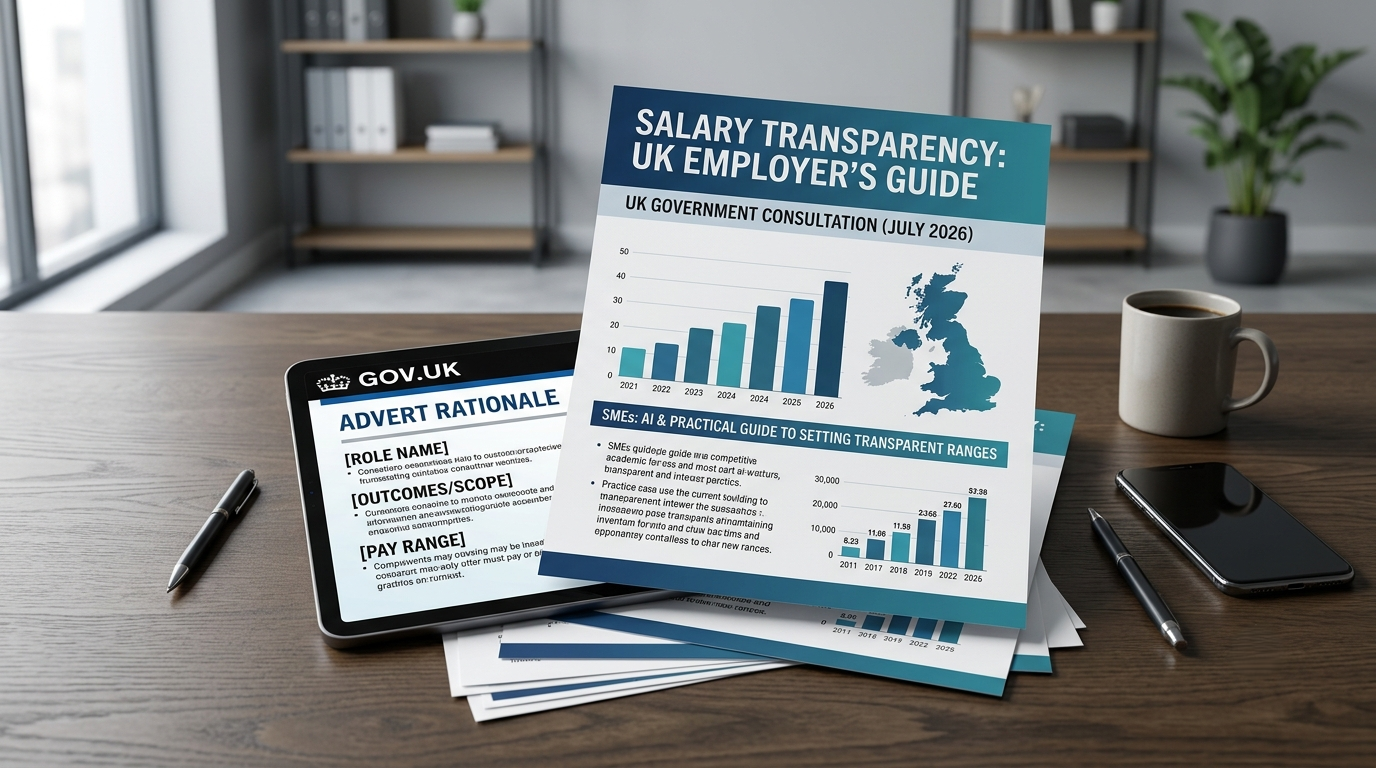
Scope note. This article is practitioner commentary on hiring practice, written from a talent acquisition perspective. It discusses a UK government consultation on equal pay and pay transparency published in July 2026. The measures described are proposals, their final form may change, and they are proposed to apply in England, Scotland and Wales. For decisions about your contracts, pay structures or obligations, a qualified employment law or reward specialist can advise on your specific situation.
“What do we put in the salary box?” A founder asked me that last spring, halfway through drafting an advert for an operations manager. Her first answer was “competitive”. Her second was £35,000 to £55,000. When I asked what would put someone at £55,000, the room went quiet. Nobody had decided. That is the moment pay transparency stops being a policy topic for UK employers and becomes a hiring decision.
That silence is the real problem for most small and mid-sized businesses. Publishing a number takes seconds. Knowing why it is the right number, and applying the same logic to the next hire, is where the work sits.
In July 2026 the UK government published a consultation that could turn that work from good practice into a requirement. Here is what it proposes, what it means for employers with 51 to 200 people, and a practical way to use AI to get your pay ranges in order before anything changes.
The government is proposing a legal requirement for employers to publish pay information in job adverts, or to give it to candidates in writing before interview where there is no advert.
The proposal sits inside a wider consultation on equal pay and pay discrimination, published by the Office for Equality and Opportunity on 14 July 2026. Pay transparency in recruitment is the first measure in its opening chapter, and the reasoning is preventative. The government argues that when pay is opaque, salary decisions can be shaped by stereotypes rather than ability or responsibility, and that publishing pay encourages employers to evaluate a role properly before they recruit.
Much of the detail is still open. The consultation asks whether employers should publish a pay range, a specific salary or a benchmark rate, and what else should count as pay information, such as benefits. The precise rules, including how wide a range could be, would be set later through regulations. The government has also said it will seek an extended implementation period before any measure starts.
Two points shape how you should read this. It is a proposal, and nothing has changed in law yet. The proposed scope is also Great Britain, so employers with people in Northern Ireland would need to check separately. The consultation page on GOV.UK shows whether responses are still open and what happens next.
As proposed, yes. The job advert requirement is described as applying to all employers, with no headcount threshold set out.
That is a real shift for businesses of our size. Until now, pay transparency duties for UK employers have mostly meant reporting that only reaches larger organisations. Gender pay gap reporting, for example, applies to employers with 250 or more employees on the snapshot date. A private company with 120 people is unlikely ever to have had to publish anything about pay. Under this proposal, every advert it posts would carry pay information.
The government expects the burden to be low, noting that most employers already publish pay ranges voluntarily. The evidence suggests the habit is patchier than that. In the CIPD’s Pay, performance and transparency 2024 survey of 832 UK HR professionals and decision-makers, carried out in October 2023, only 41% said they always share salary ranges in external job adverts. The figure is now almost three years old, but the gap it describes between “sometimes” and “always” is exactly where inconsistency creeps in.
Across the 300+ businesses I have advised, the SMEs most exposed here are rarely the ones that leave pay off entirely. More often, they are the ones where each hiring manager sets the number for their own vacancy, and nobody compares the results.
Most SME ranges fall apart because nobody wrote down what moves a candidate from the bottom of the range to the top.
When I review adverts with founders, the same patterns keep appearing. The widest ranges usually hide an undecided role. A £20,000 band on a mid-level job tells candidates you have not worked out whether you are hiring someone to learn the job or someone to run it.
Ranges also drift. A role advertised at one level in January gets re-advertised in June with a higher ceiling because the first round went badly, while the person already doing similar work stays on the old number. Nobody intended that outcome, and nobody checked for it either.
Then there is the negotiation gap. When the final offer depends on how hard a candidate pushes, your published range stops describing your pay structure and starts describing your negotiating habits. That is the kind of opaque pay decision the consultation says it wants to prevent.
None of this requires bad intent. It happens because pay decisions in growing businesses are made one vacancy at a time, by different people, under time pressure. Publishing ranges makes those decisions visible to candidates and to your existing team. It also shapes how candidates judge you before they apply, which is why pay belongs in your employer branding work as much as your reward policy.
Start from what the role delivers and what you already pay, then write down the rule that places a candidate within the range before the advert goes live.
You do not need a full job evaluation scheme to do this well at 51 to 200 people. You need a short written rationale for each role that a manager, a candidate or an existing colleague could read and follow. This is the method I use with clients.
Define the role by its outcomes. Write down what the person will own in their first year, the scope of their decisions and who they will work with. A range built on a task list will always be vague. If your adverts still read like task lists, our guide to using AI to write job adverts that sound like your business covers that brief in detail.
Map it against the people you already pay. Identify who in the business does comparable work and where their pay sits. If the floor of your new range lands above an existing employee in a comparable role, you have found something to resolve before you publish, not after.
Check the market with sources you can name. Use recognised salary surveys, recruiter benchmarks and your own recent offers, including the ones candidates turned down. Record each source and its date so the range can be explained and refreshed.
Write the placement rule. The CIPD recommends that employers using pay scales indicate where the successful candidate would expect to start and where they could expect to be after a few years. Go one step further and state what moves someone up the range: specific skills, qualifications or scope, applied the same way to every applicant.
Keep the range honest. Publish a range you would genuinely pay at either end. If nobody will ever be offered the top figure, it does not belong in the advert.
Name one approver. Give one person, usually the founder or HR lead, sign-off on every advertised range. Consistency should not depend on which manager happens to be hiring that month.
AI works best here as a consistency checker and drafting assistant, while the pay decision itself stays with a named person.
This is where a sensible AI workflow can save an SME real time. Here is where it earns its place.
Audit what you have already published. Paste the text of your last twelve months of adverts into an AI assistant and ask it to list each role title, the stated pay, the width of any range and any vague wording such as “competitive” or “depending on experience”. Then ask it to flag similar roles with different ranges. For many SMEs this is a short first step, and the results often surprise people.
Draft the rationale, not the number. Give the tool your written outcomes, anonymised comparator bands and named market sources, and ask it to draft a plain-English placement rule plus a short explanation a candidate could read. Finish by asking what a candidate would want to know that the draft does not answer.
Stress-test for consistency. Ask the assistant to compare the rationales for two related roles and point out where the logic differs without an obvious reason. It will not know the answer, but it is good at spotting the question.
Prepare the conversation. Draft talking points for hiring managers on how to explain where an offer sits in the range, so every candidate hears the same reasoning.
Two guardrails keep this safe. First, keep personal data out. Salaries linked to named or identifiable employees are personal data, so work from anonymised bands and role-level figures. Second, do not ask a general-purpose AI tool what a role “should” pay. These tools can produce confident salary figures with no reliable, current or UK-specific source behind them. Use AI to organise and challenge your evidence, and let a person own the number.
Treat this period as a preparation window: tidy your ranges now, and consider telling government how the proposals would land in a business your size.
For most UK employers, the audit above is the quickest way to see where the pay transparency gaps really sit. Then fix anything obvious before your next advert goes live, beginning with roles you hire for repeatedly.
If the consultation is still open when you read this, consider responding. It asks employers directly what pay information would be proportionate, whether a range, a specific salary or a benchmark rate should be required, and what costs and timescales employers would face. Businesses with 51 to 200 people have a practical perspective that is easy to miss in these debates.
Where your audit uncovers differences you cannot explain between people doing comparable work, bring in a qualified employment law or reward specialist before you change anything. That is the point where hiring practice becomes a question about your specific obligations.
Pay transparency asks UK employers one simple question of every hire: can you explain the number? The government itself points to a practical upside, with fewer candidates reaching interview on mismatched pay expectations. SMEs that can answer that question clearly will write sharper adverts, attract better-matched candidates and have fewer difficult conversations with the people they already employ.
Stop searching. Start hiring with numbers you can stand behind.
Not at the time of writing. The requirement is a proposal in a government consultation published in July 2026. The government would still need to introduce the requirement, with the detail set out in regulations, and it has said it will seek an extended implementation period. The GOV.UK consultation page shows the current status.
That is still undecided. The consultation asks whether a pay range, a specific salary or a benchmark rate should be required, and proposes that details such as the size of a range would be set later in regulations.
As proposed, the job advert requirement is described as applying to all employers, with no headcount threshold set out. That differs from gender pay gap reporting, which applies to employers with 250 or more employees.
The proposed geographical scope is Great Britain: England, Scotland and Wales. Employers with staff in Northern Ireland should check the position there separately.
Use AI to organise your evidence, audit past adverts and draft explanations, but keep the pay decision with a named person. Work from anonymised, role-level figures, and do not rely on a general-purpose tool to tell you what a role should pay.
About the author
Sabiha is Talent Acquisition Director at Get Sponsored Job with 16+ years of international hiring experience across the UK, Dubai, South Africa and Malaysia. Shortlisted for Best Career Coach UK by the Career Development Institute, she has advised 300+ businesses on hiring and retention. Her forthcoming book, How to Use AI to Win Talent and Retain People (Trotman, Autumn 2026), is aligned to the CIPD Profession Map.

Global Talent. Ethical AI. Strategic Hiring. Sustainable Retention.