

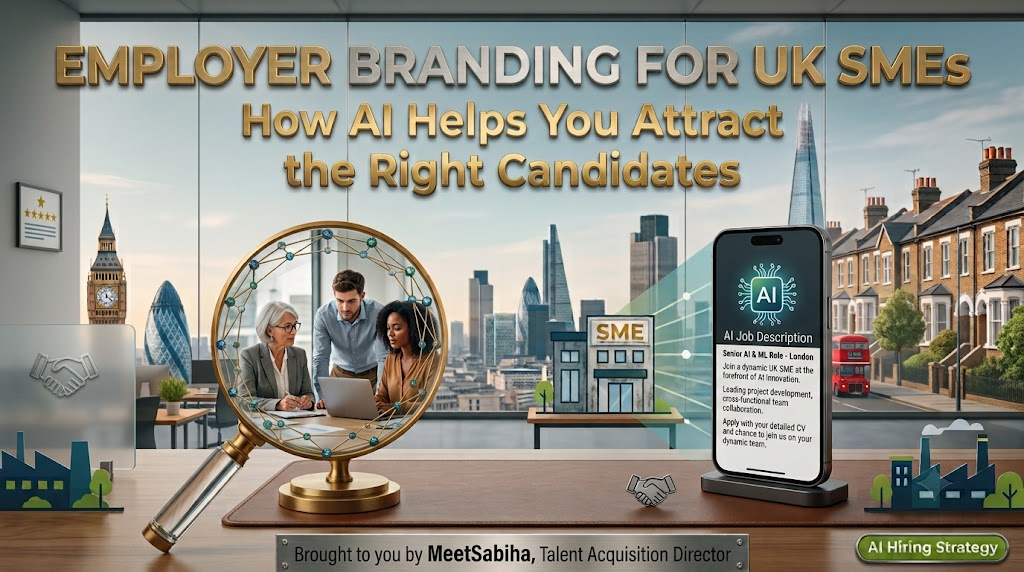
UK SMEs are not competing with global brands for attention. They are competing for the trust of a candidate who is deciding, in three minutes on a phone, whether you are worth their time. This is one face of the broader UK talent crisis. The good news is that AI, used well, has closed a lot of the production gap between what a scaling SME can put out and what a mid-sized brand can put out. The bad news is that most SMEs are still not using it.
Because candidates now research every employer, and empty digital footprints look like red flags.
The market has shifted underneath most SMEs without them noticing. According to Totaljobs’ Spring 2026 Hiring Trends update, the average UK time to hire has climbed to 12 weeks, up from 10 weeks in Autumn 2025. Applications submitted are up 16%. Interviews required to fill a single role are up 18%. The system is groaning under the load, and the candidates who are actually worth hiring can feel it. They are choosier, faster to disengage, and more likely to check reviews before they hit apply.
The rest of the market has caught up. The CIPD’s 2024 Resourcing and Talent Planning Report found 81% of UK organisations reported taking action to improve their employer brand in the last year. Increasing flexible working, competitive pay and benefits were the most common levers. If your competitors have moved and you have not, that gap shows up in your funnel long before it shows up in your board pack.
There is a retention consequence to this too. The same CIPD research found that 41% of UK employers said new recruits always, mostly or sometimes resigned inside the first 12 weeks. A weak employer brand does not just cost you applications. It costs you the people you did hire, because they arrive with expectations the reality cannot match. I unpacked the mechanics of that early-attrition problem in more detail in Why New Hires Quit in the First 90 Days.
Everything a candidate can see about you before they apply, and everything an employee says about you after they leave.
The CIPD employer brand factsheet defines it as the way businesses differentiate themselves in the labour market to attract talent. In practical SME terms, it is your Employee Value Proposition, made visible.
The visible layer is the one you already know. Your careers page, LinkedIn company page, Google search results, employer review sites, social content, and the job ad itself. Anything a candidate can pull up on a phone in 90 seconds.
The less visible layer is the one that quietly moves the needle. How ex-employees describe you at industry events. What comes up when a candidate asks a friend about your name. How your process itself feels: whether the candidate hears back, whether the interview felt professional, whether they were treated well even when they were the ones you did not pick.
Used well, AI lets a small SME produce what only a mid-sized brand used to be able to. The substance still has to be real.
The gap for years has been resource. Global brands had content teams, video producers, and social managers. A 40-person SME had one People lead trying to fit careers-page copy in between payroll and disciplinary work. AI has narrowed that gap sharply. A good AI-assisted content flow now lets one internal person do the work of what used to take a three-person team, at a fraction of the cost.
Practically, this looks like: one 30-minute interview with a team member becomes a careers-page story, a LinkedIn post, a short video script and a job ad hook. One quarterly all-hands becomes four employee spotlight posts. One customer win becomes a piece of content that quietly signals what it is like to work here.
AI also helps you check job ads for inclusive language, adapt one core message across channels for different audiences, and analyse candidate feedback at scale so patterns surface faster than a human reader can catch them. I mapped out that full sequence in the AI hiring and retention implementation guide.
One named owner, one core story per month, and a feedback loop that tells you what actually pulls candidates in.
The SMEs I see doing this well are not running elaborate stacks. They are running a small, disciplined loop.
An owner. One person, usually the People lead or a founder in very small firms, whose objectives include this and who has time protected weekly. Not a committee, not a rotating group. One person accountable for what the outside world sees.
A content pipeline. Each month there is one core piece of substance, often a real conversation with a team member or a founder note about what the business is trying to build. That piece feeds four or five outputs across the careers page, LinkedIn, and any relevant job ads. AI does the heavy lifting on formatting and adapting. The human does the choosing and the editing.
Start with what would make you apply, then remove everything that would put you off.
Most SME job ads still read like they were written to satisfy a legal review that never happened. They lead with the job title and a long list of essential qualifications. They talk about the company in the third person. They bury the salary or leave it out entirely. Nothing about that reads like an invitation. This is where a lot of the attraction problem actually lives. I went deeper on the mechanics of this in Why Your Job Description Is Costing You the Best Candidates.
The ads that work in 2026 do the opposite. They lead with the person and the impact. They describe the skills the role actually needs, not the credentials that vaguely correlate with them. They include a salary band, because the data is clear that transparency lifts application quality. They give a realistic picture of the working week rather than a corporate list of values.
AI is genuinely useful here. It can rewrite a stiff ad in a warmer register in seconds, check for gendered or exclusionary language, and adapt one ad for three different channels without losing the core story. A hiring manager still owns the ad. AI does the polish.
Marketing without substance, silence during hiring, and forgetting that the candidates you rejected still talk.
The first failure mode is aspirational content that does not match reality. A careers page full of stock language about wellbeing and growth, when the actual experience is unpredictable rotas and no career conversations. Candidates spot this quickly. So do employees, who then leave, and the churn shows up on review sites within a year. This is why employee onboarding and the promise you made in the job ad have to line up.
The second is silence. A candidate applies, hears nothing for four weeks, gets a two-line rejection or gets ghosted entirely. The person you did not hire has a phone, a network and often a public voice. Every silent rejection is a small brand cost. Multiply it across a year, and it is a meaningful drag on how you are perceived in your labour market.
The third is founder-centric branding. All about the CEO, nothing about the team who actually works there. Candidates for anything other than a co-founder role can see through this immediately. They want to know what it is like to be them at your company, not what it is like to be the person hiring them.
Three numbers matter more than any dashboard, and most UK organisations are not tracking any of them.
The CIPD found that only 12% of UK organisations had taken steps to measure the impact of their employer brand. If nine in ten do not measure it, you win the moment you start.
Quality of applications, not just volume. A 40% rise in applications is meaningless if 90% of them are irrelevant. Track the share of applications that convert to first-round interviews at the level your hiring managers actually want.
A brief regulatory note. From 2 August 2026, the EU AI Act’s high-risk provisions cover AI used for targeted job advertising and candidate evaluation. UK employers with any candidate flow from the EU should be aware of this direction of travel. A qualified UK data protection or employment law specialist can translate what it means for your setup.
Yes, and often more effectively than a 200-person firm. Small firms tell more honest stories, and honest stories perform. What you cannot do is win by trying to sound bigger than you are. Sound like what you actually are, with more polish.
Two to four hours from one named owner, done consistently, will move the needle in a year. Less than that struggles to compound. More than that, at SME scale, tends to be spent chasing platforms rather than telling stories.
If any of your candidates come from the EU, the direction of travel is toward transparency, human oversight and bias testing on AI used to target or evaluate applicants. This is a regulatory signal, not a legal instruction. For a definitive answer on your setup, speak to a qualified UK data protection specialist.
Rewrite your careers page in a human voice, add a salary band to every job ad, and set up a one-page reply for rejected candidates. Three moves. All doable inside a month. Everything else follows from there.
Sabiha is a Talent Acquisition Director, Speaker and forthcoming Author (Trotman, Autumn 2026) with 16+ years of international hiring experience across the UK, Dubai, South Africa and Malaysia. She has helped over 300 businesses improve their hiring and retention outcomes and was shortlisted as Best Career Coach UK by the Career Development Institute. Her book, How to Use AI to Win Talent and Retain People, is aligned to the CIPD Profession Map and lands with Trotman in Autumn 2026.

Global Talent. Ethical AI. Strategic Hiring. Sustainable Retention.