

| Scope note. This article shares a hiring practitioner’s perspective. References to UK GDPR, the Data (Use and Access) Act 2025 and ICO guidance are regulatory context, not legal advice. The ICO’s consultation on draft automated decision-making guidance closed on 29 May 2026, and the ICO’s guidance plans page lists the final version for winter 2026. For decisions about automated tools, candidate data or rejecting applicants, a qualified specialist can advise on your circumstances. |
Here is a gap worth sitting with for anyone reading AI generated CVs this year. In the Greenhouse 2026 AI in Hiring Report, 42% of candidates across the UK, Ireland and Germany said they had used prompt injections, the hidden text some applicants plant in a CV to steer an AI screening tool. Only 28% of hiring managers said they had spotted one in the past year.
The distance between those two numbers tells you something important. A lot is happening inside your applicant pile that your hiring team cannot see.
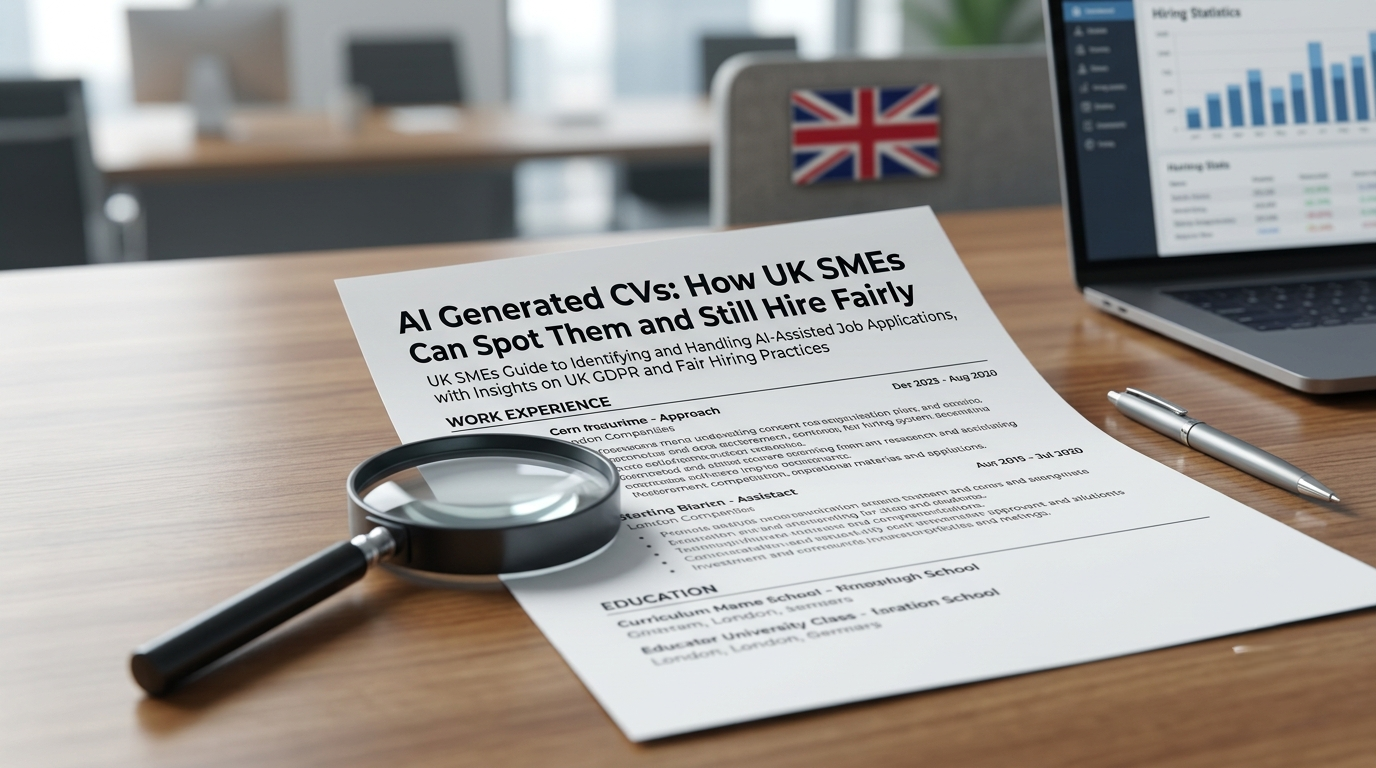
AI generated CVs are now the default. For UK SMEs, the useful question has moved on from whether candidates use AI to what you do about it. After sixteen years of hiring across the UK, Dubai, South Africa and Malaysia, my view is simple: a CV has always been a marketing document. AI has made the marketing more polished. What protects your business is a process that tests the person, not the prose.
Yes, but the bigger risk is the misrepresentation nobody is checking for, rather than the AI itself.
The scale is clear. In the Greenhouse 2026 AI in Hiring Report, which surveyed 1,700 jobseekers and 571 recruiters and hiring managers across the UK, Ireland and Germany, 78% of candidates said they use AI to tailor their CV or application at least some of the time. The same report found 86% of recruiters had caught or suspected candidate fraud in the previous 12 months. The most common forms were fake references (51%) and CV exaggeration (35%).
Early careers data points the same way. The Prospects at Jisc Early Careers Survey 2026, run in January and February 2026 with around 5,000 students and graduates, found 73% had used AI at some point in the application process and 46% had used it to write a CV or cover letter.
Here is the part that matters most for smaller employers. A YouGov survey for Hedd, the degree verification service run by Jisc, polled 526 HR decision makers in April 2025. Small businesses reported application fraud less often than medium-sized firms (20% against 42%), and experts quoted in the research believe that is partly because smaller firms check less. More than a quarter of small companies (26%) said they do not check qualifications at all.
SMEs rarely come unstuck because a candidate used ChatGPT to tidy a CV. They come unstuck when nobody checks what the CV claims.
For most roles, yes, provided every claim is true and the candidate can talk it through with you.
Blanket bans on AI generated CVs sound tidy, but they tend to punish the wrong people. NHS Employers guidance advises against automatically rejecting applications where AI use is suspected or declared. It also notes that candidates from traditionally disadvantaged groups are more likely to use AI, so an intolerant stance risks shrinking your talent pool. For international professionals writing in a second or third language, AI can help them present experience they genuinely have.
Trust is thin on both sides. In the Prospects survey, 46% had used AI to write a CV or cover letter, yet only 38% thought it was acceptable for employers to use AI to screen one. When both sides use the same tools and distrust each other’s use, the employer who sets clear rules first earns the advantage.
The useful line sits between assistance and misrepresentation.
| Acceptable assistance | Misrepresentation |
| Fixing spelling, grammar and layout | Inventing qualifications, employers or job titles |
| Restructuring genuine experience for a specific role | Claiming skills or tools the candidate cannot use |
| Tailoring language to your advert using true examples | Hiding instructions in the CV to manipulate screening software |
| Drafting from the candidate’s own notes, then editing | Using AI to answer live interview questions without permission |
| Practising interview answers beforehand | Altering identity, appearance or voice to mislead |
Often you cannot tell with certainty, so look for gaps between the CV and the person rather than for AI fingerprints.
Most AI generated CVs look tidy rather than suspicious. Some signals are worth noticing. NHS Employers treats near-identical answers across several applicants as a likely sign of AI use. Other flags include achievements with no numbers or context, a cover letter that sounds like a different person from the CV, phrasing that simply mirrors your advert, and skills or tools that do not fit the career timeline.
None of these proves anything on its own. Plenty of genuine candidates write stiffly, and plenty of AI-assisted CVs are perfectly honest.
The more reliable test is a conversation. Pick one claim that matters for the role and ask the candidate to walk you through it: what they did, what went wrong and what they would do differently. Someone who did the work can answer with detail in a few minutes. Someone who borrowed the sentence usually cannot.
Watch the interview itself too. Among hiring managers in the Greenhouse survey who had encountered a candidate using AI to cheat, 48% had seen candidates reading AI-generated responses in a live interview.
Treat detection tools for AI generated CVs with real caution, and never let one reject a candidate on its own.
NHS Employers states there is currently no official marketed technology for detecting AI and advises against using anything unproven or uncertified. The research gives a further reason for care. A Stanford study published in Patterns in 2023 tested seven widely used detectors and found that, on average, they flagged over half of the writing samples from non-native English speakers as AI-generated, while classifying native speakers’ writing almost perfectly. That study used essays rather than CVs, and detection tools have developed since. For an SME hiring international talent, though, the pattern is a fairness risk you cannot wave away.
A flag from a detector should start a conversation with the candidate, never end their application. Many employers are adding detection anyway. Greenhouse found 59% of hiring managers use software to detect or monitor AI use during interviews at least some of the time.
There is a regulatory signal to note. Since 5 February 2026, the Data (Use and Access) Act 2025 has replaced the old Article 22 of UK GDPR with Articles 22A to 22D, and the ICO has consulted on updated guidance on automated decision-making with recruitment as a focus. The direction of travel is clear: a tool that rejects applicants without meaningful human involvement is where scrutiny is heading. A qualified specialist can advise on your own setup.
If you are weighing up software, my guide to choosing AI recruitment software covers the questions to put to vendors. Using AI to screen your own applicant pile is a separate decision, which I cover in how AI CV screening works for UK SMEs.
It should say what is welcome, what is not, what you check, and how you use AI yourself.
A short statement on your adverts does more to manage AI generated CVs than you might expect. In a peer-reviewed study published in 2026 by researchers at Wilfrid Laurier University and the assessment provider Talogy, a warning that set out consequences nearly halved the share of applicants who said they used generative AI during a pre-hire assessment. Applicants’ sense of fairness did not appear to suffer. The study looked at assessments rather than CVs and relied on self-reporting, but the lesson carries: clear expectations change behaviour.
Disclosure should run both ways. Greenhouse found 85% of candidates say it is important that employers disclose their own use of AI in hiring.
Put it where candidates see it before they apply: the advert, the application form and the acknowledgement email. Here is a statement you can adapt:
We welcome candidates using AI tools to check spelling, structure a CV or prepare for interviews. Everything you submit must accurately reflect your own experience, qualifications and skills. Please do not use AI during interviews or assessments unless we tell you it is allowed. We may ask you to talk through anything in your application, and we verify qualifications and references before any offer. Misrepresentation may mean we cannot progress your application. In our own process we use [describe your tools, or say you use none], and a person reviews every decision.
Move the weight of your decision from the document to evidence the candidate produces with you.
None of this needs expensive software. It needs a process that assumes AI generated CVs will arrive and plans for them from the first sift.
Ask questions AI cannot answer for them. NHS Employers suggests replacing generic supporting statements with role-specific questions that require real understanding. A question such as “Tell us about a supplier dispute you resolved and what it cost” beats “Why do you want this role?”
Add a short screening call. Fifteen minutes on one or two claims filters more effectively than another hour of reading CVs.
Use a work sample. A small, paid or time-boxed task tied to the actual job shows you capability directly.
Verify qualifications at source. Hedd found only 39% of small firms validate qualifications through the awarding institution, a screening agency or a verification platform, compared with 85% of large organisations. A certificate on its own is not proof.
Take up references properly. Fake references were the fraud recruiters reported most often in the Greenhouse data. Call the referee on a number you have found independently.
Keep a person in every rejection. Tools can sort. People should decide.
AI generated CVs are here to stay, and that is manageable. Treat every CV as the opening of a conversation. Stop searching for AI fingerprints. Start building a process that finds the truth about the person in front of you.
NHS Employers advises against automatic rejection where AI use is suspected or declared, and notes the decision should follow your own organisational policy. The fairer approach is to set expectations in your advert, then judge candidates on whether their claims hold up.
NHS Employers says there is no official marketed technology for detecting AI. Research on detection tools has also found higher false-positive rates for non-native English writers. Use any flag as a prompt for a conversation, never as a decision.
Greenhouse describes prompt injections as hidden instructions embedded in a CV or application, often invisible to a human reader, designed to confuse or bypass AI screening. Pasting a CV into a plain text editor can reveal hidden text.
Yes. In the Hedd research, 26% of small companies said they do not check qualifications at all. Verifying directly with the awarding institution or through a verification service is far more reliable than viewing a certificate.
Yes. In the Greenhouse 2026 report, 85% of candidates said it is important that employers disclose their use of AI tools in hiring.
ABOUT THE AUTHOR
Sabiha is Talent Acquisition Director with 16+ years of international hiring experience across the UK, Dubai, South Africa and Malaysia. Shortlisted for Best Career Coach UK by the Career Development Institute, she has advised 300+ businesses on hiring and retention. Her forthcoming book, How to Use AI to Win Talent and Retain People (Trotman, Autumn 2026), is aligned to the CIPD Profession Map.

Global Talent. Ethical AI. Strategic Hiring. Sustainable Retention.