

Three interviewers walk out of the room. The hiring manager says the candidate was impressive. The ops lead says they were a bit too polished. The engineer says they didn’t really answer the technical question. No one wrote anything down. Two hours later, nobody can agree what actually happened, and the decision drifts to whoever speaks loudest in Slack.
That is a group memory exercise under pressure, not an interview process. It is also the single most common pattern in UK SME hiring.
An interview scorecard template fixes it. Not because paperwork solves hiring, but because scoring forces evidence, and evidence survives the week. The problem is that most of the free templates on the internet were built for 500-person companies with trained interviewers, panel calibration meetings and a dedicated talent team. For a 70-person SME where the hiring manager is also the operator, those templates are theatre. This piece walks through what a scorecard actually needs to do, what the research says about whether it works, and how to run one without turning every interview into an interrogation.
What is an interview scorecard template, and why do most of them fail small teams?
An interview scorecard template is a one-page tool that lists the criteria you are hiring against, a defined scoring scale, and space to capture the evidence behind each score. Most templates ship with the first and the third and forget the second.
The version an SME typically downloads has twelve rows (communication, teamwork, problem-solving, leadership, cultural fit, and so on), a 1-to-5 rating next to each, and a comments box at the bottom. It looks defensible. It is not. Twelve criteria is too many for anyone to score honestly after a 45-minute conversation. The ratings have no definition attached, so one interviewer’s 4 is another interviewer’s 2. And “cultural fit” as a line item is where most hiring bias enters the building.
The template a UK SME needs is smaller, sharper, and built around the specific role. Four to six criteria, each tied to something the person will actually do in the first 90 days. A scoring scale where every point has a written description, not just a number. Space for evidence of what the candidate said or did, not opinion on how they came across. That is a scorecard. Anything else is a feelings log with a grid on it.
Does using a scorecard actually change who you hire?
Yes. The best meta-analytic evidence puts structured interviews at roughly twice the predictive validity of unstructured ones, and a scorecard is what turns a structured interview into a structured decision.
Sackett, Zhang, Berry and Lievens published a re-analysis of the personnel selection literature in the Journal of Applied Psychology in 2022. After correcting for a range-restriction error in earlier meta-analyses, they put the predictive validity of structured interviews at .42 and unstructured interviews at .19. Structured interviews came out as the single strongest predictor of job performance across all the common selection methods, ahead of cognitive ability tests, work samples and biodata. A structured scored interview is more than twice as likely to predict who will actually perform in the role.
The CIPD’s Resourcing and Talent Planning Report 2026 adds the operational picture. Of 1,014 UK employers surveyed in April and May 2026, 52% said competition for well-qualified talent had increased in the past year and 44% said talent was harder to retain. Only 19% measure the return on their recruitment investment. You cannot improve what you do not score. A scorecard is the first piece of data an SME needs if it ever wants to know which interviewers hire well, which questions actually discriminate between strong and weak candidates, and which roles are being filled on vibes.
What should an interview scorecard template include for a UK SME?
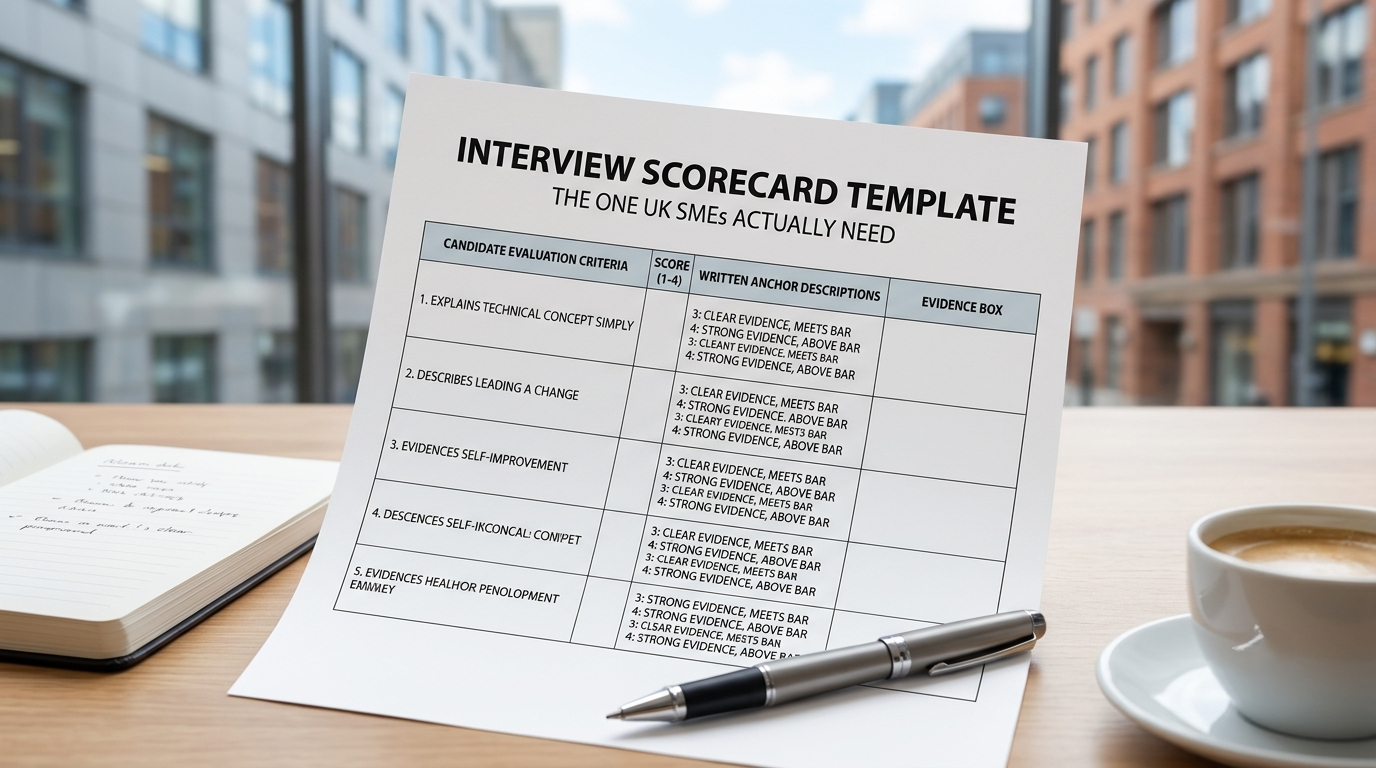
Six components, no more. Role and date header, four to six scored criteria with written anchors, an evidence box per criterion, a knockouts section, an overall recommendation with reasoning, and the interviewer’s name.
The role and date header exists so completed scorecards file against the right vacancy. Obvious, often skipped, and the reason HR cannot find anything three months later when a candidate raises a question.
Four to six criteria, drawn from the job description, phrased as observable behaviours rather than traits. Not “communication” but “explains a technical concept so a non-technical colleague can act on it”. Not “leadership” but “describes a time they changed how a team worked and what happened next”. The criterion is the question you are actually trying to answer.
Written anchors for each point on the scale. A 1-to-4 scale works better than 1-to-5 for SMEs because an odd-numbered scale invites fence-sitting on the middle score. Each number gets a sentence: 1 is “no evidence or evidence of the opposite”, 2 is “limited evidence, needs development”, 3 is “clear evidence, meets the bar”, 4 is “strong evidence, above the bar”. Without anchors, scores mean whatever the interviewer felt that day.
An evidence box per criterion for what the candidate said or did, with direct quotes where possible. This is the single most important feature of a scorecard and the one almost always missed on free templates. Scoring without evidence is just a number.
A knockouts section for anything disqualifying that came up: right-to-work issue, salary expectations well outside band, non-negotiable location conflict. Cleaner than burying it in comments.
An overall recommendation with two-sentence reasoning grounded in the scores above. Advance, hold, reject. Not “nice person” or “gut feel”. And the interviewer’s name, because accountability matters and because you will want to track interviewer scoring patterns over time. Our walk-through of how to run fair AI-era interviews covers how this feeds into the broader selection process.
How should interviewers actually use it in the room?
Fill it in after the interview, not during. Score independently before any debrief. Hold the conversation about the candidate only after everyone has submitted.
Writing on a scorecard mid-interview kills the conversation and makes candidates feel they are being graded live, which they are, but they do not need to watch it happen. The interviewer’s job in the room is to ask the questions, listen hard, and take sparse notes in their own notebook. The scorecard is a 10-minute job done immediately after the candidate leaves.
Independent scoring before debrief matters because the first person to speak in a debrief anchors everyone else. When three interviewers walk into a room and one opens with “I really liked them”, the other two subconsciously adjust their scores to match. When each has already submitted, disagreement becomes useful signal rather than social noise. Where scores diverge by two points or more on the same criterion, that is the single most valuable conversation in a hiring process. It usually surfaces that two people were listening for different things, which is a job description problem, not a candidate problem.
Calibration takes a cycle or two to settle. The first five scorecards will be noisy. By the tenth, interviewers start scoring more consistently, and the hiring manager can compare candidates across weeks rather than only within a single Monday.
What about AI-generated CVs and AI-coached candidates?
The scorecard matters more, not less. A scored structured interview is the point in the process where polish stops helping a candidate and evidence starts.
A candidate can produce a flawless CV with ChatGPT in 20 minutes. They can rehearse 50 common interview questions the night before using any one of a dozen tools. What they cannot do is fabricate a specific example, under pressure, to a follow-up question that probes the detail. “You said you led the migration. Who was on the team and who did what?” is the kind of question no AI coach can prepare for, because the answer only exists if the thing actually happened.
Scoring on evidence rather than impression is the defence. If the evidence box is empty, the score is a 1 regardless of how confident the candidate sounded. In a market where applicant volumes have been pushed up by AI tools, this turns the scorecard into a real filter, because surface quality has become cheap.
How long should you keep the scorecards, and can candidates ask to see them?
Most UK employers retain interview records for six to twelve months after the hiring decision. Unsuccessful candidates can submit a subject access request for any personal data held about them, scorecards included. Write them accordingly.
There is no fixed statutory retention period for interview notes under UK law, but the common practice is six to twelve months. The retention window needs to cover the three-month tribunal claim deadline for a discrimination claim under the Equality Act 2010 and allow headroom for subject access requests. HR should set one retention period and apply it consistently.
Everything on a completed scorecard counts as personal data. A candidate can request it. The rule that follows from this is simple: write only what you would be content to show the person you wrote it about. Evidence, scores, reasoning. Not personal remarks, not assumptions about anything protected under the Equality Act 2010, not jokes. A scorecard written to be defensible is also the scorecard that makes the hiring decision defensible, which is the whole point.
Where this leaves UK SMEs
Most SMEs do not have a hiring problem in the sense they think they do. They have a decision-recording problem. The interviews are happening. The candidates are being seen. What is missing is the one-page tool that forces each interviewer to put their view into evidence and score, before they can be talked out of it or into it by someone else in the room.
Download the interview scorecard template
Both are editable. Rewrite the criteria for your role before you use them.
The template provided alongside this post is a starting point, not a finished answer. Each role needs its criteria rewritten and its anchors tightened, and that is the work most SMEs skip. Scorecards earn their place in the process when they are built once per role family and used every time.
About the author
Sabiha is a Talent Acquisition Director, speaker and 2026 author with 16+ years of international hiring experience across the UK, Dubai, South Africa and Malaysia. She advises UK SMEs on vendor-free AI hiring and retention strategy. Her forthcoming book, How to Use AI to Win Talent and Retain People (Trotman, Autumn 2026), is CIPD-aligned and explores the UK talent crisis, practical AI foundations for HR, and the human-centred systems that keep good people from leaving.

Global Talent. Ethical AI. Strategic Hiring. Sustainable Retention.